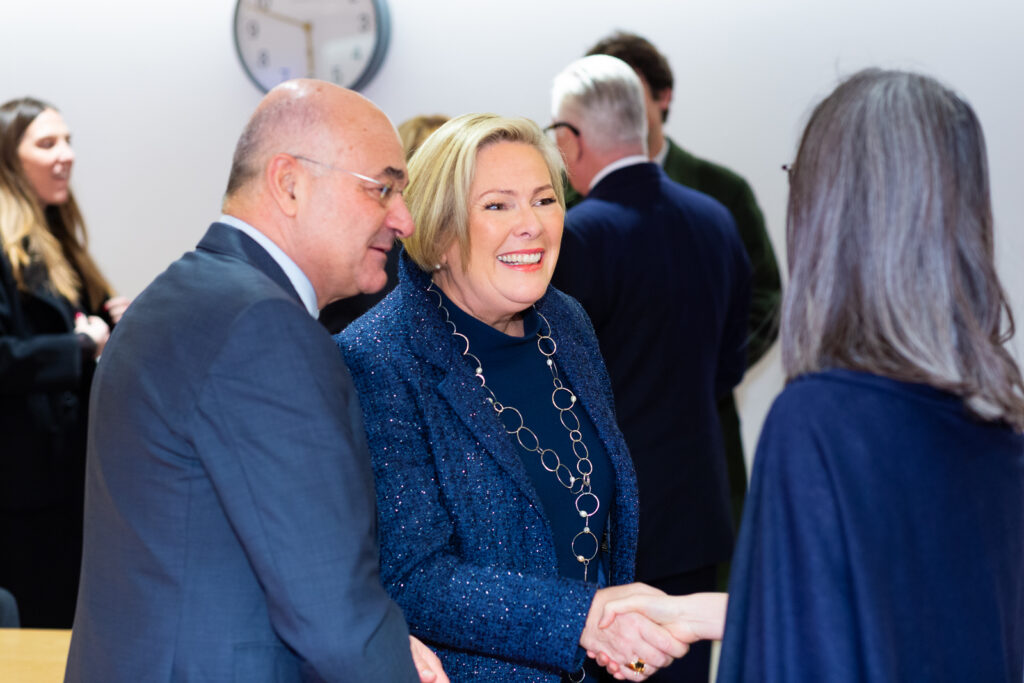
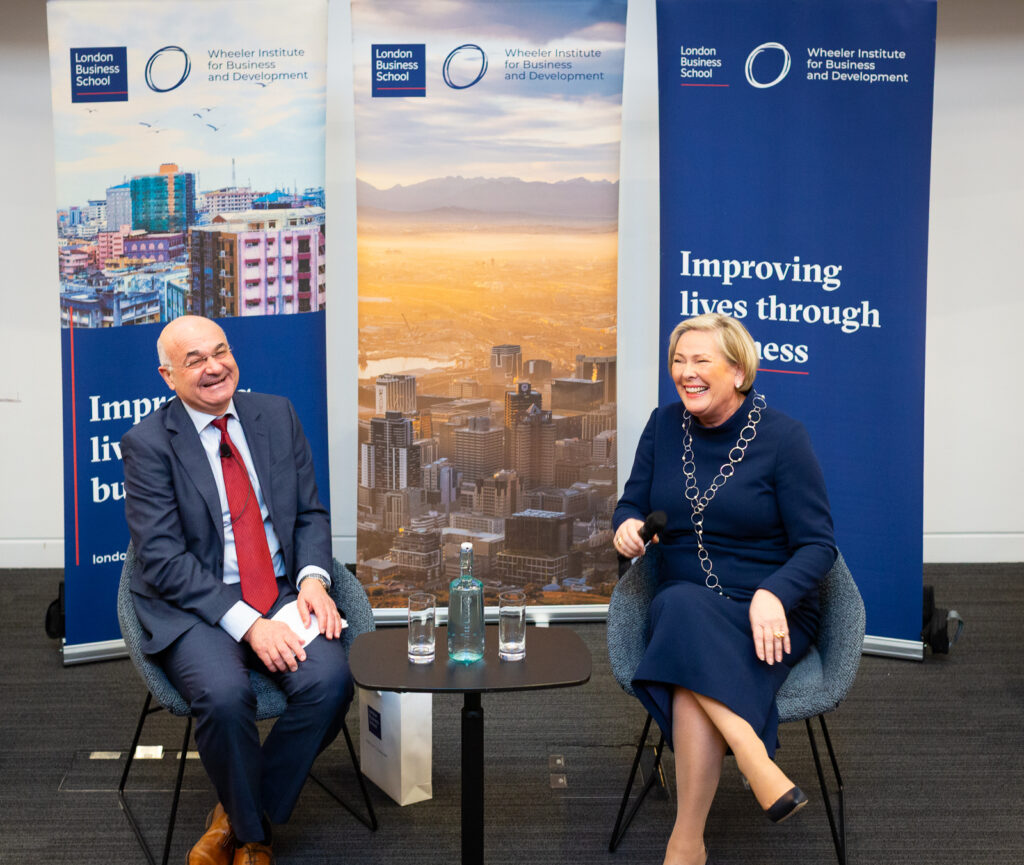
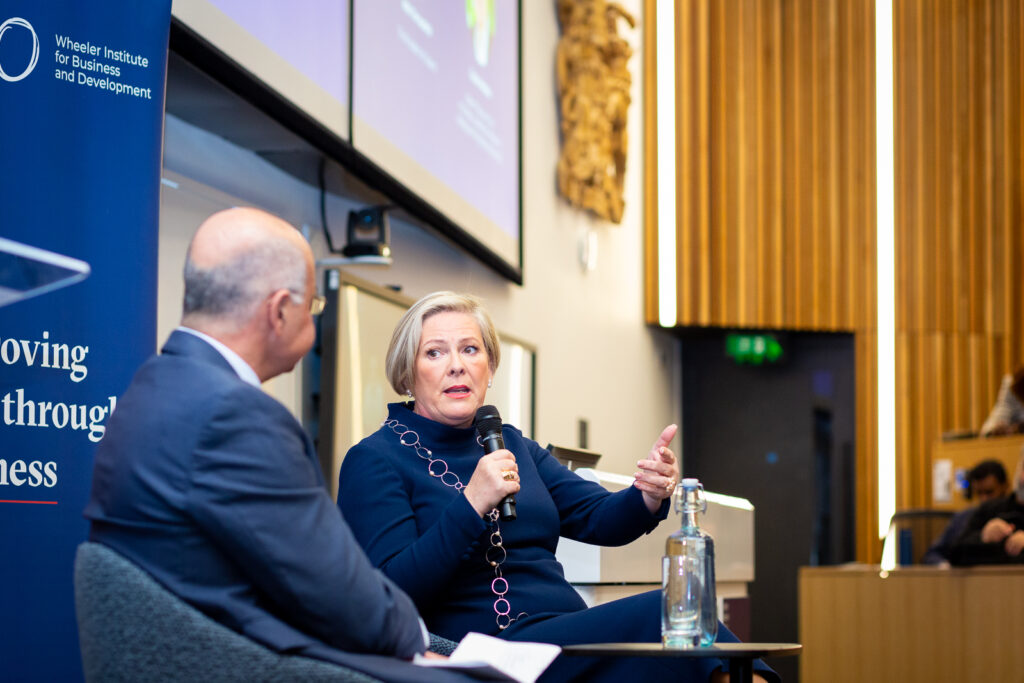
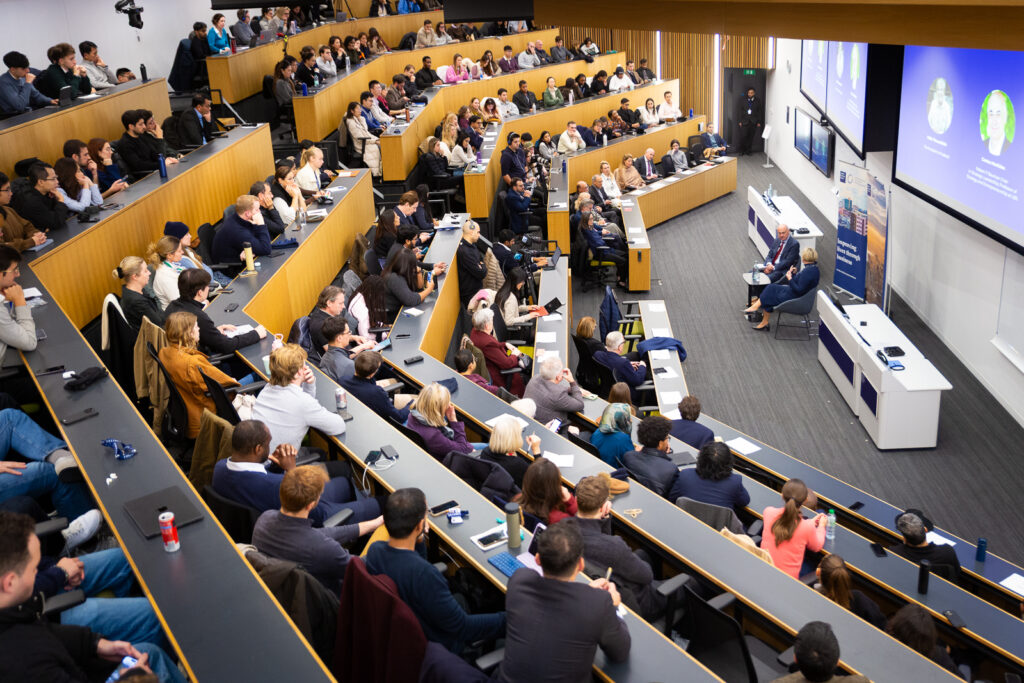
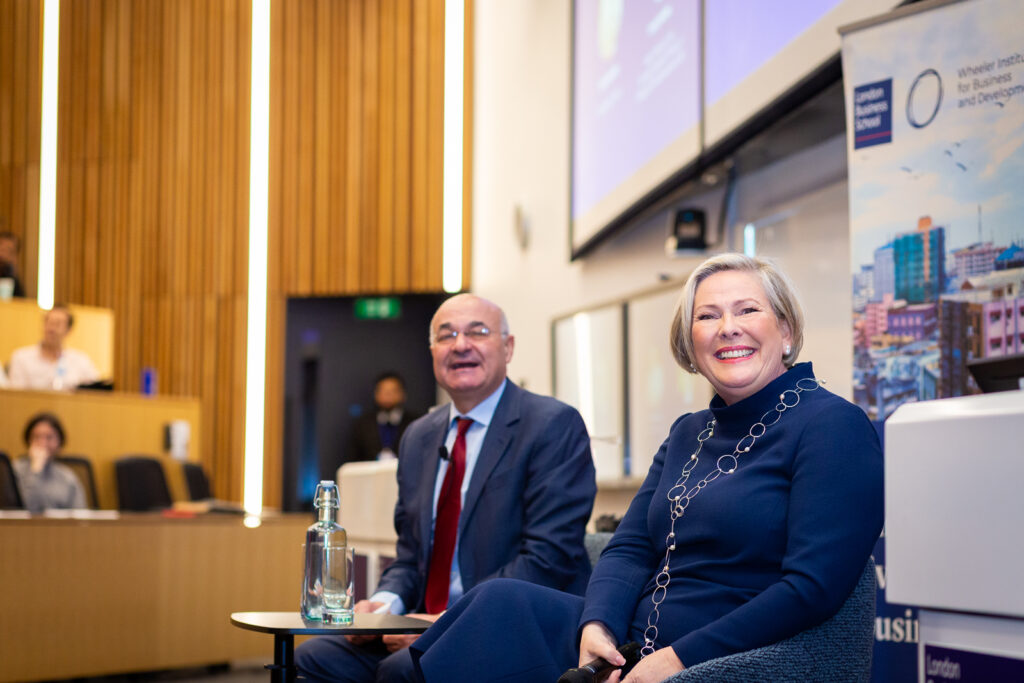
London Business School was honoured to welcome President of Iceland, Halla Tómasdóttir, for a conversation on what leadership with purpose means today. Drawing on her career spanning both the private and public sectors, she argues that in a world facing a cross-sector and cross-generation trust crisis, leadership can no longer be driven from a single background. She stressed the role leaders play in rebuilding trust, widening definitions of success and enabling a sustainable world for future generations.
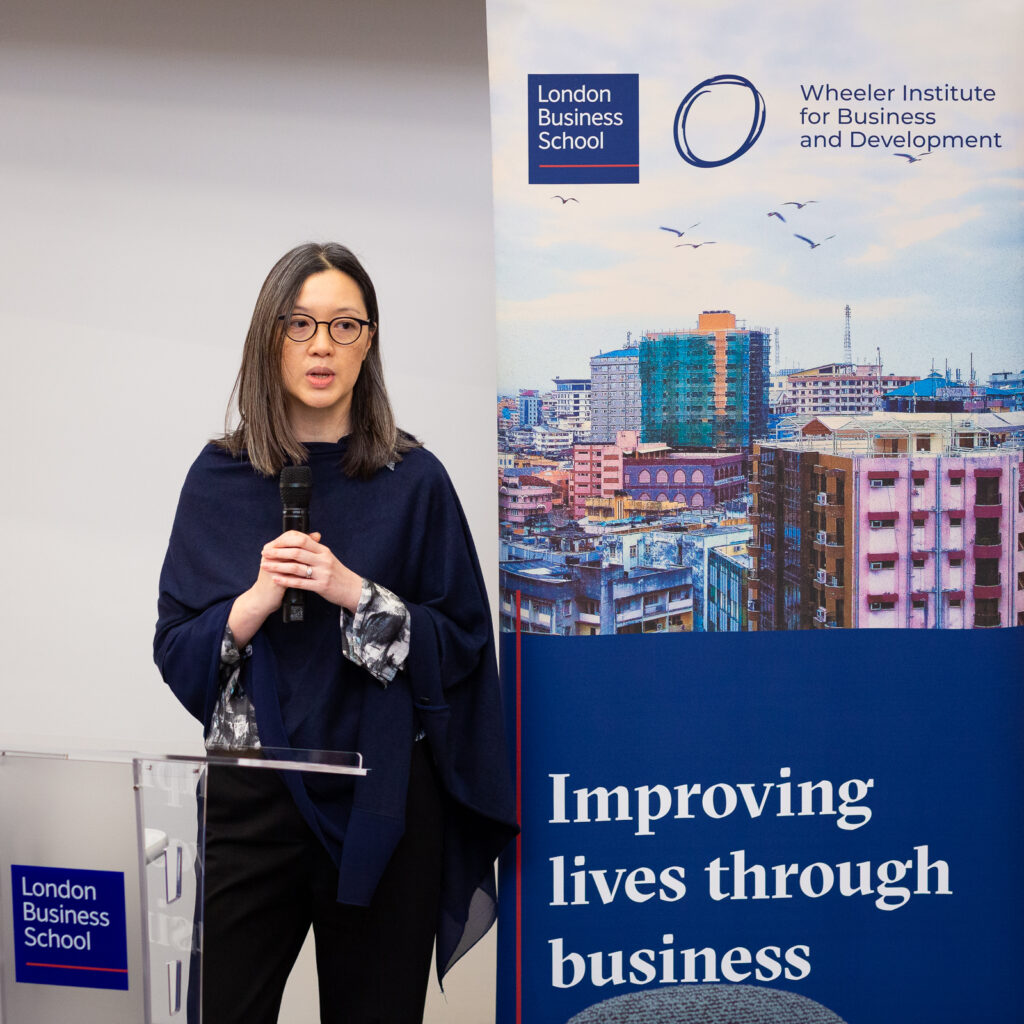
The event was opened with remarks from Gillian Ku, Professor of Organisational Behaviour and Deputy Dean of London Business School, and the conversation moderated by Costas Markides, Robert P Bauman Chair in Strategic Leadership and Professor of Strategy and Entrepreneurship at London Business School.

Business with purpose: returning to the core of problem‑solving
Tómasdóttir frequently emphasised on a central belief: “business at its best solves problems,” not simply generates quarterly profits. She traced today’s narrow focus on shareholder value back to Milton Friedman’s 1970 New York Times article and argued that this model has driven strong economic growth yet also contributed to environmental degradation, declining mental wellbeing and democratic fragility.
She argued that these are fundamentally a design problem. Current systems over‑emphasise delivering financial returns for a narrow group of shareholders, while underestimating purpose or problem-solving for people and the planet. The results is a model where the way we are doing businesses, the rules we set for business, and the way we are consuming together create problems. While classical economics might treat these as externalities for governments to fix, she insisted that all actors share responsibilities: governments should reset rules, citizens should hold business and government accountable, and companies should innovate to solve problems rather than offload them.
She also highlighted how short‑term market pressures make this redesign harder. CEO tenures have shortened in many markets, while quarterly earnings expectations lock leaders into short timeframes even when they want to invest for 10–15 years. She cited examples of leaders who explicitly told investors, “If you’re not in it for the long run, don’t be in it at all,” yet still faced pressure when markets turned. For Tómasdóttir, “we need different metrics and different time horizons” if we are to build a sustainable world, and emerging sustainability reporting standards can help broaden the definition of corporate success.
The crisis of conformity and a leap of courage
Beyond structural incentives, Tómasdóttir described a deeper cultural problem: a “crisis of conformity,” where leaders have similar educations, networks and worldviews, leaving too little room for age, gender, geographic and experiential diversity. Harvard Business School research she shared shows that half of its own MBA students doubt whether current systems can solve climate change, inequality, and social fragmentation.
She also contrasted paralysing fear with the courage to transform, “Fear lives in our heads, while courage lives in the heart.” She argued that humanity needs to rely more on what the heart knows: caring about their children, about nature and their communities. To tap into that shared intuition, “we need to drop from our heads to our hearts more often and listen to what truly matters”, cultivating courage tempered by humility, so that leaders remain open to learning and collaboration rather than becoming rigid or arrogant based on one’s experience.
Three proposals for leadership with purpose
To address the design problem and the crisis of conformity, Tómasdóttir proposed three shifts in who leads and whose interests define success: closing gender gaps, bringing youth into decision‑making, and empowering the Global South as equal partner.
- Close the gender gap and redefine success:
On gender equality, she quipped that Iceland is “fuelled by girl power and geothermal power,” and pointed out how gender has helped change the country’s definition of success. On 24 October 1975, around 90% of Icelandic women stopped working for a day, effectively bringing the country to a standstill and catalysing major legal and cultural changes. Five years later, Iceland elected the world’s first democratically chosen female president; today it has ranked number one in the World Economic Forum’s Global Gender Gap Index for most of the last 17 years.
She stressed that gender equality is not just about numbers. Research and experience suggest that more gender‑balanced leadership teams are more likely to cooperate, think long‑term and keep people, climate, and the next generation on the agenda. Leaders must recognise that gender has transformative power to change how success is defined, so that the wellbeing of all people and the planet becomes central, not peripheral.
2. Bring youth voices into decision-making:
Young people, she suggested, naturally take a longer view on issues such as climate, technology and fairness. She shared the story of a CEO of a fossil fuel company, whose teenage daughter asked, “Do you want to be responsible for the climate crisis for the next generation?”, prompting him to reconsider the time horizon and impacts of his company’s strategy. Companies such as Novozymes and IKEA, she noted, have experimented with youth advisory boards and deep intergenerational dialogues, using younger voices to stretch leaders’ imagination and accountability beyond the next earnings call. Leaders, in her view, need to invite not only youth input but genuine cross‑generational conversation that challenges comfortable assumptions.
3. Empower and partner with the Global South:
Turning to global development, Tómasdóttir described countries in the Global South, particularly across Africa, as “engines of innovation, talent and renewable potential” rather than passive aid recipients. As an example, she cited Iceland’s long‑standing partnership with Kenya: over recent decades Icelandic institutions have helped train hundreds of geothermal engineers, supporting Kenya’s move towards more than 90% renewable electricity generation and a rapidly growing clean‑energy sector. For Tómasdóttir, genuine empowerment and partnership mean confronting historical imbalances, reshaping supply chains, and investment flows, and ensuring regions such as Africa gain meaningful seats at global decision‑making tables where inclusive and effective solutions to climate, energy and development can be designed.


Transforming systems and rewriting the rules for the future
Systemic change, she argued, requires governments to “write the rules for the future, not the past.” During Europe’s recent energy crisis, many states subsidised household energy bills largely through support to fossil‑fuel‑based systems, rather than accelerating the green transition. She called the environmentally harmful subsidies, which totalled at least six trillion US dollars per year globally, “intergenerational crimes”, because only a fraction of this is redirected towards decarbonisation and resilience.
Technology adds another layer of urgency. Around ten companies now account for roughly 20% of global stock market value, and many of the most highly valued are AI leaders. Tómasdóttir expressed concern about “AI without principles, without purpose, without compassion,” likening the current rush of investment in AI technologies to the leveraged bets that preceded the 2008 financial crisis. In her view, innovation must be guided by clear human principles and social purpose; otherwise, new tools risk reproducing past crises at far greater speed and scale. She suggested that part of the unanswered “human science” of our time is how to align rapidly advancing technologies with human values, dignity and security.
Wellbeing and mental health
Iceland is part of the Wellbeing Economy Governments partnership, working with countries such as Scotland and New Zealand to embed wellbeing and mental health into national goals and budgeting, not just into add‑on social programmes. Tómasdóttir noted alarming statistics on rising loneliness, depression and youth disengagement, warning that no growth model is sustainable if people feel hopeless about their lives.
Only three weeks into her presidency, a teenage homicide shocked the country as violent crime involving young people is rare in Iceland. Tómasdóttir convened around 30 practitioners and young people for a long dialogue in the presidential residence. That conversation led to “Knights of Love,” a youth‑led movement promoting compassion and social connection, including men’s groups and “compassion circles” exploring what it means to be a good man today. For Tómasdóttir, such movements show how culture and policy must reinforce each other if societies are to address violence, alienation and mental health issues.
She also raised concerns about the attention economy and social media, noting how constant notifications and online comparison can erode confidence and real‑world connection. She argued for bringing practices such as meditation and “inner work” into schools so that young people can build the self‑knowledge and emotional resilience needed to navigate an age of AI and constant digital stimulation.
Purpose as guiding force
Leadership, in Tómasdóttir’s view, is not conferred by position but by clarity of purpose and a willingness to act in service of the greater good, “there is a leader inside each of us.” With around ten companies now accounting for roughly 20% of global stock market value and technology, including AI, concentrating power in even fewer hands, she warned that principles and purpose must shape innovation or risk repeating past crises at greater scale. Securing a liveable future, she argued, is ‘the challenge of our time’ as the world already has the capital, technology and knowledge required. What is missing is the collective courage, humility, and imagination to redesign systems so that economic success, environmental sustainability, and human wellbeing reinforce rather than undermine one another.
about the speaker
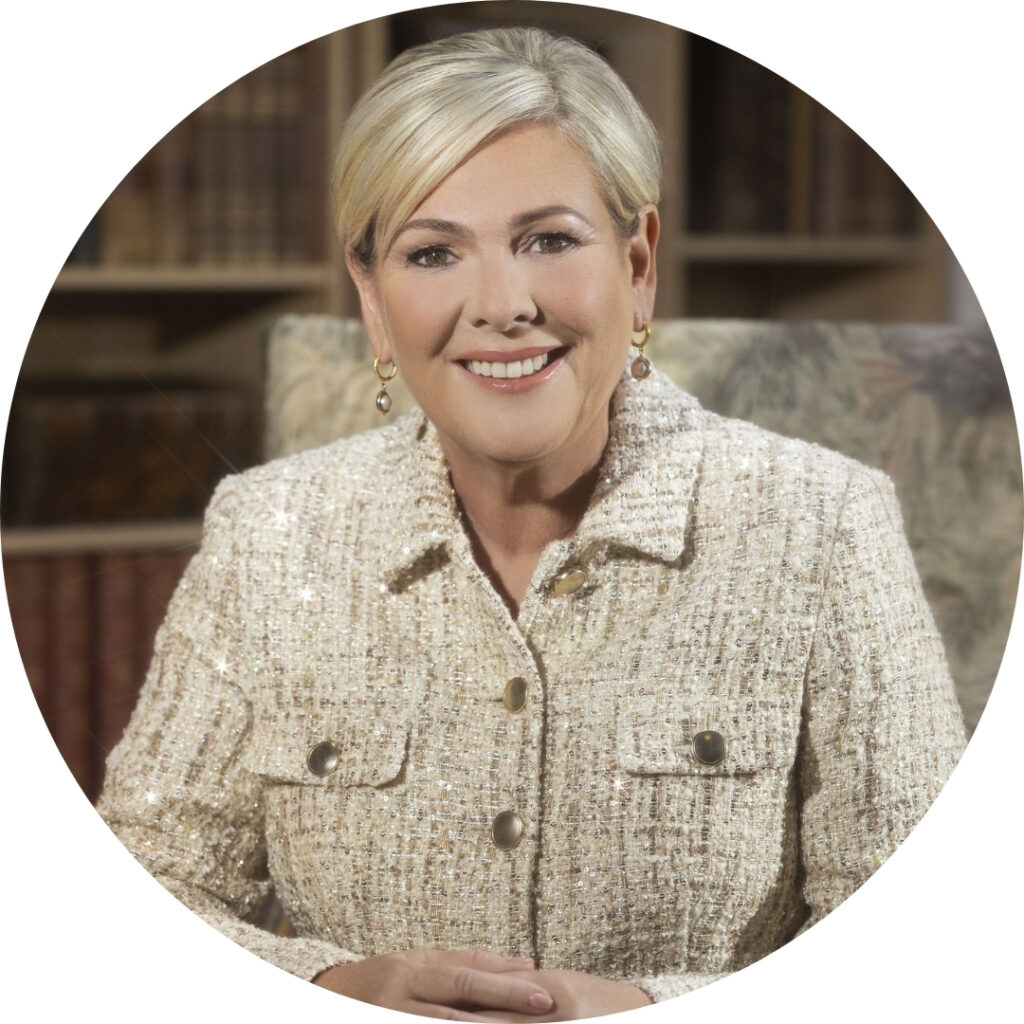
Halla Tómasdóttir is the seventh President of Iceland, assuming office on 1 August 2024. Prior to becoming President, she built a distinguished career as a business leader, entrepreneur and global advocate for inclusive leadership and sustainability. She was the first female CEO of the Iceland Chamber of Commerce and co-founded Auður Capital during the financial crisis, leading the firm through the upheaval, and later served as CEO of The B Team from 2018 to 2024, a global nonprofit focused on values-driven business.
As President, Halla Tómasdóttir has emphasised unity, long-term thinking, gender equality, ecological responsibility and participatory governance. Her leadership champions empathy and inclusion as essential tools for tackling global challenges, while reinforcing Iceland’s reputation as a nation that leads by example on sustainability and equality.
about the moderator
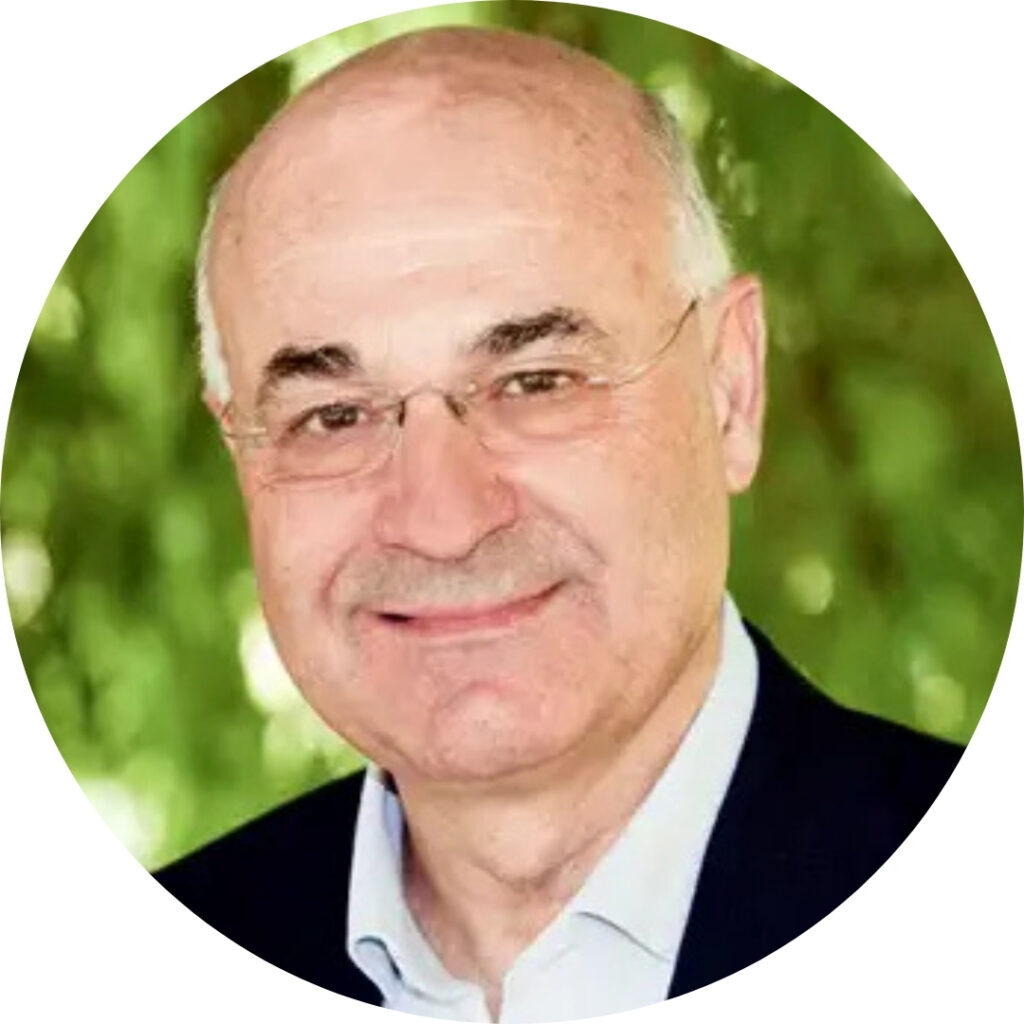
Costas Markides is the Robert P. Bauman Chair in Strategic Leadership and Professor of Strategy and Entrepreneurship at London Business School. A leading authority on leadership, strategy and innovation, his work examines how individuals and organisations can lead with vision, adapt to disruption and inspire purposeful change.
He has written extensively on strategic renewal and organisational transformation, and is the author of several influential books, including All the Right Moves, Fast Second, Game-Changing Strategies and Organizing for the New Normal. With a distinguished career at London Business School, Professor Markides has guided and inspired leaders from across the world to unite creativity with discipline, and to lead with authenticity, courage and integrity.
about the writer
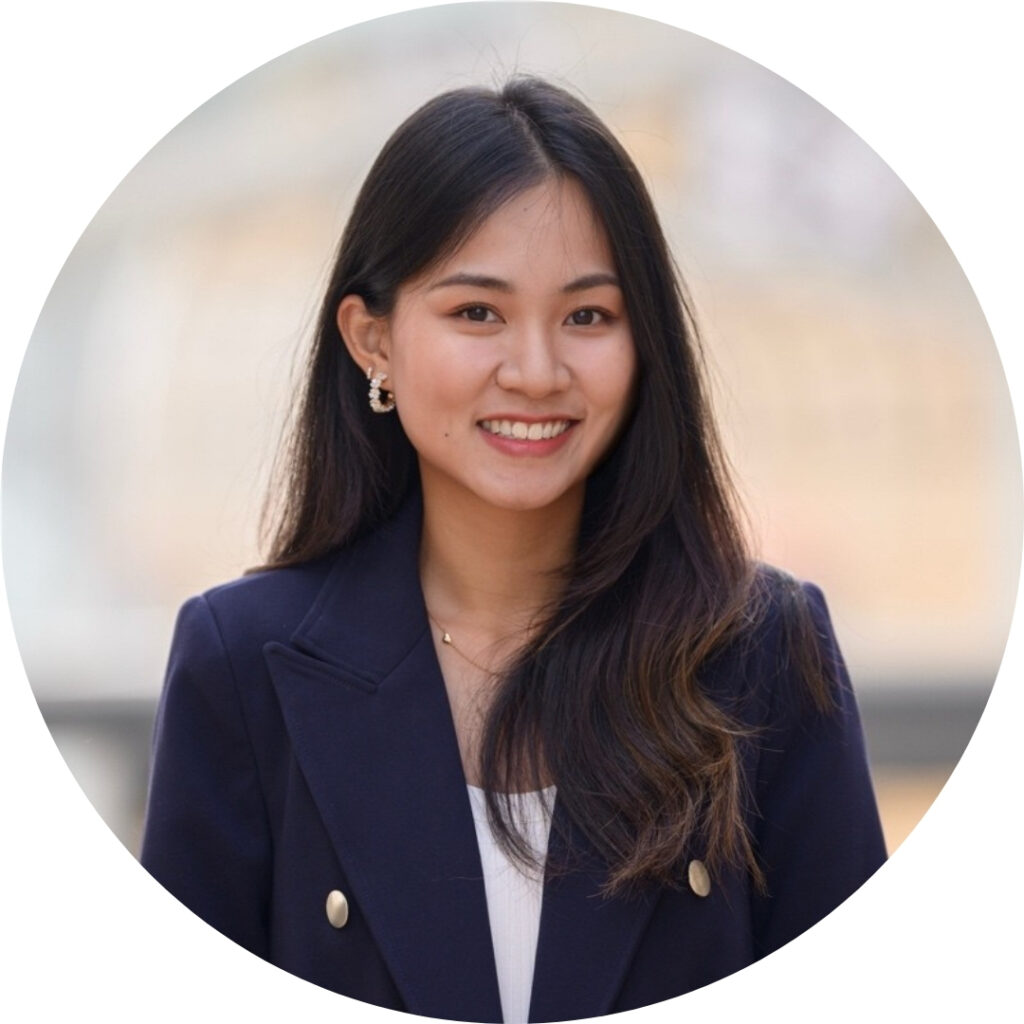
Luise Lin is an MBA 2026 candidate at London Business School and an Outreach and Communication Intern at the Wheeler Institute for Business and Development. Prior to joining London Business School, she worked at Boston Consulting Group as Consultant in Australia, where she advised clients across private and public sectors as well as social enterprises. Luise is passionate about leveraging innovative business models and financial solutions to drive scalable economic development impact in developing regions. She is particularly interested in the intersections of management, policies, and social impact, exploring how private sector solutions can contribute to sustainable development.