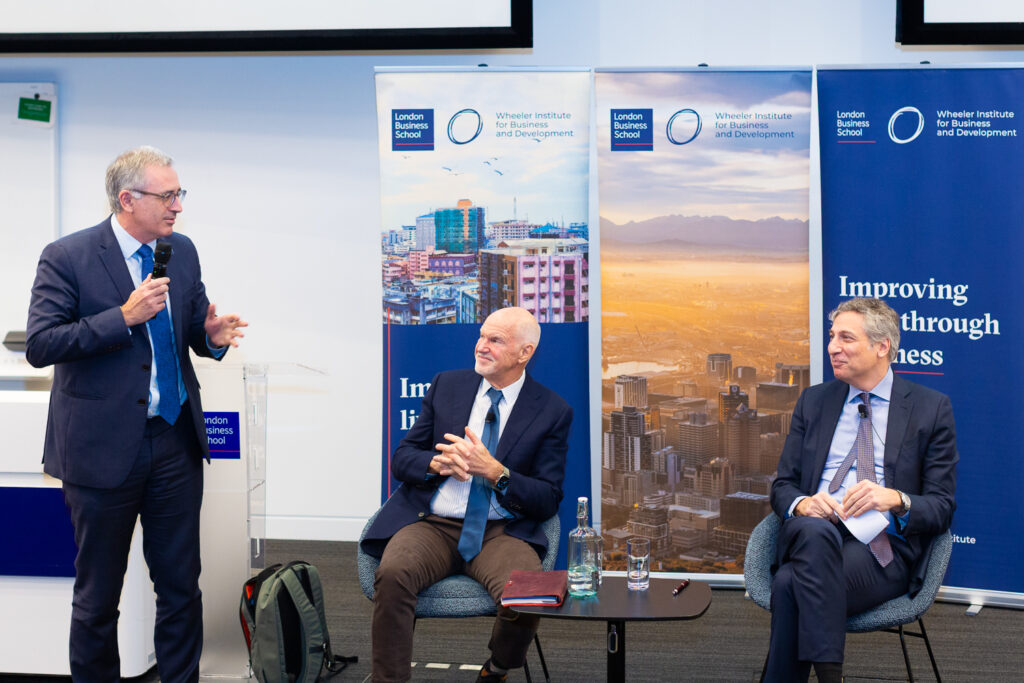
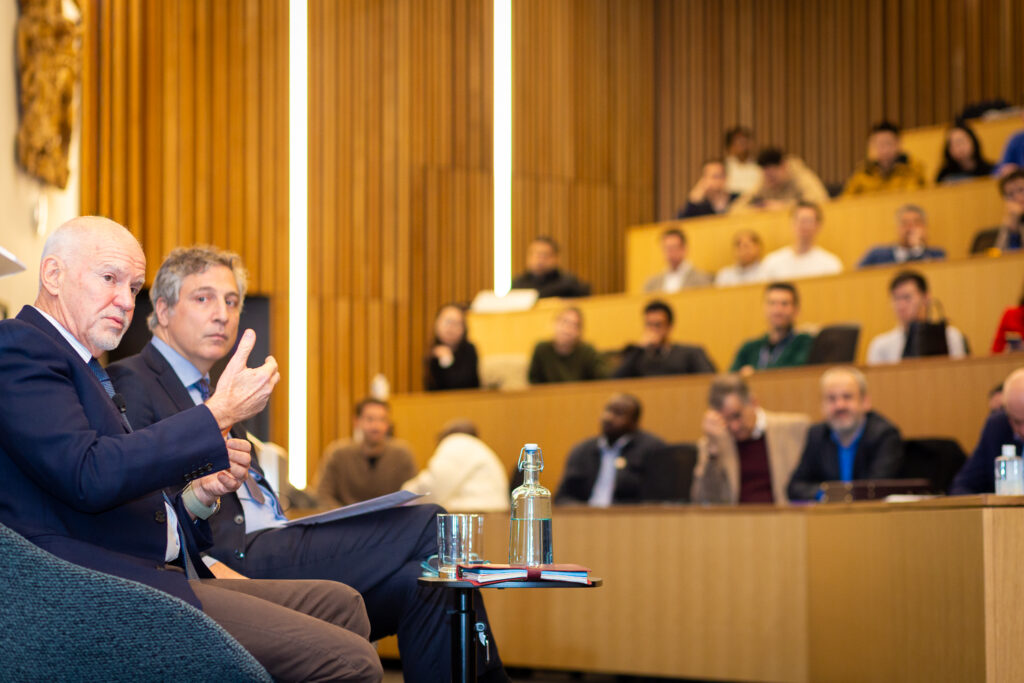
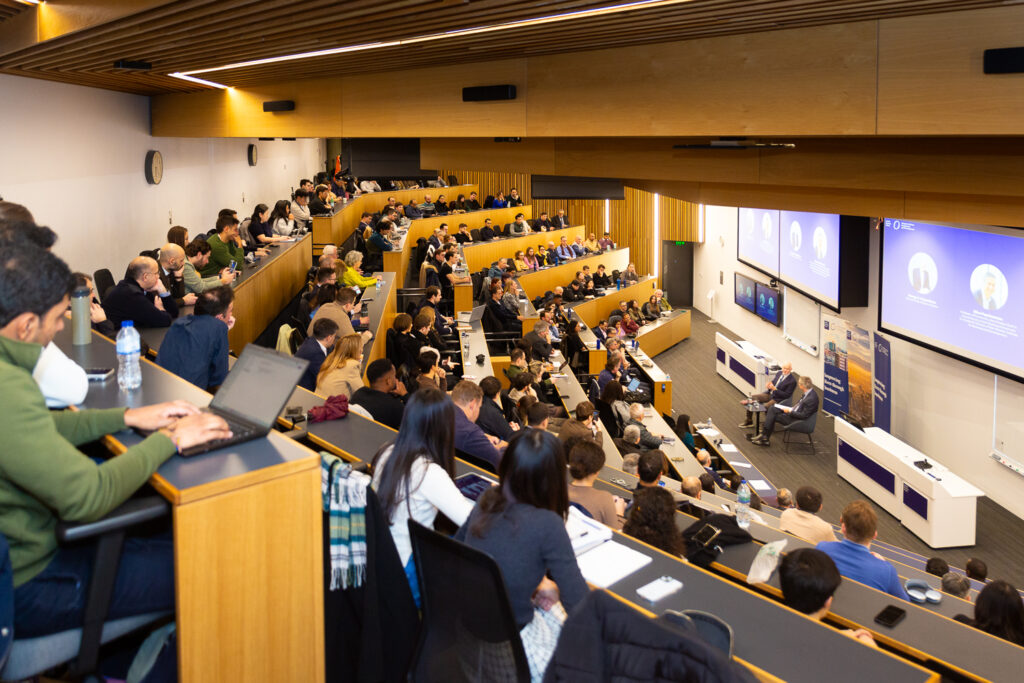
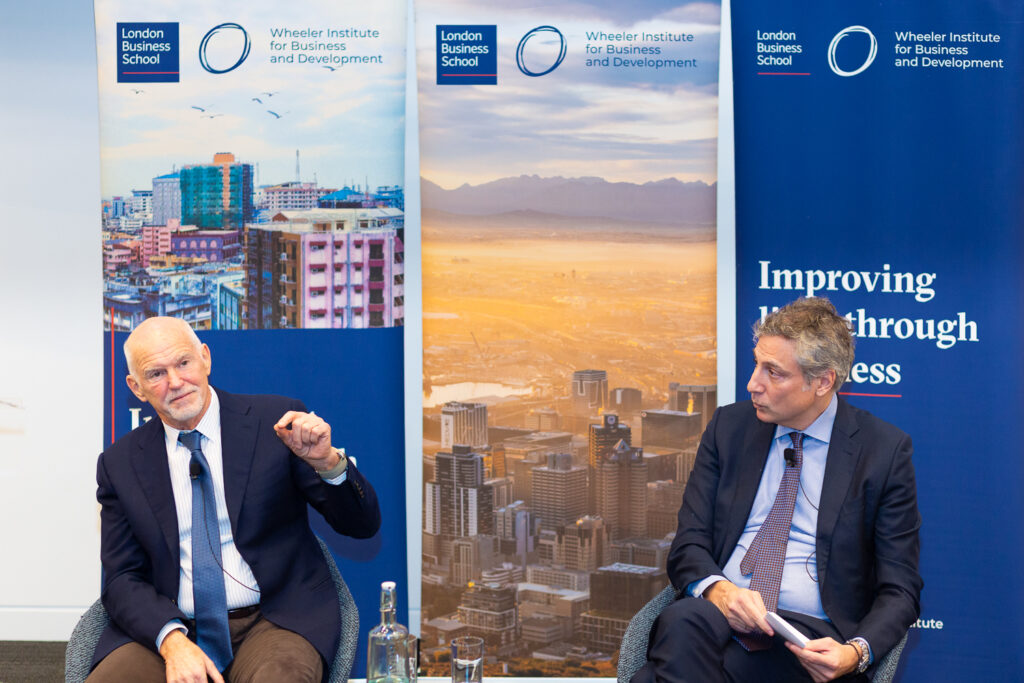
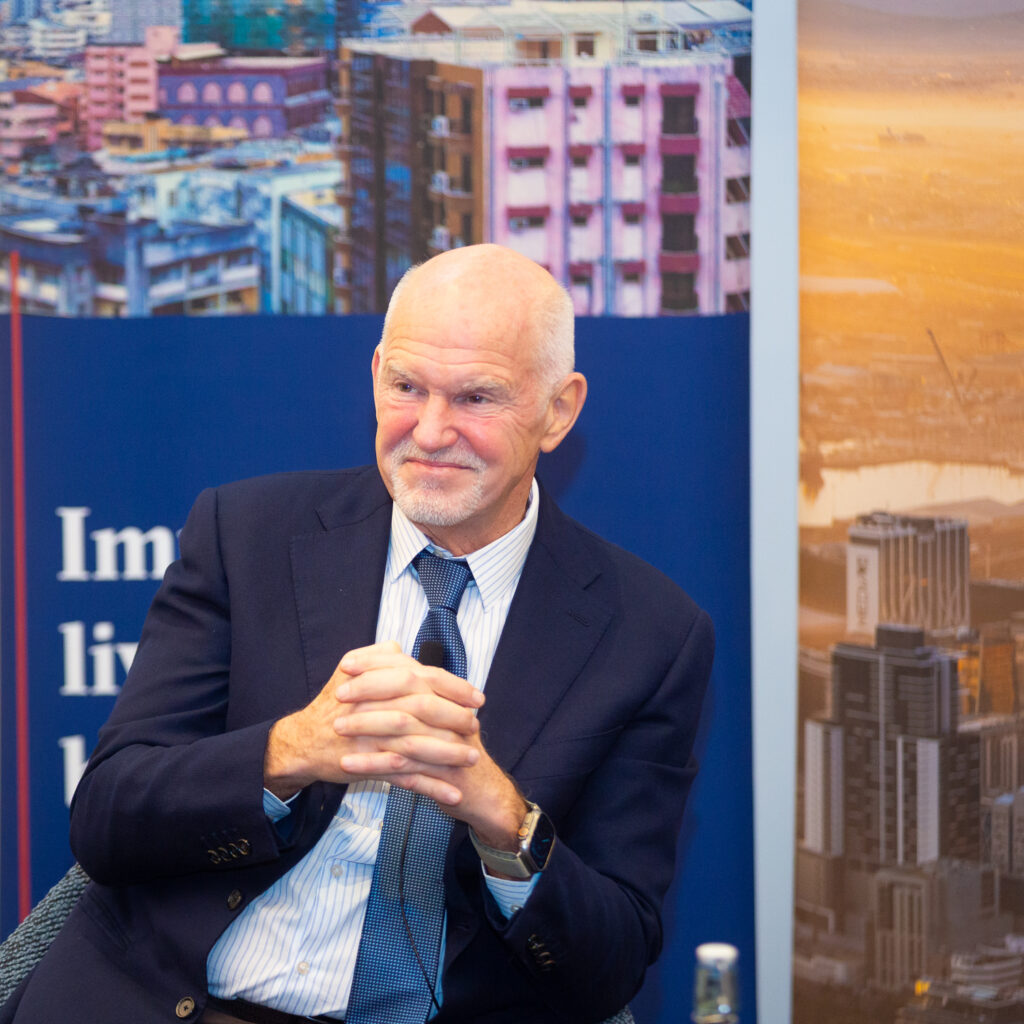
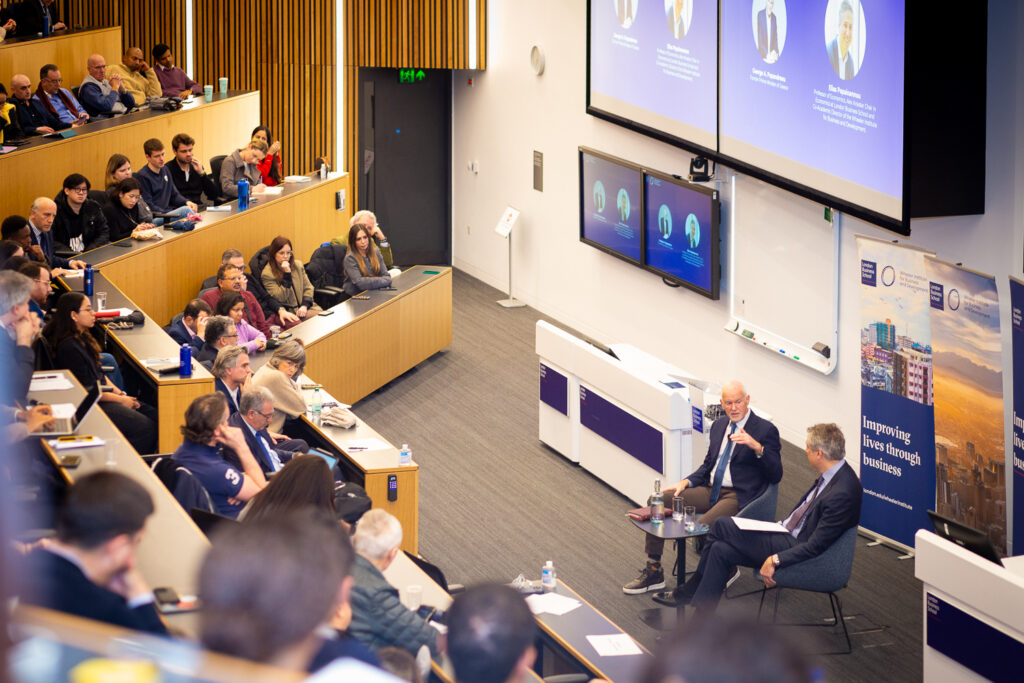
The Wheeler Institute had the pleasure of welcoming the former prime minister of Greece and current member of parliament, George A. Papandreou. Leveraging on his experience serving in public office and in diplomacy, Papandreou’s insights were timely given the current state of the world in which many countries seem to be more divided than they are together. His remarks emphasized that there is no such thing as a small country, rather each country has a role to play. He also stressed that Europe can take concrete steps to strengthen its global position, and that democratic legitimacy must be reinforced through clearer, more forward-looking approaches.
The event was opened with remarks from Sergei Guriev, Professor of Economics and Dean of London Business School (LBS), and the conversation was moderated by Elias Papaioannou, Professor of Economics, Alex Knaster Chair in Economics at LBS and Co-Academic Director of the Wheeler Institute for Business and Development.
There is no such thing as a small country
Drawing from his experience in office, Mr. Papandreou noted that building trust is especially critical in an increasingly interdependent world. When trust is lost, tensions escalate rapidly, making it imperative for countries to ground their actions on strong principles. A key element of building trust lies in each country playing its role in the global system rather than retreating from it. Countries should reflect on what they can contribute to the world, thinking through what is of value not only to themselves, but also to the international community and engage in dialogue that prioritizes collaboration over competition.
Using Greece as an example, Papandreou emphasized that so-called “small” countries can play to their strengths and act as beacons of hope and trust. By leveraging its strategic location and advocating for a rule-based international order, Greece has demonstrated its commitment to cooperation in addressing global challenges. This approach offers a model for other countries to consider how they can meaningfully show up on the world stage and contribute to collective solutions. To illustrate this idea further, Papandreou drew on his personal experience of leading Greece’s disaster relief efforts to Turkey in the early 2000s, following Turkey being hit with a series of devastating earthquakes. Despite longstanding tensions between the two nations, Greece was the first country to offer assistance and sent specialized rescue teams and humanitarian supplies. This act of solidarity bypassed traditional hostility and demonstrated how countries can use their capabilities to help rather than dominate. Shortly thereafter, Greece was struck by a major earthquake, and Turkey was amongst the first countries to reciprocate with disaster relief support. This period, later referred to as “earthquake diplomacy” marked a significant improvement in relations between the two countries. The event stands as a powerful example of how trust can be built through principled action and mutual support, and how even countries perceived as small can make a profound impact on the global stage.
Reimagining Europe’s role in a fragmenting world
Papandreou thinks that beyond initiatives such as completing a banking union or further integrating financial markets, a concrete policy Europe could implement would be the creation of a clear mission statement that defines Europe’s role in the world and articulates what it uniquely contributes to the global system. In discussing the idea, Papandreou reflects on concerns about widening inequalities, ecological destruction, persistent poverty, and the failure to harness technology for the public good, and challenges Europe to propose a vision for the global economy that is principled rather than opportunistic, and oriented toward long-term sustainability and shared prosperity.
Papandreou further argued that the collapse of the multilateral system would pose an existential threat to Europe itself, as the continent would risk fragmentation in a world governed by power politics rather than rules. He believes Europe’s survival therefore depends on its strength, which in turn requires a firm commitment to supporting and reshaping the multilateral system. This entails developing a unified vision of what multilateralism should look like and aligning European goals with a coherent strategy for achieving them. Leaders must draw on lessons from the past, while preserving what has worked and correcting past failures in order to build a more effective and resilient global order. Once such a vision is established, Europe could present its charter for a renewed multilateral system to the international community and seek partnerships with other nations. While not all countries would necessarily participate, those that do could form new coalitions around a shared understanding of global order and cooperation. This process reflects Europe reclaiming strategic agency, not through isolation, but by empowering its societies and improving internal coordination through stronger and more coherent policies. Crucially, this effort must operate at both the “grass tops” and grassroots levels. At the grass tops level, political leaders would engage in dialogue to determine the path forward. At the grassroots level, Europe should try experiment with new forms of democracy that enhance visibility, participation, and citizen influence. This could include the creation of citizen councils or even the development of a “fourth,” deliberative branch of governance, designed to give Europeans a direct voice in the policymaking process. Ultimately, for Europe to gain a lasting legitimacy and resilience, significant structural and democratic reforms will be necessary.
Preserving democratic legitimacy in a changing global order
Reflecting on contemporary politics, Papandreou argues that political leaders often place excessive emphasis on democratic institutions while overlooking the powerful economic forces that underpin them. Politics and the economy are frequently treated as separate spheres, despite being deeply interconnected. The growing concentration of wealth, in particular, has become a significant challenge, as economic power increasingly translates into political influence, thereby shaping electoral outcomes and the distribution of authority. These dynamics raise fundamental questions about the legitimacy of democracy. Addressing legitimacy therefore requires more than focusing on who is elected, it also requires understanding of how democracy is structured and governed in practice.
Papandreou also observes that Europe has remained relatively quiet in response to major global developments. Regardless of the reasons for the silence, he warns that the longer Europe hesitates to speak or act, the less relevant it will become on the global stage. It is therefore salient for Europe to engage at the right moment and to do so in a coordinated and organized manner. Failure to do so runs the risk of Europe gradually becoming irrelevant or slowly fragmenting. When considering practical next steps for navigating current global challenges, Papandreou urges Europe to think creatively and avoid conventional constraints. He emphasizes the need for democratic, forward-looking reforms and cautions against delaying action. Decisions about where and when Europe intervenes need to be tactical and Papandreou acknowledges that there may be instances in which political consensus is reached within institutional settings while financial markets react unfavorably. In such moments, Europe’s response should be guided by the willingness to take bold, principled steps in pursuit of long-term legitimacy and stability.
Stronger together
In Papandreou’s view, Europe must be strong in order survive, and that strength is achieved through unity. Working together, developing new forms of leadership and embracing innovative approaches to governance are essential to Europe’s survival. Equally important is the need to give citizens a genuine voice in decision making, reinforcing democratic legitimacy and public trust. Strength, however, also requires courage. Europe must not remain silent but instead learn when and where to speak out with clarity and purpose.
Papandreou emphasizes that bold, unconventional steps will be necessary to meet the challenges of today’s world. Europe must be willing to think beyond established frameworks and act decisively in defense of its values and interests. More broadly, he reminds us that global challenges cannot be solved in isolation. Retreating into national or regional silos is no longer viable in an interconnected world. Instead, Europe and the global community as a whole must recognize that we are part of a shared global village, and only through collective action and cooperation can meaningful and lasting change be achieved.
About the speaker
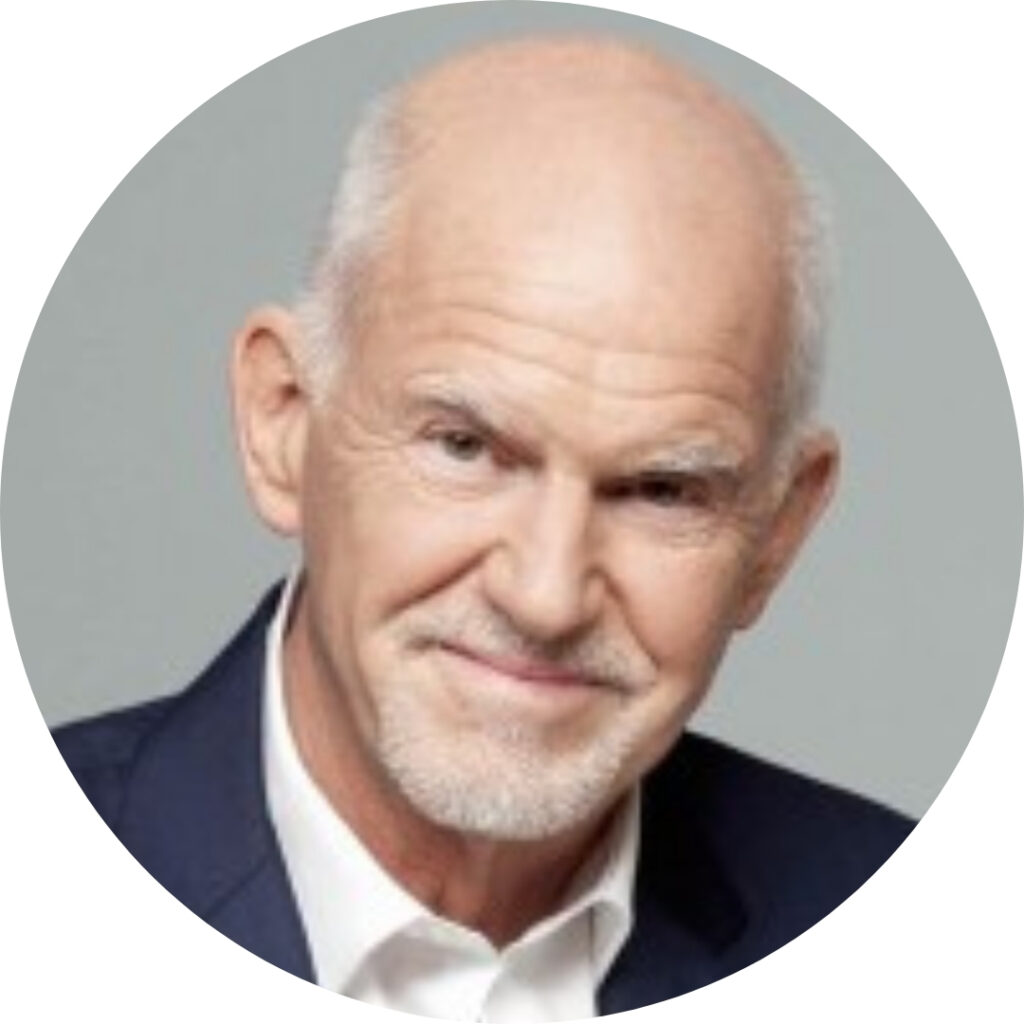
George A. Papandreou is a former Prime Minister of Greece and a senior international political leader with a distinguished record in public service and diplomacy. He previously served for several years as Minister of Foreign Affairs, including during Greece’s EU Presidency in 2003 and the period leading up to EU enlargement in 2004. In addition to his political career, he has been a fellow at Harvard University’s Center for International Affairs and the Institute of Politics and has lectured at institutions such as Columbia University’s SIPA and Sciences Po. He currently serves as President Emeritus of the Socialist International and President of the Commission for Democracy of the Council of Europe, engaging with leaders and organisations globally on governance, development and democratic cooperation, and remains active in academic and policy discussions on global governance, economic transformation and development, with particular attention to emerging and developing economies.
About the moderator
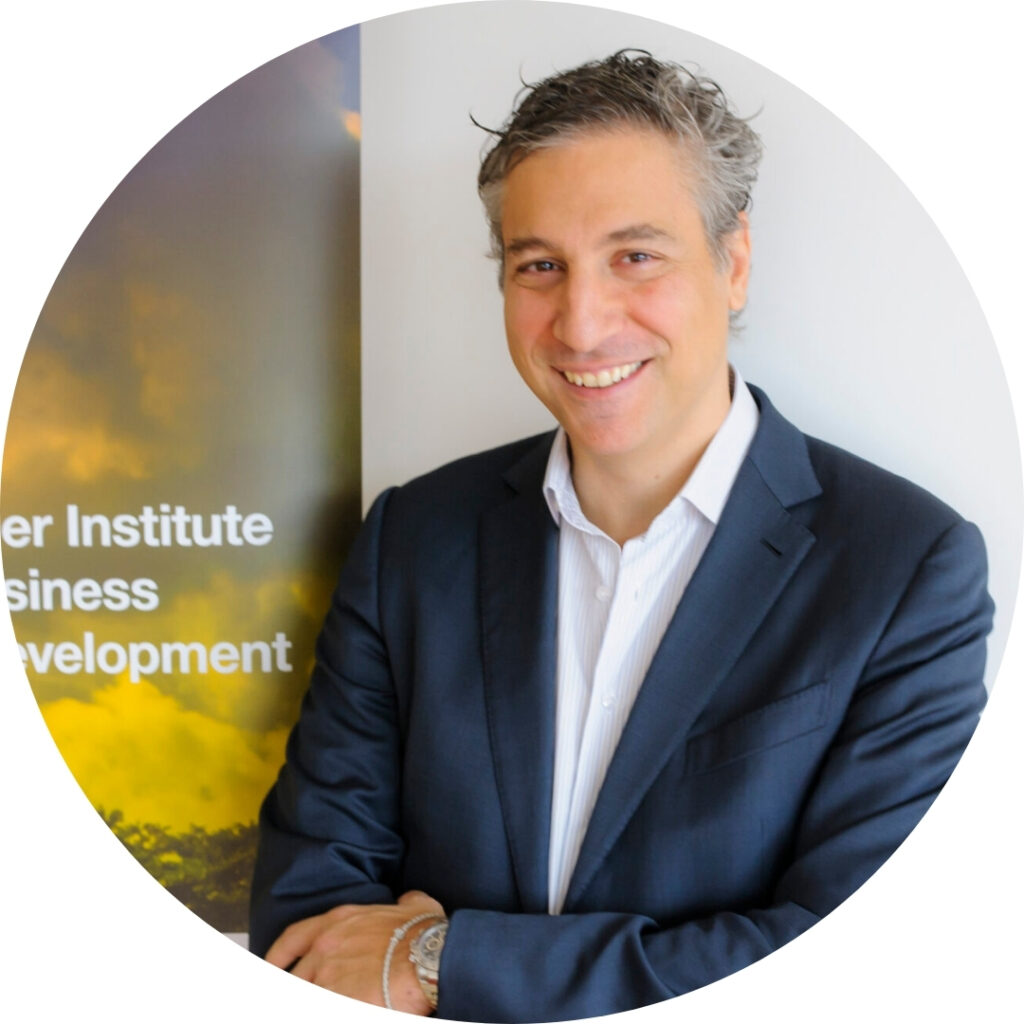
Elias Papaioannou is Professor of Economics, Alex Knaster Chair in Economics at London Business School and Co-Academic Director of the Wheeler Institute for Business and Development. His research focuses on international finance, political economy, economic history, growth, and development, with work published in leading journals such as Econometrica, Review of Economic Studies, Quarterly Journal of Economics, Journal of Political Economy, American Economic Review, and Journal of Finance. He is also a CEPR Research Fellow, Managing Co-Editor of the Review of Economic Studies and Fellow of the British Academy. In the 2019/2020 academic year, Elias held the Varian Visiting Professorship of Economics at the MIT Department of Economics.
About the writer
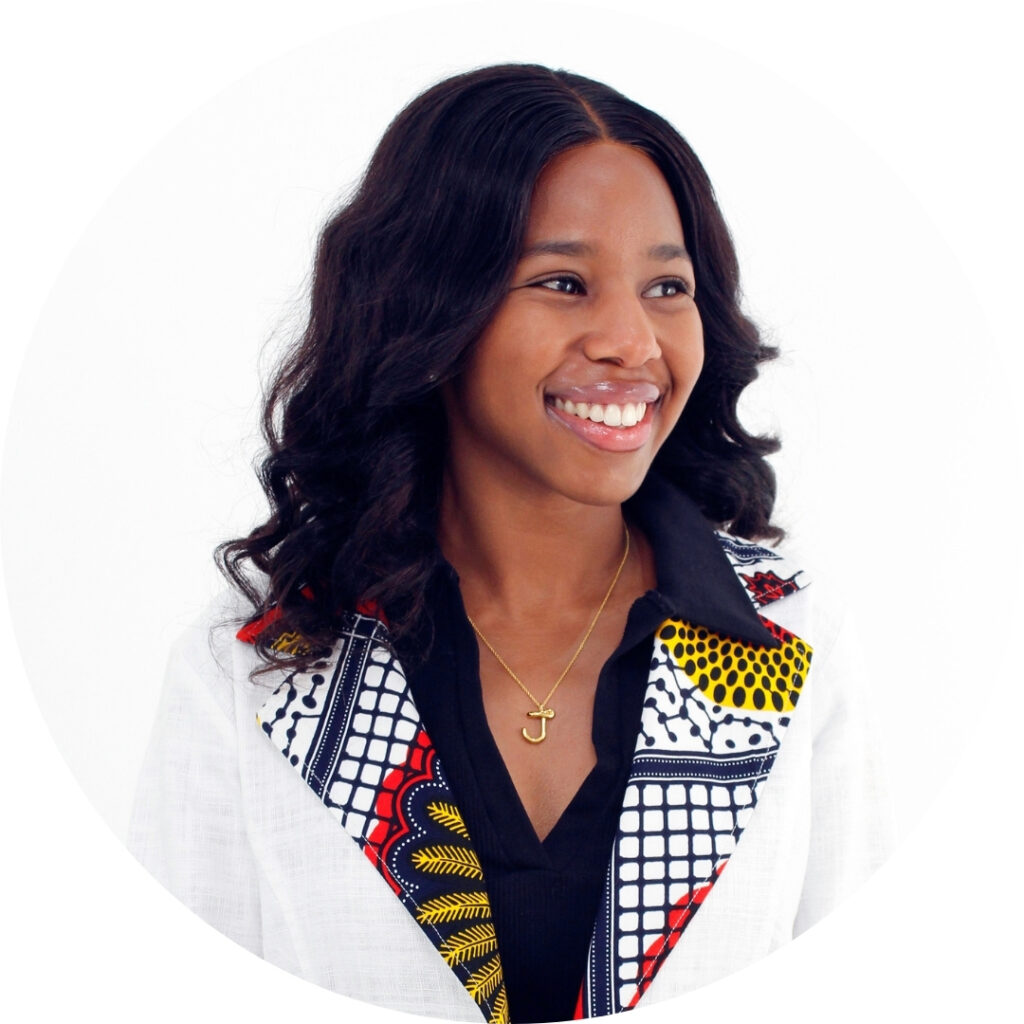
Joanne Ngotho is an MBA class of 2027 candidate at London Business School and a Research Intern at the Wheeler Institute for Business and Development. She previously worked at McKinsey & Company (Nairobi), advising clients across Africa on projects in both the private and public sectors. Joanne is driven by a desire to tackle the root causes of Africa’s development challenges and shape solutions that operate at scale, with a core focus on strengthening education systems as a foundation for long-term growth.