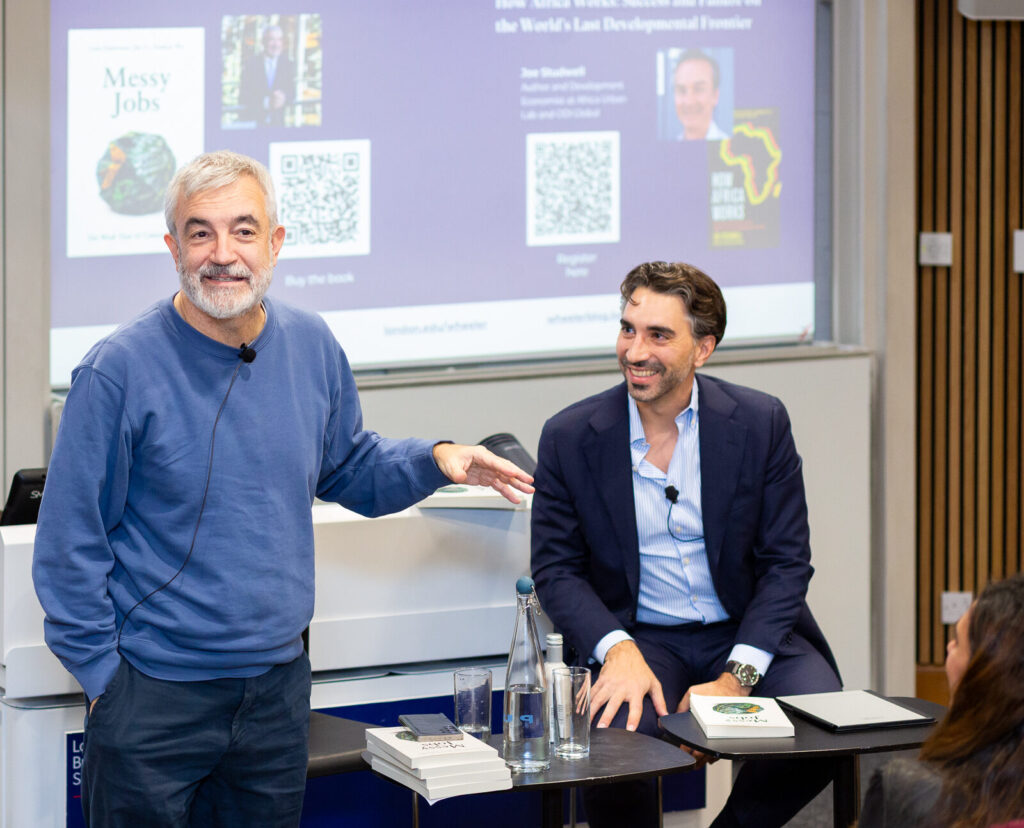
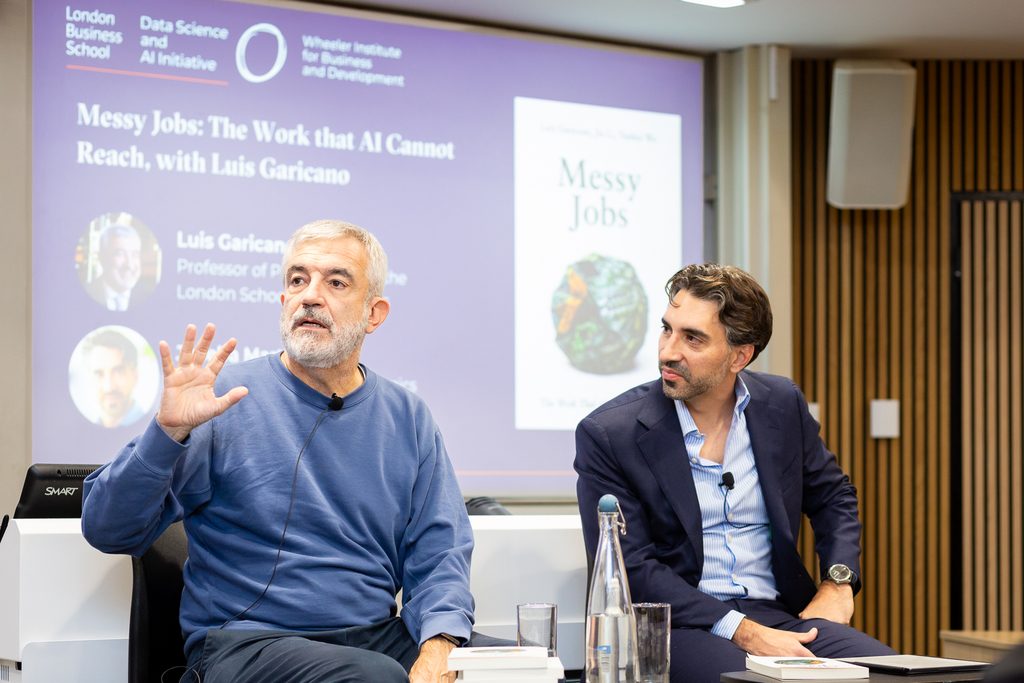
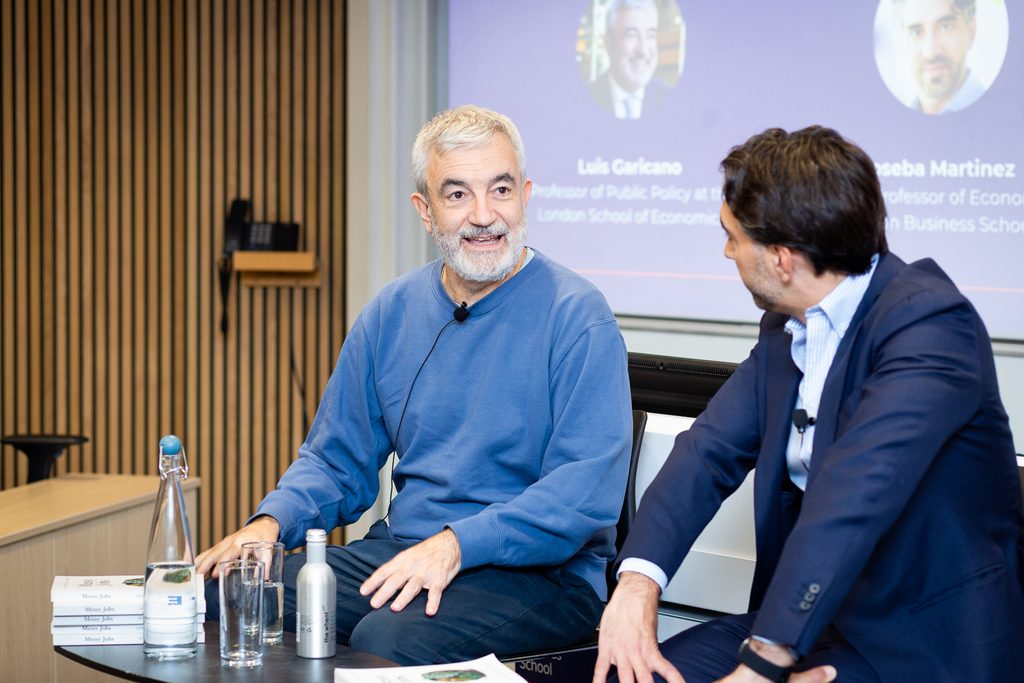
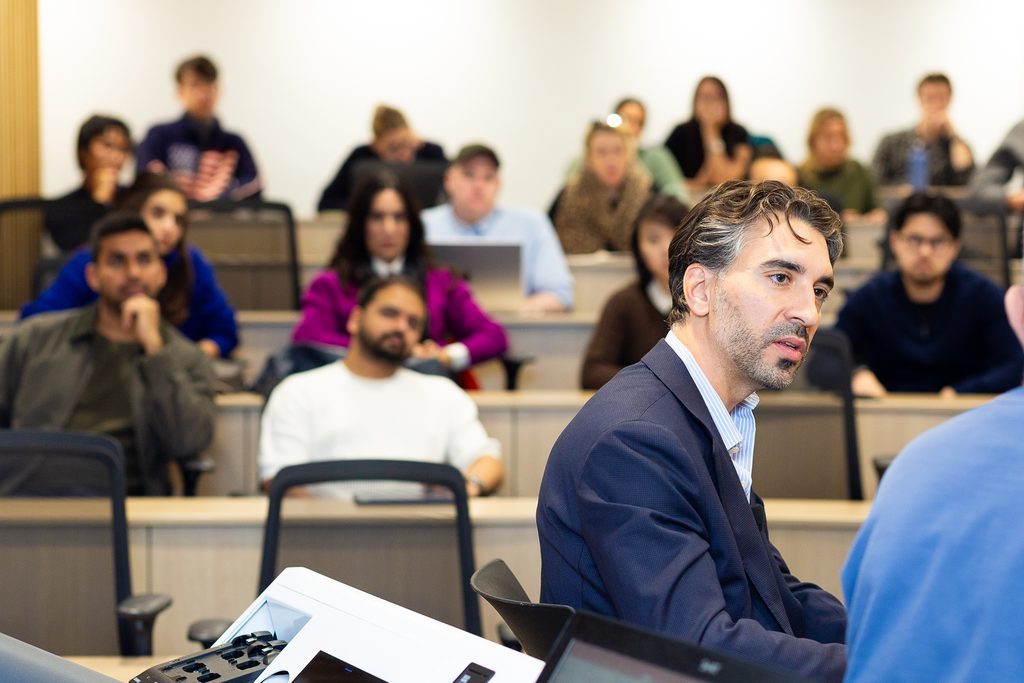
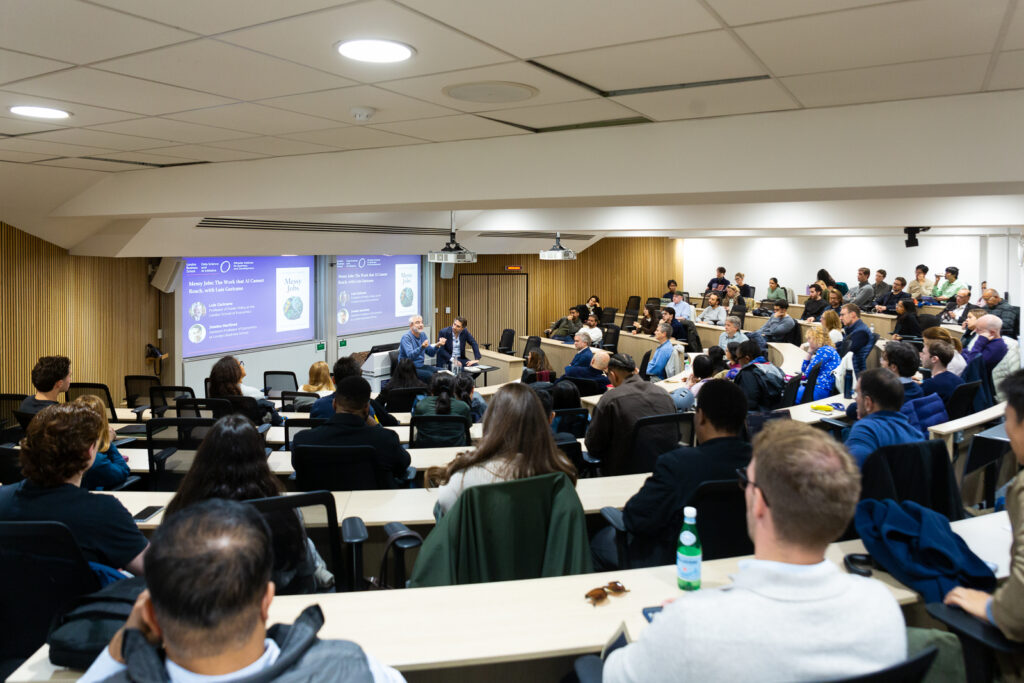
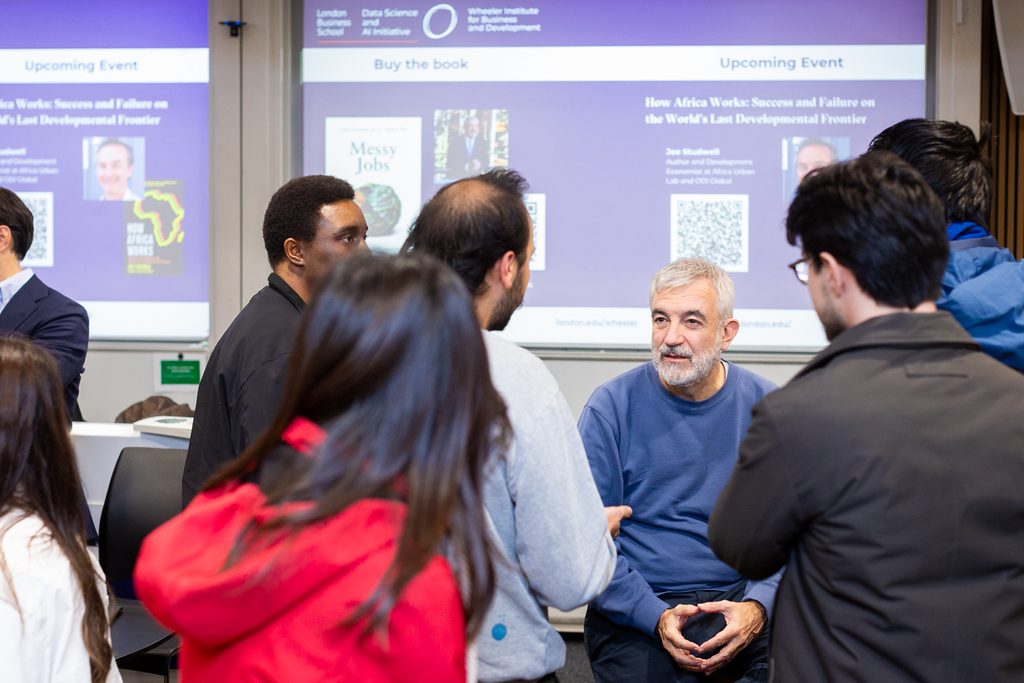
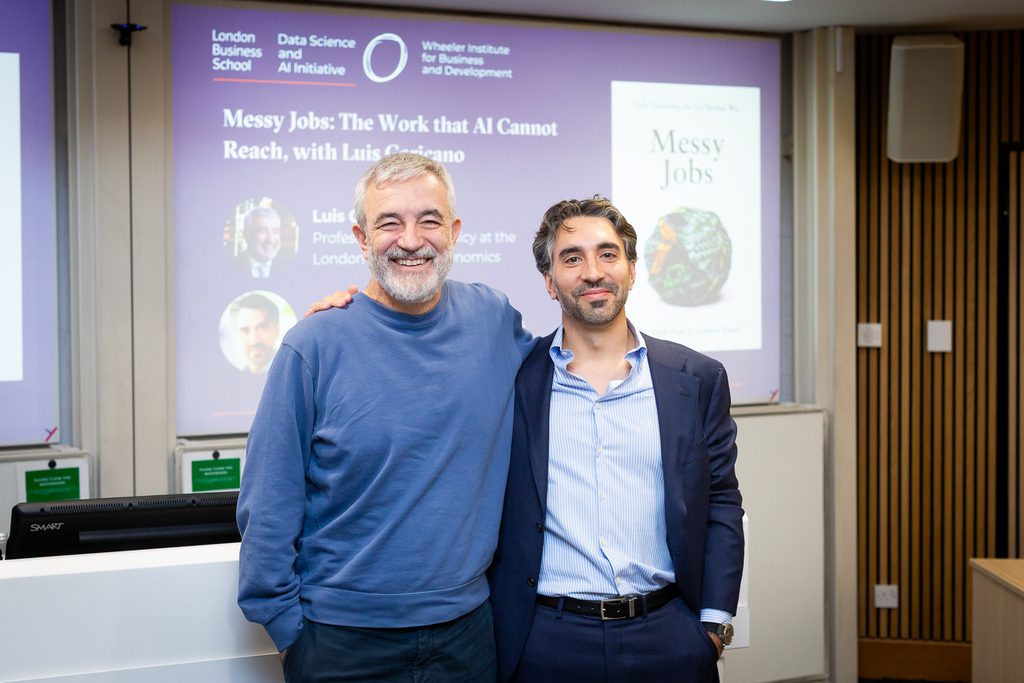
A conversation between Luis Garicano, Professor of Public Policy at the London School of Economics and Joseba Martinez, Assistant Professor of Economics at London Business School. The event was a collaboration between the Data Science & AI Initiative and the Wheeler Institute for Business and Development at London Business School.
In July 2025, Sam Altman, CEO of OpenAI, took the stage at a Federal Reserve conference in Washington and told a room of bankers and regulators that some jobs would simply disappear. Customer service, he said, would soon be “totally, totally gone”. More than a year later, those jobs are largely still there, and by this summer Altman was admitting on a podcast that the transformation was moving more slowly than he had expected, because “the economy just has so much inertia”.[1]
Altman is not alone among AI CEOs in forecasting very pessimistic outcomes for workers as AI diffuses through the world economy. It was with statements like his that Joseba Martinez, Assistant Professor of Economics at London Business School, opened his conversation with Luis Garicano, Professor of Public Policy at the London School of Economics and a former Member of the European Parliament at an event at London Business School. Those statements, Garicano explained, were what had prompted him to write Messy Jobs: The Work that AI Cannot Reach with Jin Li and Yanhui Wu of the University of Hong Kong. The people building AI, he argued, know an awful lot about the technology and not nearly enough about what people actually do at work.
The Gantt chart fallacy
Garicano starts with the project manager. In Silicon Valley’s imagination, he said, this is someone who stares at a Gantt chart and moves the bars along. In practice, the job looks more like a building site. The electrician is off sick, and the carpenter can’t come later and doesn’t want to. Most of the work is absorbing that friction.
Then he moved closer to home. Imagine a perfect AI agent. You wake to find it has rebooked your holiday at a better, cheaper hotel and fixed the dentist appointment you keep putting off. Then your youngest announces they are not going swimming today. Now you are in a management job. Why do they not want to go? Is it the water, the teacher, or a friend? Do you push or listen? The agent can find you a time slot, however it cannot decide what kind of parent to be that morning.
Clean tasks and strong bundles
AI’s great successes, Garicano argued, have come in work that is clean, single-task and verifiable. AlphaGo, built within blocks from LBS, learned by playing millions of games against itself, each ending in a clear win or loss. Chess, coding and theorem proving are similar, because the game is won or lost, the code runs or it doesn’t, and the proof holds or it fails.
Most jobs are not one task but a bundle of them, and the question is how tightly the bundle holds. In a weak bundle, AI takes over the clean tasks and leaves a shell of a job that far more people can do, which pushes wages down. In a strong bundle, the tasks cannot be separated, and the person doing them is still needed.
Garicano identifies three things that hold a bundle together, and the first is liability. In 2016 Geoffrey Hinton suggested that we stop training radiologists, since spotting a tumour is a yes-or-no judgment a machine can learn. Radiologists are still in demand because reading the scan was only ever part of the job. They also sign the diagnosis, break the news to patients, agree the treatment with other doctors, and carry the responsibility if they get it wrong.
The second is synergy. Garicano described a team of consultants redesigning an airline’s frequent flyer programme, where the model came together quickly, however implementation took six months. Most of that time went towards negotiating with a marketing department anxious about the brand, a customer support team bracing for thousands of furious flyers who had lost their lounge access, and a finance team managing the savings. The analysis and the negotiation could not be split, because every discussion required a deep understanding of the model.
The third is relational knowledge, and here Garicano drew on his years in politics, which he called the messiest job of all. Very little happens in the council chamber, he said, because decisions get made in the corridor outside, when one minister quietly lets another know that pushing a measure through will not be forgotten. No record of that conversation exists, so no AI can learn from it.
Cheaper, and so more
Martinez asked: if AI makes the analysis cheaper, won’t firms need fewer consultants? And won’t the next models handle the mess too? On the first, Garicano reached for the Jevons paradox. When steam engines began using coal more efficiently, Britain burned more of it rather than less, because cheaper power made all sorts of new uses worthwhile. Coding may follow the same path, since if a program that once took a month can be written in a day, a great deal of work that was never worth automating suddenly becomes worth doing, and demand for software engineers could rise. This only holds when demand can keep growing, however. As light became vastly cheaper over the past two centuries, people did not want proportionally more of it, and lighting shrank from a real share of the economy to a sliver.
On the second, he was careful not to underestimate the technology. The book assumes that an AI agent will be able to book the holiday and hire the nanny, and argues only that someone must still own the decision and manage the relationships around it. He referenced his own personal trainer, who he still pays even though an app could tell him which exercises to do, because without the trainer he simply would not go.
Take the mess
For the students in the audience, Garicano’s advice was to take the messiest version of any job on offer. A logistics role spent entering data might last six months, he suggested, and one spent taking calls from clients perhaps a year. A role that involves taking an overseas supplier to dinner, and knowing both what they supply and who they are, is far harder to replace.
He also warned that when every cover letter has been polished by the same tools, recruiters fall back on what cannot be faked, such as grades earned in the exam hall or references from coworkers. Entry-level jobs are slowing, not disappearing, but the currency juniors once used to pay for their training (slides, spreadsheets and first drafts) is losing its value. Graduates will need to arrive with judgment and relationships to offer, and with the analytical basics firmly in hand. AI will happily produce two hundred pages, and the graduate’s value lies in judging which single page matters.
Attention is all you need
Garicano finished not with a skill but with a resource. The 2017 paper that introduced the technology behind today’s AI models was titled “Attention Is All You Need”, and attention, he said, is all humans need too. As AI covers for us, it becomes tempting to skim the book or prepare the presentation with one eye elsewhere. That may pass unnoticed the first time, but it rarely does for long. A client can tell when you are distracted, and so can your mother when you take a second too long to answer.
This may be the book’s most hopeful idea. The prophets of the job apocalypse imagined work as a set of clean problems. Garicano’s reply is that work, like life, is a tangle of people: the electrician who is off sick, the child who won’t swim, the minister in the corridor, the colleague who needs a phone call rather than an email. The more the machines take on, the more the value of the job flows toward that tangle, and toward whoever is paying attention to it.
[1] Quoted in John Cassidy, “Has the A.I. Job Apocalypse Been Postponed?”, The New Yorker, 7 September 2026.
About the speaker

Luis Garicano is Professor of Public Policy at the London School of Economics. Former Member of the European Parliament (2019–2022), his research focuses on the acquisition and transmission of knowledge in organizations, and on how technology reshapes the value of expertise in the economy. He has previously held faculty positions at the University of Chicago Booth School of Business and IE Business School, and visiting appointments at MIT, Columbia Business School and London Business School. He holds a PhD from the University of Chicago.
About the moderator

Joseba Martinez is Assistant Professor of Economics at London Business School. He is a macro- and financial economist whose research interests include the effect of automation on productivity, economic growth, and income distribution, and whose work on the design of banking system stress-tests has been published in the Review of Economic Studies. Before his PhD, he worked as a trader at ABN AMRO London and as a senior manager at the European Bank for Reconstruction and Development. He holds a BSc from University College London, an MSc from LSE, and a PhD from New York University.
About the writer

Anna Sutton is an MBA 2027 candidate at London Business School and an Outreach Intern at the Wheeler Institute for Business and Development. Prior to LBS, she worked at Boston Consulting Group in Australia as a Senior Associate, working with organisations across the public, private, and non-profit sectors.
Anna is interested in how technological innovation, public policy, and business strategy interact to support sustainable long-run growth and inclusive economic outcomes.