For decades, the U.S. dollar has served as the undisputed anchor of the global financial system – the primary currency for international trade, global assets, and central bank reserves. But as the world enters an era of increasing fragmentation, is that dominance under threat?
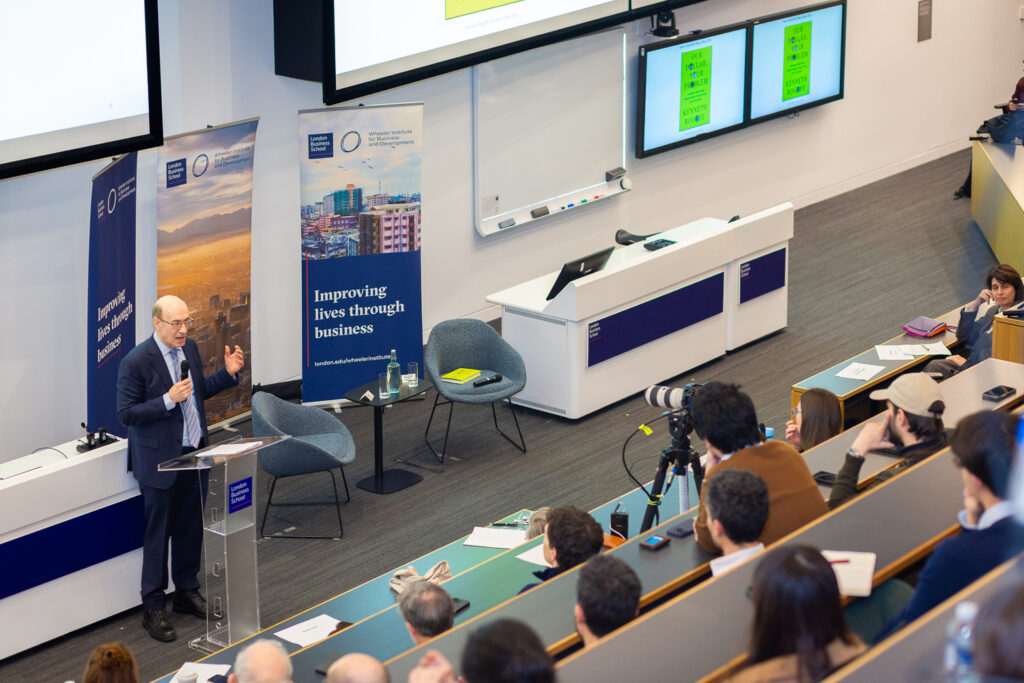
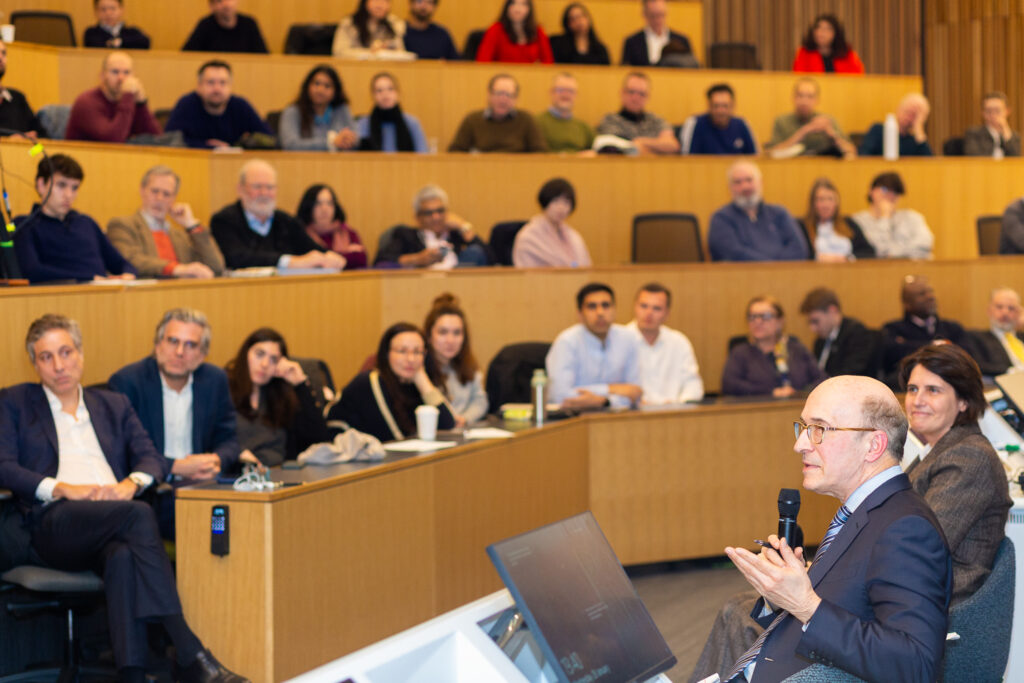
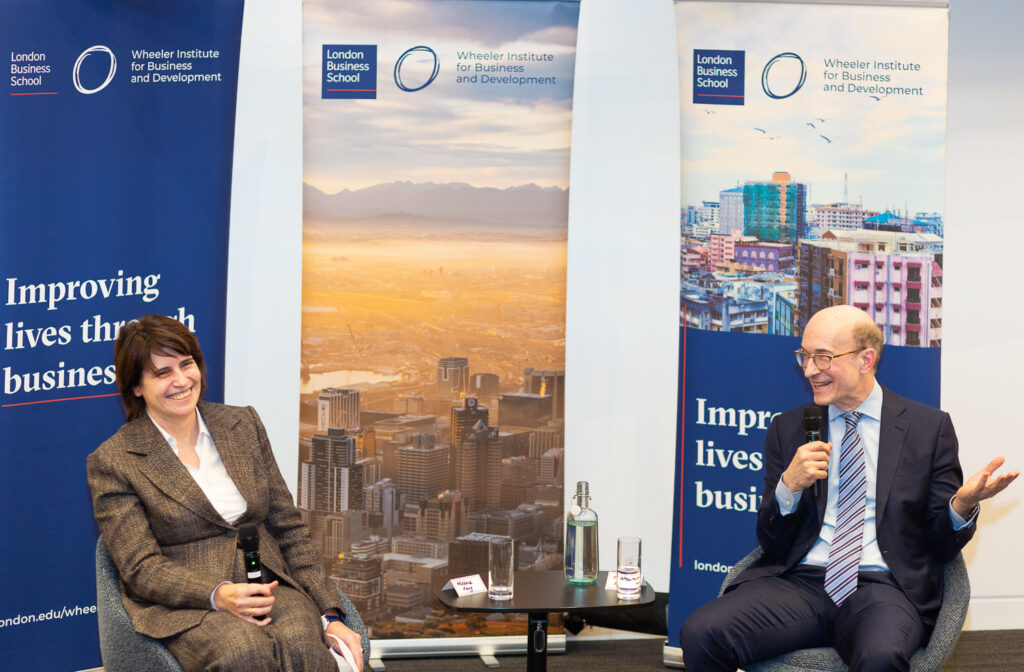
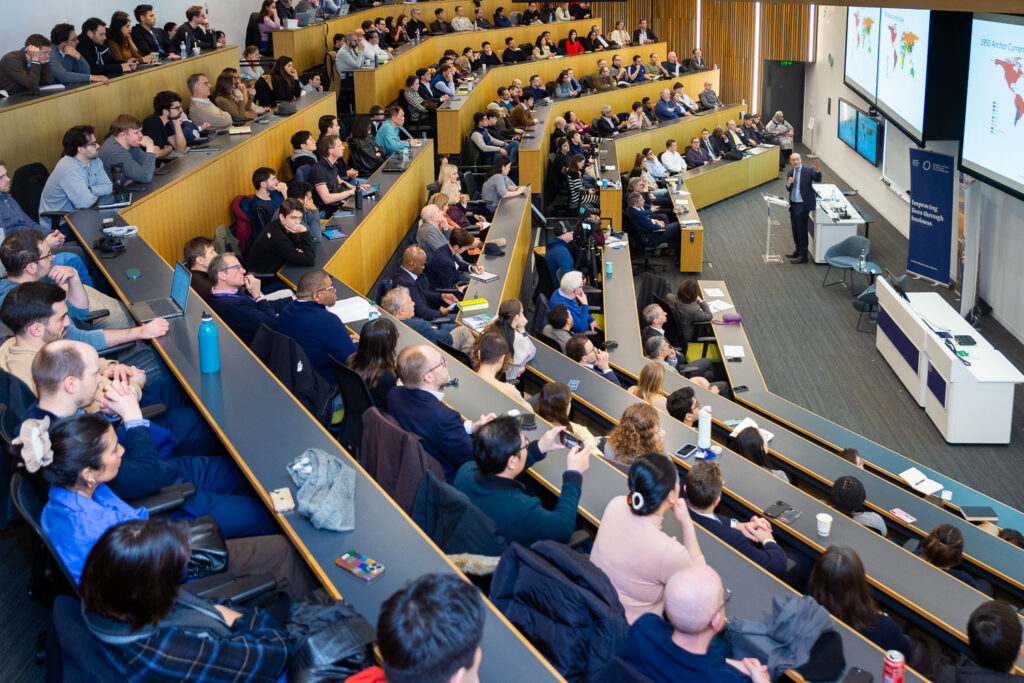
At a recent Wheeler Institute event, Kenneth Rogoff, Maurits C. Boas Chair of International Economics at Harvard University, sat down with Hélène Rey, Lord Bagri Professor of Economics at London Business School, to discuss the themes of his new book, Our Dollar, Your Problem: An Insider’s View of Seven Turbulent Decades of Global Finance, and the Road Ahead. The title itself reflects a famous 1971 exchange where the then-U.S. Treasury Secretary John Connally told a group of frustrated international finance ministers, “The dollar is our currency, but it’s your problem”.
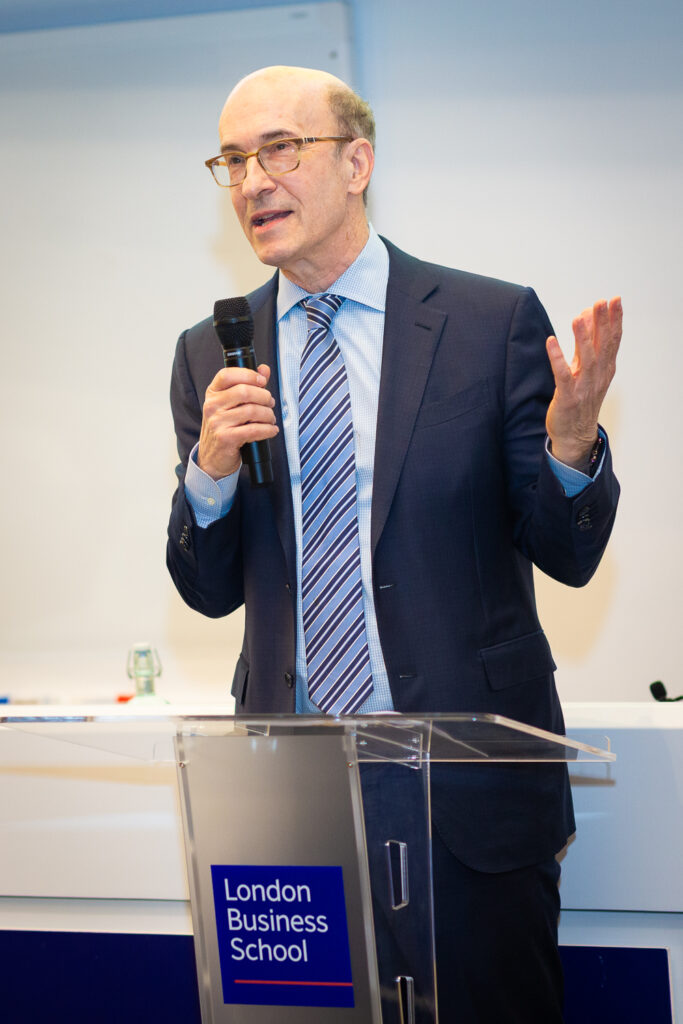
Following opening remarks by Elias Papaioannou, Professor of Economics, Alex Knaster Chair in Economics at LBS and Co-Academic Director of the Wheeler Institute for Business and Development, Kenneth Rogoff opened the evening by setting out the core pillars of his book. He began with a historical overview that framed the broader discussion with Hélène Rey exploring the past, present, and the future of the almighty dollar.
A Grandmaster’s Gambit: Looking Back to the Future
An international chess grandmaster, Rogoff, approached the discussion with the strategic foresight that has defined his career as a policymaker and academic. He seamlessly walked the audience through the arc of global finance, beginning with the post-war era, when the dollar’s rise reflected not only sound policy, but also a measure of historical good fortune. From there, the discussion moved to the period of peak dollar dominance and its subsequent gradual decline, pointing toward a more multipolar endgame ahead in which the United States can no longer dictate the rules of the board with the same unilateral authority it once enjoyed.
Dollar Dominance: The Privilege and the Peak
Historically, the U.S. has enjoyed an exorbitant privilege: the ability to borrow at low rates, while investing globally in high-return projects. Rogoff illustrated this with a personal story about his great aunt, who used the dollar’s strength to launch a successful luxury shoe production in Italy – an investment made possible because the dollar sat at the centre of the world.
History, however, is filled with examples of the ‘would-be’ challengers. The Soviet Union, Japan, and later the Eurozone were all, at different times, expected to rival the dollar. Japan’s ascent in the 1980s was especially striking: at its peak, the total value of Japanese real estate exceeded that of the entire United States, despite the country being smaller than California. Each contender ultimately stumbled, undone by structural weaknesses, policy missteps, or financial crises of their own.
While the U.S. share of global GDP has remained surprisingly resilient, sitting at roughly 25% today, Rogoff identifies 2015 as the “peak of dollar dominance”. In the decade since, he notes a “gentle decline,” one that points toward a more multipolar monetary system, with the dollar still on top, but no longer standing alone.
The Euro: A Missed Opportunity
The Euro was once seen as the most formidable threat to the dollar. Two decades ago, it was widely believed that the Euro would eventually pull up to the dollar’s level of dominance. Rogoff noted that at one point, there was even more European debt than American debt on the global market.
However, the Euro’s trajectory was hampered by internal challenges. Rogoff suggested that admitting certain countries into the Eurozone prematurely made subsequent crises much harder to manage, ultimately stalling the currency’s rise as a global rival to the dollar.

China: The Housing Conundrum
One of Rogoff’s most contrarian views over the past decade concerns China. While many saw its economic ascent as unshakeable, he had warned early on that the country was building up dangerous imbalances, particularly in housing.
Chinese households hold a staggering 80% of their wealth in real estate, compared to a far more balanced split between housing and equities in the United States. By painstakingly reconstructing block-by-block data, even as key indicators remained state secrets, Rogoff and his collaborators found that per‑capita housing stock in China exceeds that of much wealthier economies.
As property prices in China have begun to fall, those vulnerabilities are now fully exposed, and the country faces an internal crisis. Rogoff argues that this growth model, historically driven by infrastructure and housing, is fundamentally broken, making the Renminbi an unlikely immediate successor to the dollar.
The Digital Underground: Cryptocurrency and Shadow Banking
Rogoff identifies cryptocurrencies and digital assets as potential legitimate competitors, but specifically within the “underground economy” – an area traditionally dominated by the U.S. dollar, particularly by large‑denomination banknotes. This shadow economy, fueled by regulatory and tax avoidance, is enormous and increasingly conducted through digital channels operating outside regulated financial intermediaries.
He shared a striking story of a ‘Bitcoin shop’ in Lebanon during its financial crisis. While traditional banks were shut, this shop was processing transactions for hundreds of thousands of dollars in cash using Bitcoin. As the U.S. increasingly uses the dollar to invoke sanctions, it inadvertently drives the world toward these digital, non-state alternatives that can bypass the traditional system.
Vulnerabilities from Within: The U.S. Debt Reckoning
Rogoff noted that perhaps the greatest threat to the dollar doesn’t come from an external force, but from Washington itself. Today, the U.S. has more public debt outstanding than all other advanced economies combined. Rogoff pointed to an often-forgotten episode from the 1930s, when Franklin D. Roosevelt raised the price of gold from $20 to $35 an ounce, effectively devaluing the dollar and eroding the real value of U.S. debt. This serves as a reminder that when the pressure becomes too great, even the “undisputed king” can change the rules to survive.
For years, many argued that high debt was manageable because interest rates were near zero. Rogoff, drawing on eight centuries of data from his classic work This Time is Different, warned that interest rates stay low – until they don’t. As real interest rates normalise, the world’s largest debtor faces a major reckoning that could undermine the very institutional credibility the dollar relies on.
Conclusion: King of a Smaller Hill
Rogoff’s message was not one of imminent collapse. The dollar, he suggested, is likely to remain the world’s leading currency but “king of a smaller hill”. The future points toward a more fragmented, multipolar system, in which other currencies, including digital currencies, each command greater space.
Looking ahead, the U.S. can no longer take the dollar’s supremacy for granted. The “gentle decline” of the last decade may mark the beginning of a broader shift. In a world of fragmenting interests, while the dollar remains the world’s currency, sustaining its authority is increasingly everyone’s problem.
About the speaker

Kenneth Rogoff is the Maurits C. Boas Professor of International Economics at Harvard University and one of the world’s most influential macroeconomists. A former Chief Economist of the International Monetary Fund, he has played a central role in advancing understanding of financial crises, sovereign debt, exchange rates and global capital markets. His bestselling book This Time Is Different: Eight Centuries of Financial Folly (with Carmen Reinhart) remains a landmark in the study of economic history, and his graduate text Foundations of International Macroeconomics is a defining reference for researchers and policymakers. Rogoff is an elected member of the National Academy of Sciences and the American Academy of Arts and Sciences. He has long ranked among the top dozen most cited economists and is an international grandmaster of chess.
About the moderator

Hélène Rey is the Lord Bagri Professor of Economics at London Business School. Until 2007, she was at Princeton University, as Professor of Economics and International Affairs. Her research focuses on the determinants and consequences of external trade and financial imbalances, the theory and empirics of financial crises and the organization of the international monetary system. She was elected President of the European Economic Association in 2022. Rey is an elected Fellow of the British Academy, of the Econometric Society, of the European Economic Association, of the American Academy of Arts and Sciences, a Foreign Honorary Member of the American Economic Association, a correspondent of the Académie des Sciences Morales et Politiques. She was made O.B.E for services to Economics.
About the writer

Shivam Jain is a MiF 2026 candidate at London Business School and a Research Intern at the Wheeler Institute for Business and Development. Before joining London Business School, he was an Investment Specialist at Mercer, where he advised pension funds and endowments on global asset allocation and investment strategy. Shivam is focused on how channelling capital through innovation and policy design generates investment opportunities for sustainable growth. He is particularly interested in how capital allocation and incentive drivers can be used to support long-term economic development in emerging markets.