
Over the centuries, innovation has transformed our way of life, giving rise to ideas and technologies that have significantly improved societal wellbeing. At the heart of these breakthroughs are pioneers such as Thomas Edison, inventor of the light bulb; Malvin De Groote, known for discovering a chemical composition for chocolate ice cream; and Nikola Tesla, who invented alternating current.
While these innovations are widely celebrated, far less attention is given to the taxation policies that may have influenced them. What role does taxation play in driving innovation? And how do perceptions differ from reality when we consider the relationship between public policy and innovation?
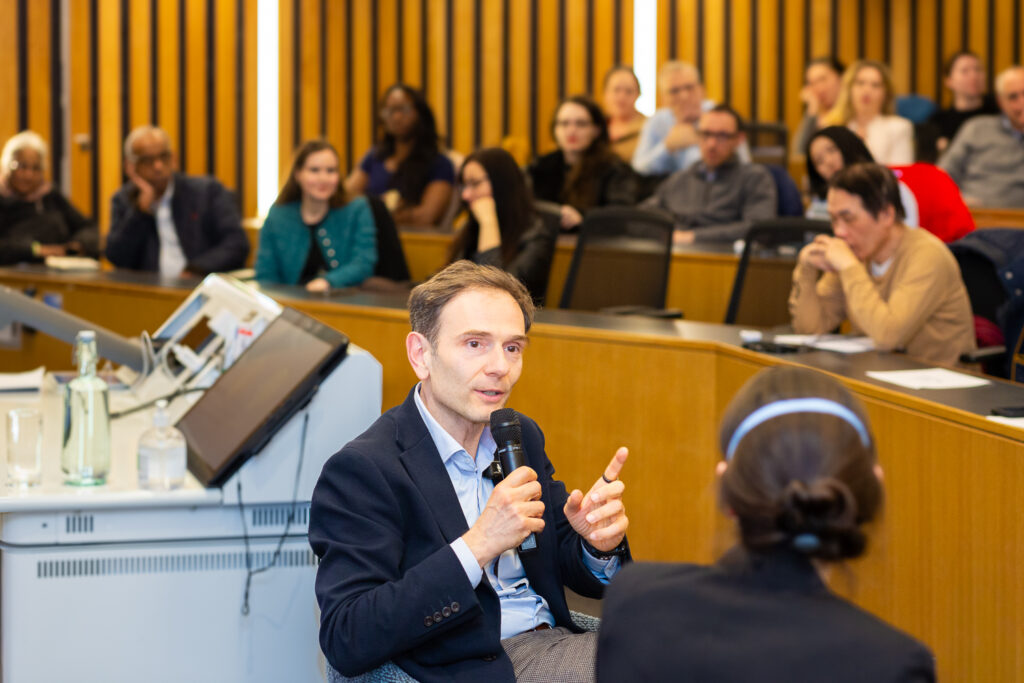
The Wheeler Institute for Business and Development recently hosted an insightful conversation with Stefanie Stantcheva, Nathaniel Ropes Professor of Political Economy at Harvard University, to explore the economics of taxation and innovation from individual, corporate, and governmental perspectives.
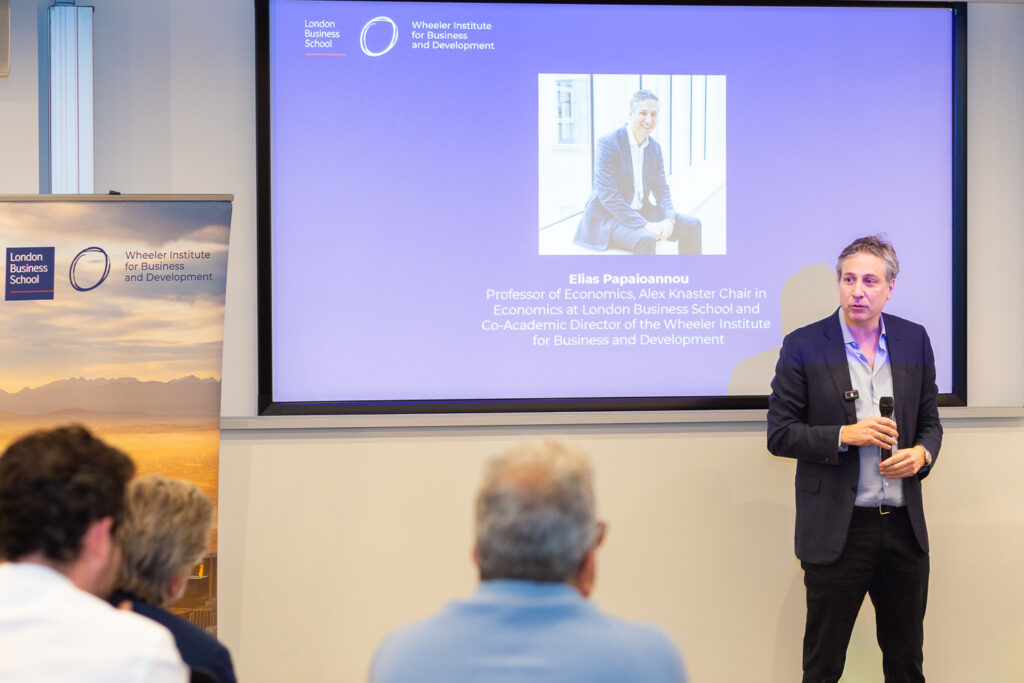
The event was moderated by Paolo Surico, Professor of Economics at London Business School and opened by Elias Papaioannou, Professor of Economics, Alex Knaster Chair in Economics and Co-Academic Director of the Wheeler Institute. It marked the second event of the ongoing series Public Policy in the Age of Innovation, a series led by Paolo Surico.




Who Drives Innovation? Individual vs Corporate Power
Stefanie distinguished between two broad categories of innovators: individual and corporate entities, which differ in productivity, team quality, skill levels, and life cycles. Regardless of the channel through which innovation occurs, tax policies are applied either as general taxes such as personal and corporate income taxes or as targeted measures specifically designed to promote innovation. These targeted policies include instruments such as education subsidies, R&D tax credits, start-up incentives, and location-based corporate subsidies.
Against this backdrop, she highlighted that empirical evidence has demonstrated that most modern innovation, approximately 92% to 95%, originates from companies and corporations rather than individuals. She further noted that US tax data reveals a strong linear relationship between innovation and income: top 1% of inventors earn about $2.28 million, while those in the top 5% earn $883,990.00 per citation.
Tax Policies, Mobility and Tax Simplicity
Despite the inherent challenges in measuring innovation, particularly across different geographies and time periods, Stefanie’s research identifies three key findings:
- Taxation significantly influences the quantity of patents per inventor (intensive margin) and the locations where inventors choose to work (extensive margin). However, the negative effects are lessened in areas where tax revenues are perceived to be effectively reinvested in societal development. This conclusion is based on a panel dataset of U.S. inventors dating back to 1920, combined with historical state-level tax data.
- Individuals in the “superstar” top 1% of inventors, as well as those who work for multinationals firms,are more likely to respond to locational tax differentials by relocating to more tax-favorable countries or states for innovation. In contrast, individuals employed by companies with more localized research activities tend to be less sensitive to taxation.
- In considering tax simplicity using France as a case study, evidence suggests that people value simplified regimes enough to accept additional costs of up to 10-20% of their total revenue. France has experimented with three regimes (standard, simplified, and super-simplified), with eligibility determined by activity-specific revenue thresholds. While simplicity is highly valued, some individuals attempt to remain within simplified regimes by underreporting or adjusting revenue. However, the overall revenue loss from such behavior among small businesses is relatively minimal.
Tax Policy Effects on Inventor Migration
In addressing trends surrounding talent migration, Stantcheva established that international migration often arises as a response to pressures such as high taxes, but its impact depends on what taxes are spent on. For instance, California has sustained high taxes, but retained good innovative talent due to excellent infrastructure and amenities that serve as incentives for these inventors. Creating stronger career and social incentives through innovative hubs and supportive environments further motivates talent to stay.
She further posited that, rather than relying on blunt tools such as general taxes and patent boxes, it is crucial to implement more targeted, upstream policies that foster innovation and encourage inventors to remain. These policies must be applied cautiously to avoid subsidising R&D projects that would have occurred regardless.
Corporate Innovation and Tax Trade-offs
How do we view the inter-play between firms and the government in response to tax policies?
When states adjust taxes, companies often respond by relocating to other jurisdictions rather than creating new firms or innovators locally. Such shifts in resources generally do not generate substantive benefits despite the personal gains that individuals derive from innovation. This “beggar-thy-neighbor” dynamic highlights the need for minimum or floor taxes in home countries to prevent counterproductive competition. It further necessitates the integration of tax regulatory standards and policies across Europe, in deriving optimal results from innovation.
In the United States, taxpayers can be linked to patents and inventions, showing that inventors not only start businesses but also capture significant income through wages, capital, and business income. Holding a patent can yield returns of 40–50%, illustrating that innovation is both socially valuable and highly rewarding for the individuals who drive it but may not contribute much to home countries depending on tax systems in place.
Measuring and Protecting Innovation in the AI age
The emergence of AI has challenged traditional measures of innovation, such as patents and citations. In the last decade, software has been increasingly difficult to protect via patents, calling for alternative ways of measuring innovation for digital products. Citations have been a proven efficient and fair method of measuring innovation, due to the ripple effects created when subsequent users reference the impactful results of others. While this creates value, Stefanie emphasized the need to move beyond zero-sum thinking and redistribute the gains from innovation to ensure a wide societal impact.
It was further identified that the shift of talent from academia to the private sector in promoting AI innovations has raised critical concerns about losing an important springboard for fundamental research. Since the private sector has more incentive to conduct applied research than fundamental research, it leaves a gap for universities, governments and gigantic firms that have widespread influences to expand basic research labs for innovations stemming from solidified theoretical foundations.
The Way Forward
Ultimately, effective tax policy should move beyond simply raising revenue to actively shaping innovation ecosystems. This requires a careful balance: rewarding past firm-driven innovation successes, expanding access to capital for emerging startups, and fostering environments where innovative ecosystems can thrive.
We need to recognise that when people move to environments with more innovative people, they become better, and in turn, amplify their influences across the broader society.
About the speaker

Stefanie Stantcheva is the Nathaniel Ropes Professor of Political Economy at Harvard University and the Founder and Director of the Social Economics Lab. Her research focuses on public economics and political economy, with particular emphasis on taxation, redistribution, innovation, and social preferences. She is widely recognised for pioneering the use of large-scale survey methods combined with rigorous economic analysis to study how individuals perceive public policies and how these perceptions shape economic behaviour and political outcomes. Herwork is published in leading academic journals and has made influential contributions to debates on tax design, inequality, innovation policy, and the political economy of reform. She has received numerous academic awards and recognitions for her research, and her work is frequently cited in discussions on the design of effective and equitable public policy. In addition to her academic career, she is actively engaged in policy dialogue with governments and international organisations, contributing to evidence-based discussions on fiscal policy, innovation, and institutional design in both advanced economies and emerging markets.
About the moderator

Paolo Surico is Professor of Economics at London Business School. His research focuses on public policies for innovation, including public R&D, government-funded and defence-related innovation, and the role of corporate taxation in shaping firms’ innovative activity and economic performance. He has also made influential contributions to research on monetary policy, inequality, and the redistributive effects of interest rate changes and quantitative easing. His work is widely published in leading academic journals and is characterised by rigorous empirical analysis and strong policy relevance. He has extensive experience advising policymakers, including consultancy for the European Commission and the European Central Bank, and past advisory roles with the Bank of England and the Financial Conduct Authority. His research has influenced the conduct of monetary policy and the design of fiscal policy across Europe.
About the writer

Woraba Dansua Abban, MAM2026 is a Research and Outreach Intern at the Wheeler Institute for Business and Development. She holds a BSc Business Administration from Ashesi University and has worked as an Associate Consultant at Deloitte and Touche (Accra), where she assisted clients in resolving their governance and risk management needs across diverse industries. Woraba aspires to bring lasting change to Africa’s developmental challenges through her passion for the international development industry.
About the series
Public Policy in the Age of Innovation is a Wheeler Institute limited series, led by Paolo Surico, Professor of Economics at LBS. In a series of three events, Paolo will explore in conversation how innovation, public policy, and institutions can adapt to the economic, technological, and social challenges of our time. Each conversation will invite leading scholars and policymakers – Philippe Aghion, 2025 Nobel Laureate in Economic Sciences was the first guest of the series.