
If you were asked where people borrow from for their daily consumption needs, credit cards from mega-banks seem the obvious answer. However, across the developing world where brick-and-mortar banks are often inaccessible, individuals resort to local alternatives: ‘Kiranas’ or small grocery stores. No credit scores. No collateral. No paperwork. Just a shopkeeper’s quick judgment call, about whether to let a customer walk out with goods and pay later.
At a recent webinar organised by the Private Sector Development Research Network (PSDRN) and hosted by the Wheeler Institute for Business and Development, Alp Sungu, Assistant Professor at the Wharton School of the University of Pennsylvania and London Business School PhD alumnus, presented research that illuminates one of the most pervasive yet least understood financial arrangements in the developing world – store credit. The session was introduced and moderated by Tiago Martinho, Executive Director of the Wheeler Institute.
The paper, Between Trust and Trade: Informal Credit Networks in India, is Alp Sungu’s joint work with Layane Alhorr and Kartik Srivastava, both formerly PhD students at Harvard University. What makes this research distinctive is not only what it reveals about informal lending, but how it was made possible: the authors built an entire data collection infrastructure to observe a phenomenon that had long resisted systematic study. The findings challenge the assumptions about how credit works when formal finance is limited – and who it leaves behind.
The Shadow Ledger: Bigger Than Banks, Built on Trust
Sungu opened by drawing the audience’s attention to India’s national household survey data, which show that credit from shops surpasses borrowing from banks, self-help groups, friends, relatives, and moneylenders – in sheer headcount. Add every other source together, and these stores still reach more people. Yet the phenomenon is hard to study because these transactions are informal, personal, and frequently unrecorded – scribbled on notebooks and scraps of paper, or simply remembered. When the research team surveyed roughly 200 store owners across India, only about half maintained any written records at all.
To study this remarkably data-invisible ecosystem, the team built the data collection infrastructure from scratch. They partnered with 26 neighbourhood grocery stores in a low-income settlement in Mumbai – a community where the average income is roughly $0.75 per day and where the population is primarily migrant workers. A full-time research assistant was placed inside each store and was given a handheld scanner to scan purchases by consenting customers. The result was an unprecedented dataset: transaction-level records for over 750,000 transactions across 12,000+ customers, capturing products, prices, timestamps, and whether each purchase was made on credit or in cash.
Credit as the Currency of Loyalty
For an average store, only about 12% of customers receive store credit in a given month, but those borrowers generate over 30% of total store revenue, and 78% of them shop exclusively at the disbursing store. In a marketplace where price, product, and promotion are effectively identical, credit is how stores can differentiate themselves and carve out their customer base. This might explain why owners engage in the practice despite its costs: indeed, owners report spending around eight hours per week tracking and enforcing repayment.
The Hidden Bias: Who Gets the Credit?
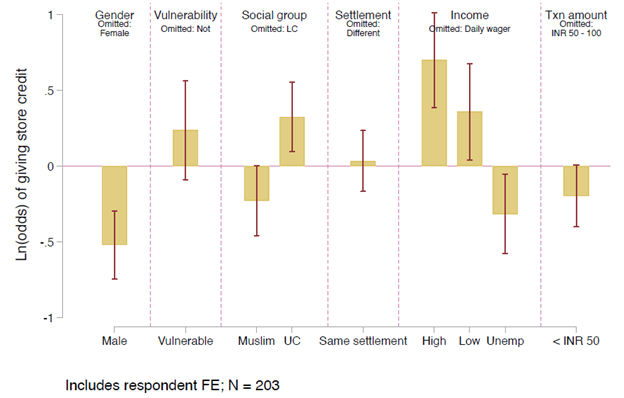
Given limited access to formal credit through banks, store credit may have important consequences on individuals’ ability to afford their daily needs. To understand the determinants of store credit disbursement, the authors set up a conjoint experiment with 203 store owners. Each owner was shown two hypothetical customer profiles – say, both Muslim, both living in the same neighbourhood, both holding a municipal pension, both buying goods worth about ₹50 – identical in every respect except one randomly varied attribute, such as gender, income, or caste. The owner then chose which customer to extend credit to.
Source: Between Trust and Trade: Informal Credit Networks in India Paper
Owners preferred women, higher-income customers, and larger spenders, consistent with repayment risk. But they also systematically favoured customers from socially privileged groups. Upper-caste customers were significantly more likely to receive credit, while Muslim customers faced the steepest disadvantage – even after accounting for observable economic characteristics that may impact their repayment profile. The transaction data confirmed this at scale: shared religion between customer and owner raised the probability of credit by 42%, operating symmetrically across Hindu and Muslim store owners alike.
One Subsidised Loan Changes Everything
The centrepiece of the research was a randomised field experiment at checkout. Over 12 weeks, customers were assigned to three arms: business as usual, a price discount (rounded down to the nearest five rupees), or store credit of up to 100 rupees, with the research team underwriting the first loan. The two interventions were designed to impose roughly comparable costs on the store, isolating the relational effect of credit from the mere financial transfer.
Credit-treated customers were more likely to return, lifting the revisit rate from roughly 74% to 92%. Discounts, on the other hand, moved it by just 4%. But the most remarkable finding lay one step further: the study only subsidised the first loan. When credit-treated customers returned and repaid, store owners began extending credit from their own funds – the probability of a subsequent owner-funded loan jumped from about 17% to roughly 70%. Total customer spending rose by approximately 20%, driven entirely by loan-financed purchases.
The study results revealed that extending credit to a first-time visitor effectively transformed them into the economic equivalent of a long-standing regular. And the natural worry that randomly assigned borrowers might be riskier? They were not. Default rates among treated customers were no worse than among borrowers the store owner had chosen independently, and treated borrowers actually repaid about 3.5 days faster.
Breaking Through the Trust and Social Barriers
Perhaps the most policy-relevant finding concerned what happened across social lines. Credit increased future visits, lending, and spending equally for co-religious and non-co-religious customers. A structural model formalised the mechanism: in the control condition, store owners’ implied trust threshold sat at roughly the 82nd percentile of their beliefs about creditworthiness. A single subsidised loan, followed by observed repayment, shifted that threshold downward by 55%.
The effects went beyond shopping habits. Treated households borrowed less from friends and family, consolidated their spending at a single trusted store, and, most strikingly, were less likely to skip meals or go without medicine. A single subsidised loan had quietly expanded their financial safety net. Not through a bank. Not through a government scheme. But through a neighbourhood shop owner who simply said: Pay me later.
Seed Capital for Trust and Inclusion
The authors’ conclusion carries a clear policy implication. A temporary, low-cost subsidy – underwriting just the first loan – can shatter the trust barrier, trigger learning, and set in motion a self-sustaining lending relationship that persists long after the intervention ends. The cost for subsidy is minimal, while the returns, measured in credit access, consumption stability, and financial inclusion, compound on their own. Financial systems in much of the world are built not on regulation and infrastructure, but on relationships – and those relationships carry both the promise of inclusion and the risk of exclusion within them.
The recording of the webinar is available here at the PSDRN website.
Sources:
Webinar link: https://www.psdresearchnetwork.com/aw-event/between-trust-and-trade/
Working Paper: https://papers.ssrn.com/sol3/papers.cfm?abstract_id=5392415
About the speaker

Alp Sungu is an Assistant Professor in the Operations, Information & Decisions Department at the Wharton School of the University of Pennsylvania. His research focuses on the economic and social impacts of digital technologies, artificial intelligence, and information environments, using large-scale field experiments and empirical methods to study learning, consumer behaviour, and development outcomes. His work has been published in leading journals including PNAS, Management Science, Production and Operations Management, and the Review of Industrial Organization. Prior to joining Wharton, he earned his PhD in Management Science and Operations from London Business School. He is also a Research Fellow at the IZA Institute of Labor Economics and co-founder of Datum Works, an organisation focused on implementing large-scale field experiments in emerging markets.
About the writer

Shivam Jain is a MiFFT 2026 candidate at London Business School and a Research Intern at the Wheeler Institute for Business and Development. Before joining London Business School, he was an Investment Specialist at Mercer, where he advised pension funds and endowments on global asset allocation and investment strategy. Shivam is focused on how channelling capital through innovation and policy design generates investment opportunities for sustainable growth. He is particularly interested in how capital allocation and incentive drivers can be used to support long-term economic development in emerging markets.
About the PSDRN
The Private Sector Development Research Network is a community of institutions with an active research agenda on Private Sector Development. The PSD Research Network is a collaboration between the Wheeler Institute, British International Investment (BII), Centre for Global Development (CGD), European Bank for Reconstruction and Development (EBRD), IDB Invest, International Finance Corporation, International Growth Centre (IGC), Think Tank ODI, Islamic Corporation for Development of the Private Sector (ICD) and the African Development Bank (AfDB), which aims to promote the exchange of ideas and facilitate collaboration.
AnyaSharma