
I was catching a sunset at a boutique hotel on Sri Lanka’s southern coast, sipping rosé on a terrace done up in the cutest pink and terracotta. The Sri Lankan staff were lovely. The drinks were cold. And the aesthetic was impeccable. Then the owner came out to greet guests: a British expatriate, or immigrant, depending on which direction you believe that distinction travels. Every person serving was Sri Lankan. The person who owned the place was not. Nobody remarked on this. Nobody needed to. The moral dissonance was immediately, quietly, obvious.
I have travelled to over twenty countries in the past decade and have enjoyed nearly all of it enormously. Travel, at its best, is precisely what Tony and Maureen Wheeler have always described it as: a force for connection, empathy, and the kind of mutual understanding that no textbook can replicate. The Wheelers built Lonely Planet from the conviction that showing up in unfamiliar places, with curiosity and humility, makes both the traveller and the host richer for it. When Maureen observed that she and Tony had “witnessed the impact, both positive and negative, that business has on our world’s most vulnerable communities,” she was identifying the precise tension this piece seeks to explore.
The pattern repeats across very different places: foreign capital arrives, builds a self-contained enclave that imports its own food, prices, and clientele, and turns the host country into little more than scenery and staff. The location is consumed; the value is exported. What looks like development is often just a more comfortable form of extraction.

The Case for Tourism
Tourism has become one of the largest categories of international trade and a leading income source for many developing economies (UN Tourism, 2025). In Jamaica, tourism remains a cornerstone of the economy, with the Ministry of Tourism projecting US$4.6 billion in tourism revenues and 4.3 million visitor arrivals in 2025 (Jamaica Information Service, 2025). In Tanzania, it generates 17% of GDP (World Bank, 2024) . Tourism creates jobs, funds livelihoods, and brings investment into regions that might otherwise remain economically peripheral. COVID made the counterfactual involuntary, and nobody enjoyed the results.
The question is not whether tourism creates value: it plainly does. The question is who captures that value.
Jamaica: The Enclave Economy
“Tourism leakage” describes visitor spending that exits the host economy before it can circulate locally: through foreign-owned airlines, imported goods, offshore hotel companies, and repatriated profits. Across the Caribbean, leakage is estimated at approximately 80%. For every $100 a tourist spends, roughly $20 stays (United Nations, 2022).
The all-inclusive resort model is the clearest expression of this. When Montego Bay Airport (now Sangster International) opened in 1947, initially used almost exclusively by affluent North Americans, Jamaica’s economy was already shaped by a century of foreign-controlled banana and sugar exports. What changed was not the direction of the value flow, but the product being extracted. Sugar and bananas gave way to sun, sea, and service, and the architecture of foreign ownership followed seamlessly.
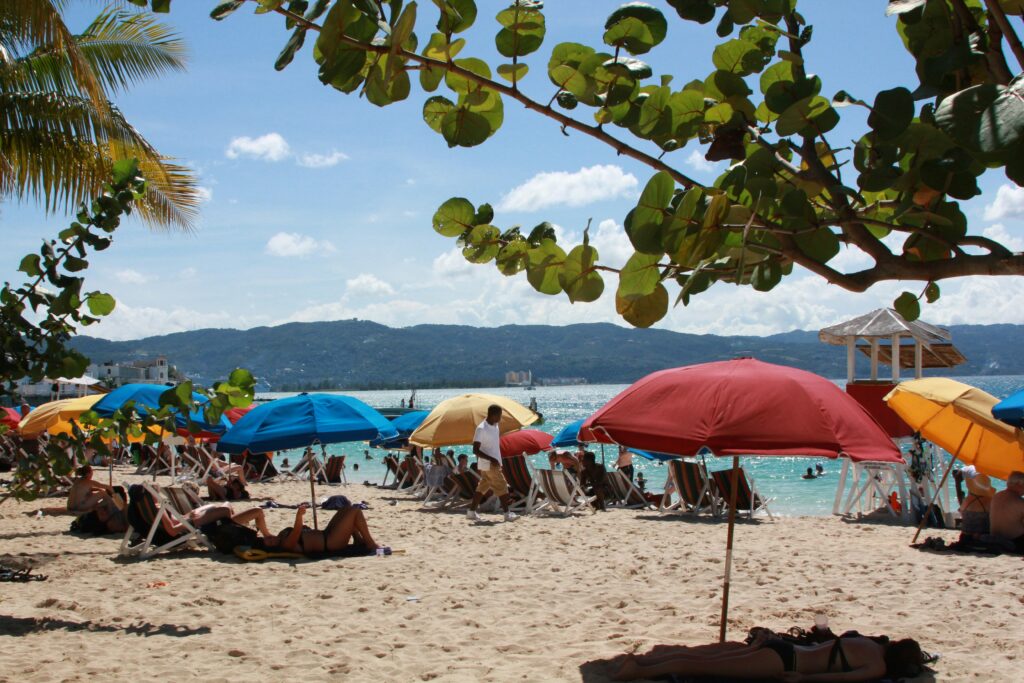
Today, American, Canadian and British tourists account for roughly 94% of stopover arrivals (Jamaica Tourist Board, 2026). It was my first all-inclusive, and I will admit that I did not think particularly hard about the economics of it at the time. You are not designed to: you pay upfront to a foreign booking platform, fly on a foreign airline, arrive at a resort operated by a multinational hotel corporation headquartered far from the Caribbean, and spend a week in a beautifully managed bubble. When I visited Montego Bay, the resort occupied prime beachfront, the town sat behind it, and in some areas beaches were fenced off with security denying local people access to their own coastline.
Sri Lanka: The Two-Tier Tourism Economy
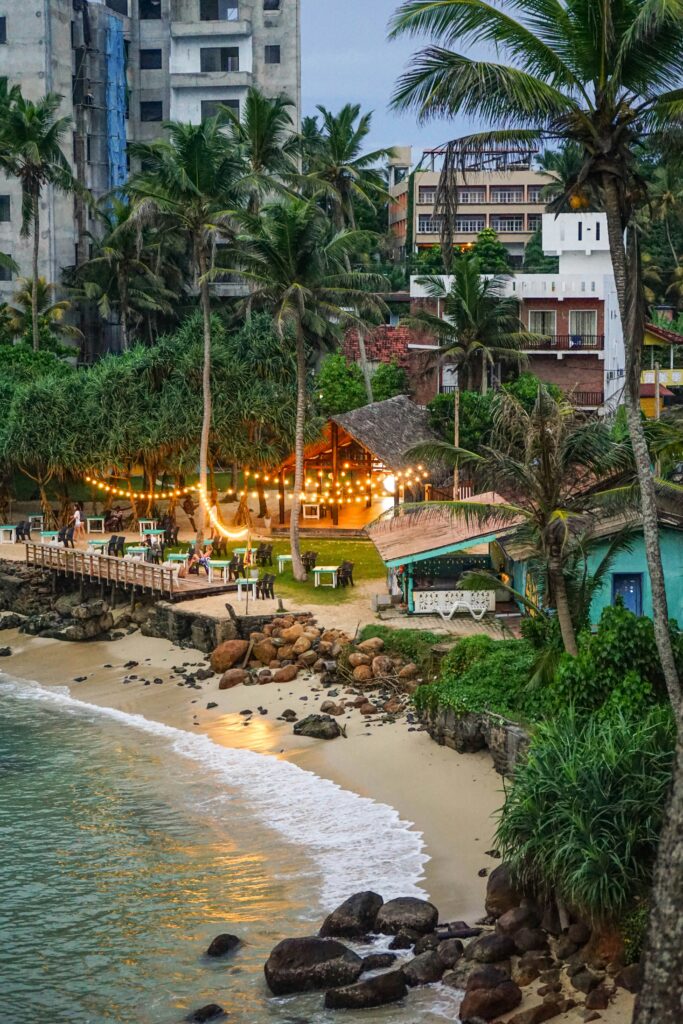
On a recent visit to Ahangama, on the southern coast, I stayed at a foreign-owned resort, one of many along this stretch of coastline. The owners were Israeli; the guests, by and large, were too. The Sri Lankan staff were warm, attentive, and employed in every operational role. But they did not own the business, set its prices, which were on par with London or Los Angeles and listed in USD, or determine who it served. The menus told the same story. Along the tourist strip, it often felt like there were more pizza places than Sri Lankan ones, and the local food that was on offer had been stripped of the spice the country is known for, recalibrated for palates that wanted the idea of Sri Lankan cuisine more than the fact of it.
This was not an anomaly. Sri Lankan press has reported significant foreign land acquisition along the southern coast, with a particularly visible concentration of Israeli ownership in Ahangama, alongside waves of Russian, Ukrainian, British, German, and other European-owned establishments across Hiriketiya, Unawatuna, Weligama, and Arugam Bay. Many acquisitions are structured through local partners or 99-year leases to navigate restrictions on foreign land ownership. A former chairman of the Sri Lanka Tourism Development Authority confirmed that unregistered foreign-run businesses enjoy roughly a 30% tax advantage over legitimate local operations, and that “in most cases, the money does not come into the economy” (Daily FT, 2024).
The more human dimensions are equally bracing. Earlier this year, a viral TikTok video showed a British Sri Lankan tourist being refused service at a beachside restaurant in Tangalle. The manager’s reported response: “We don’t serve locals.” The incident is far from isolated. Domestic travellers across the southern and eastern coasts have reported being asked their nationality before entry, told that tables are reserved for foreigners, or directed away from sea views held aside for white guests. One restaurant owner, asked whether such restrictions might violate Sri Lankan law, replied: “This is my private property. I think I can decide to whom I should open the doors.” That Article 12(3) of the Sri Lankan Constitution explicitly prohibits racial discrimination in access to shops, hotels, and restaurants appears, in his framing, to be somebody else’s problem (Kulathilaka and Dissanayake, 2026).
Meanwhile, a quarter of Sri Lanka’s population lives below the poverty line (World Bank, 2025), and 1.3 million Sri Lankans left for work abroad between 2019 and 2024 (Daily FT, 2025). The tourism sector is booming, yet it is not entirely clear for whom.
Bali: Rice Fields as an Asset Class
In September 2025, floods and landslides killed 18 people across Bali (Reuters, 2025). Officials linked the disaster directly to the unchecked construction of hotels, villas, and housing on former rice fields and hillsides, which has eroded the island’s natural resilience to heavy rainfall. The scale of the conversion is stark: between 2019 and 2024, Bali lost 6,521 hectares of rice fields, more than 9% of its farming landscape, with nearly 39% of Denpasar’s paddies disappearing in just six years. The island now loses roughly 1,000 hectares of agricultural land annually, and the consequences, flooding, water shortages, traffic, are borne by communities who had no say in the planning decisions that produced them (BPN Bali, 2025, cited in CNN Indonesia, 2025).
I visited The Yoga Barn in Ubud, the island’s most famous wellness retreat, founded by Americans and now a pilgrimage site for Western tourists seeking spiritual transformation abroad. Step through its gates and the chaos of the street outside, the motorbikes, the warungs, the everyday texture of Balinese life, disappears entirely. Inside was a compound of manicured tropical calm, populated almost exclusively by Americans and Britons who had, as the saying goes, “come to find themselves.” I was dragged there by friends and used the meditation class to nap. But that is rather the point: once, again, I did not think to question any of it. The Yoga Barn was simply on the itinerary the way a restaurant recommendation is on an itinerary. The infrastructure of enclave tourism is designed to feel like a natural amenity, not a structural choice.
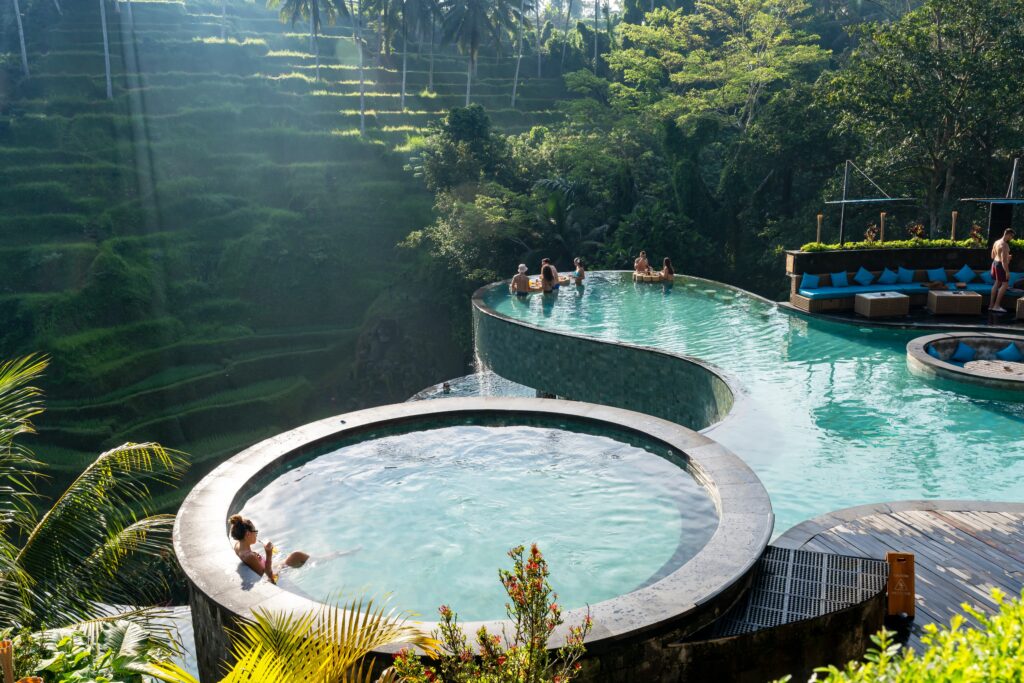
Anthony Bourdain, who spent a career arguing that travellers should eat where locals eat and sit where locals sit, captured the ethic the enclave violates. Travel, he said, should change you, and you should hope to “leave something good behind” (Bourdain, 2007). The visitor takes the calm, the sunset, the photograph; what gets left behind is a sold rice field. Foreigners cannot own land freehold in Indonesia. But through long-term leaseholds and foreign-controlled corporate vehicles, the de facto transfer of control has proceeded regardless. The yoga retreat exists because the rice field was sold, and the infinity pool is where someone’s livelihood used to be.
Mapping a Better Future
The critique here is not of travel itself. The backpacker in a locally-owned guesthouse, the traveller eating at a warung and hiring a local guide, has a fundamentally different economic footprint from the all-inclusive tourist or the foreign operator who opens an unlicensed business on someone else’s coastline. The problem is the business models that extract value rather than retain it.
And there are models that work differently. Rwanda invests 10% of park tourism revenue directly into surrounding communities, aligning conservation, tourism, and local development structurally rather than leaving them in tension (Akayezu et al., 2022). In Bali itself, Pemuteran Village has built an ecotourism model around coral reef conservation where tourism income flows directly to local community members rather than to foreign-owned platforms or operators.
Not In The Guidebooks, the B Corp travel business, founded by London Business School alumna Carol Savage, was built to challenge tourism’s unsustainable business model and solve this problem. Part of its founding mission was to combat tourism leakage by reinvesting visitor spending back into local communities, economies, and environments. Its itineraries are designed and delivered by local hosts who directly benefit from the revenue they generate, so that the value of a place stays with the people who make it worth visiting. These are not boutique exceptions: community-owned lodges, cooperative guiding enterprises, and local content requirements in hospitality procurement are functioning policy tools. The barrier is not viability, but rather the willingness to design differently.
Conclusion
Tony Wheeler once remarked that during his Lonely Planet years, the team would stress that “there’s always the place two streets over,” that travellers did not need to crowd into the same shops and cafes when something equally rewarding existed around the corner. In Ahangama, the best meal I had was at a place called Townhouse, literally two streets off the main strip, serving the food the beachfront had quietly edited out. It was a philosophy of curiosity over convenience, of genuine engagement over passive consumption. This is advice I am becoming more conscious of myself, as someone who reaches instinctively for comfort and the familiar abroad, and who is slowly learning that the richest part of travel asks you to be a little braver than that. It is also, as it turns out, a reasonable investment thesis.
Underneath the economics sits something less measurable, but no less real. Income disparity does not just shape what travellers can afford; it shapes how they behave when they get there. A holiday in a country where average wages are a fraction of one’s own quietly invites a sense of disposability about the place and the people in it. Locals become scenery. The land becomes an amenity. The fenced beach, the locals-not-served sign, the rice field sold to build a yoga studio: each of these requires a degree of indifference that a wealthier visitor from a wealthier country has been culturally permitted to extend, and that the host country has been economically positioned to absorb. Designing better business models is, in part, a way of designing out that permission. When ownership is local, when revenue circulates locally, when the people serving the visitor also own the establishment, the relationship rebalances. Respect tends to follow capital more reliably than it precedes it.
The difference between tourism that builds local wealth and tourism that extracts it is rarely a matter of tourist intention. It is a matter of deal structure, ownership design, and regulatory architecture, largely determined before a single guest arrives. These are not abstract policy questions. They are the kinds of decisions that people trained in finance, strategy, and development will be asked to make within years of leaving this building. The paradise being sold rarely belongs to the people selling it. Whether it ever does is, more than anything else, a question of how the deal was written, by whom, and on whose behalf. Those are the questions an MBA prepares people to answer. The hope, modest as it sounds, is that the next generation of those answers looks rather different from the last.
References
Akayezu, P., Ndagijimana, I., Dushimumukiza, M.C., Bernhard, K.P. and Groen, T.A. (2022) ‘Community livelihoods and forest dependency: Tourism contribution in Nyungwe National Park, Rwanda’, Frontiers in Conservation Science, 3, 1034144. Available at: https://doi.org/10.3389/fcosc.2022.1034144.
Bourdain, A. (2007) No Reservations: Around the World on an Empty Stomach. New York: Bloomsbury USA.
Badan Pertanahan Nasional (BPN) Bali (2025) Land conversion data, 2019–2024, cited in CNN Indonesia (2025) ‘6.521 Hektar Sawah di Bali Lenyap dalam 6 Tahun, Banyak Jadi Vila Baru’ [‘6,521 hectares of rice fields in Bali vanish in 6 years, many become new villas’], CNN Indonesia, 19 September. Available at: https://www.cnnindonesia.com/gaya-hidup/20250919100816-269-1275358/6521-hektar-sawah-di-bali-lenyap-dalam-6-tahun-banyak-jadi-vila-baru
Daily FT (2024) ‘Sri Lanka to crack down on unlicensed tourist-run business amid visa overstays’, Daily Financial Times, 26 October. Available at: https://www.ft.lk/front-page/Sri-Lanka-to-crack-down-on-unlicenced-tourist-run-business-amid-visa-overstays/44-768462
Daily FT (2025) ‘2024 sets record for Sri Lankans going abroad for work’, Daily FT. Available at: https://www.ft.lk/front-page/2024-sets-record-for-Sri-Lankans-going-abroad-for-work/44-771235
Jamaica Information Service (2025) 4.3 Million Visitors Expected in 2025. 16 October. Available at: https://jis.gov.jm/4-3-million-visitors-expected-in-2025/
Jamaica Tourist Board (2026) Stopover Arrivals by Country and Month of Arrivals 2025. Kingston: Jamaica Tourist Board. Available at: https://www.jtbonline.org/download/stopover-arrivals-by-country-and-month-of-arrivals-2025-pdf/
Kulathilaka, D. and Dissanayake, M. (2026) ‘Whites only tourism: Allegations of discrimination against locals cause uproar’, The Sunday Morning, 22 February. Available at: https://www.themorning.lk/articles/FhmqYpEaPXRNRAExbWIB
Reuters (2025) ‘Waters recede in Bali after floods kill 18 people, with two still missing’, Reuters, 12 September. Available at: https://www.reuters.com/sustainability/land-use-biodiversity/waters-recede-bali-after-floods-kill-18-people-with-two-still-missing-2025-09-12/
United Nations (2022) UN report underscores importance of tourism for economic recovery in 2022. UN Tourism News. Available at: https://www.untourism.int/news/un-report-underscores-importance-of-tourism-for-economic-recovery-in-2022
UN Tourism (2025) Why Tourism? Madrid: UN Tourism. Available at: https://www.unwto.org/why-tourism
World Bank (2024) Tourism Sector Background Note: United Republic of Tanzania. Washington, D.C.: World Bank Group. Available at: https://documents1.worldbank.org/curated/en/099010725095032919/pdf/P180187-a125168d-dc9e-44b5-9bc0-92bfe0bbe6b5.pdf
World Bank (2025) Sri Lanka Poverty and Equity Brief : October 2025. Washington, D.C.: World Bank Group. Available at: http://documents.worldbank.org/curated/en/099656304212531872
About the writer

Ari Elan Deshpande is an MBA 2027 candidate at London Business School and a Research Intern at the Wheeler Institute for Business and Development. Prior to joining LBS, she worked in entertainment at Netflix, Universal Pictures, John Legend’s Get Lifted Film Co., and several start-ups, holding roles in creative development and acquisitions. Ari is also a Producer and the Founder of Meet Qute Entertainment, where she develops multicultural romantic comedies and dramas for film and television. She is particularly interested in how business, media, and film can translate complex global challenges into ideas that move people to action, and in how business models, policy, and technology can be leveraged to build community and drive social impact.
Student voice
The Wheeler Institute for Business and Development is seeking to understand, illuminate and offer solutions to the challenges faced by the developing world, with an aim to identify the role of business in addressing these challenges and a focus on the implications and actions for those in developing countries. In support of our students, we approach this blog section as a reflective platform and a space where individuals can generate debate as long-term agents of positive change. This article is solely authored by a student and reflects their individual research, opinion and point of view and is not based on research led or supported by the Wheeler Institute.