Artificial intelligence, technological disruption, and geopolitical instability are reshaping the policy landscape. In an era defined by overlapping economic and technological transitions, governments face renewed questions about prioritisation: how should states balance immediate social pressures (“butter”) with longer-term strategic and security demands (“guns”)?
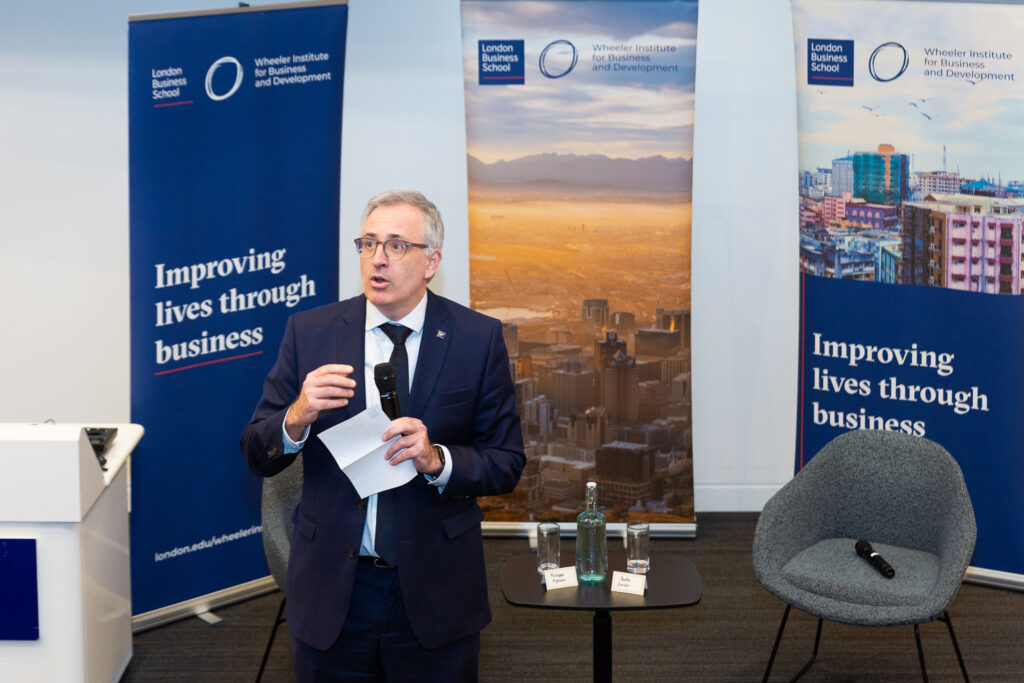
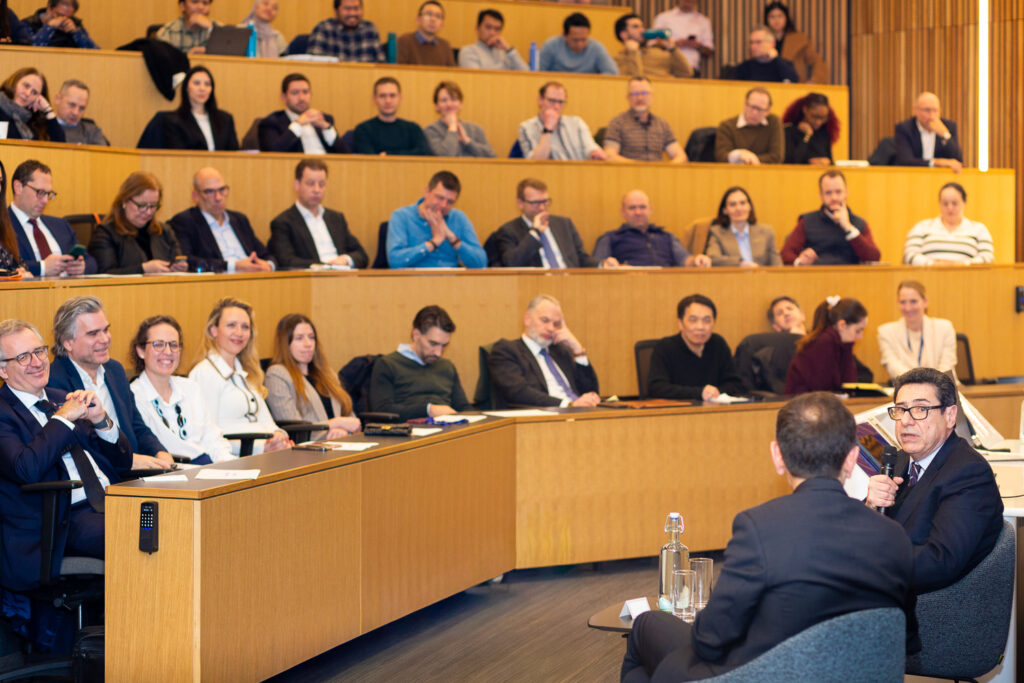
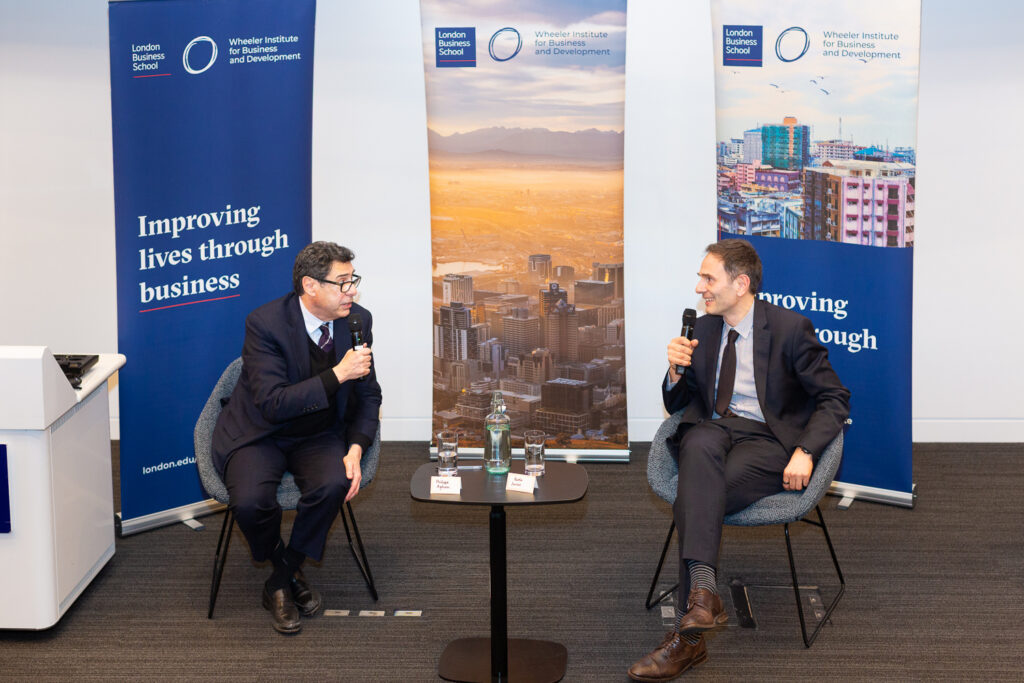
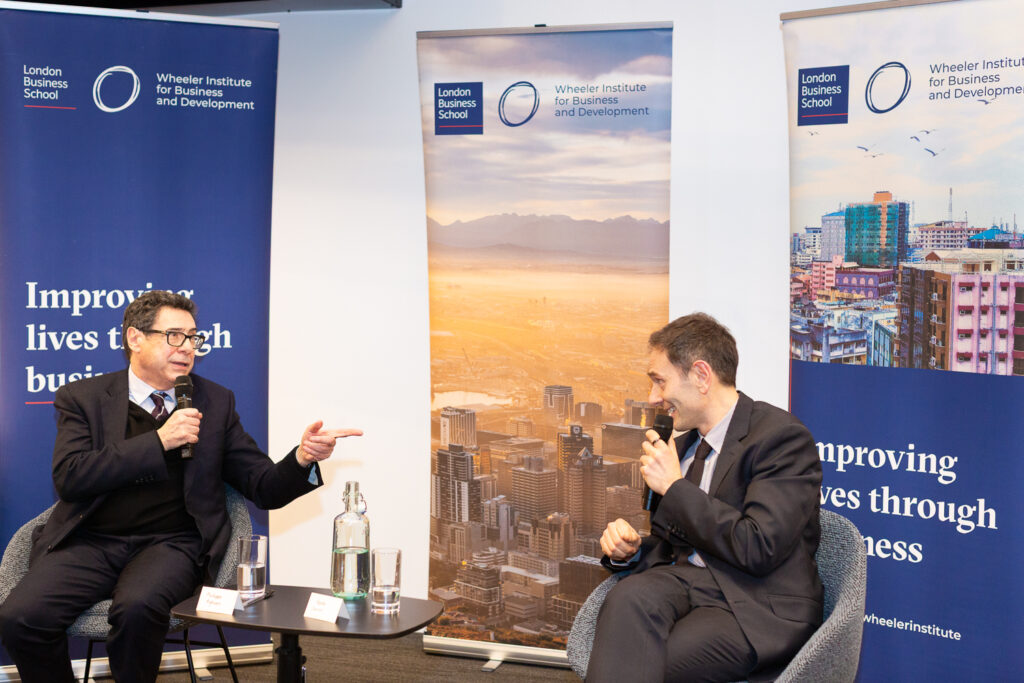
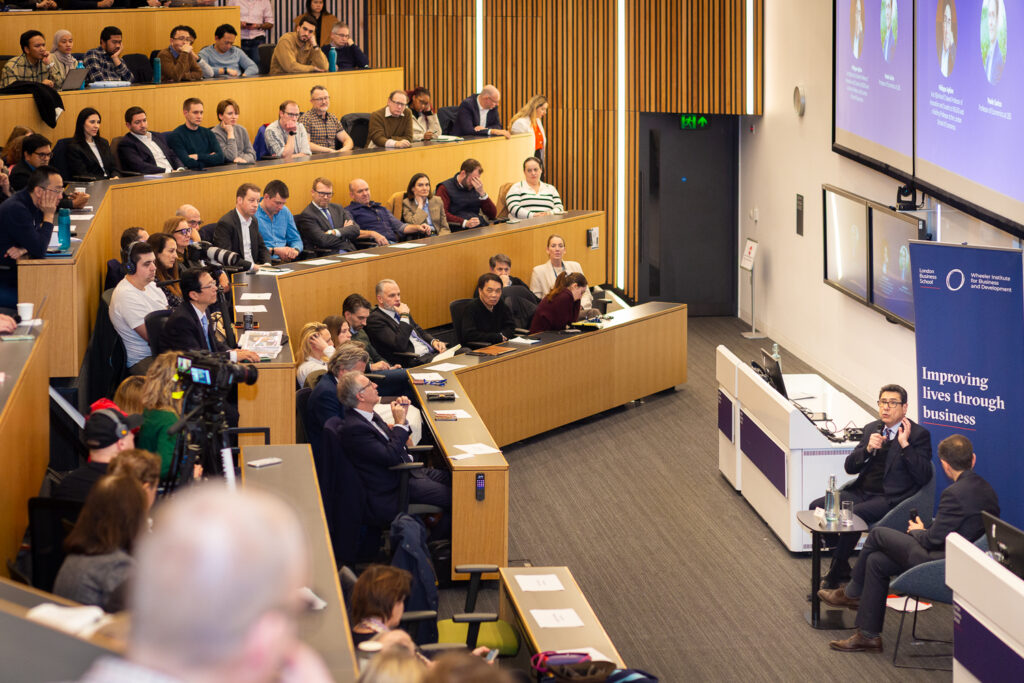
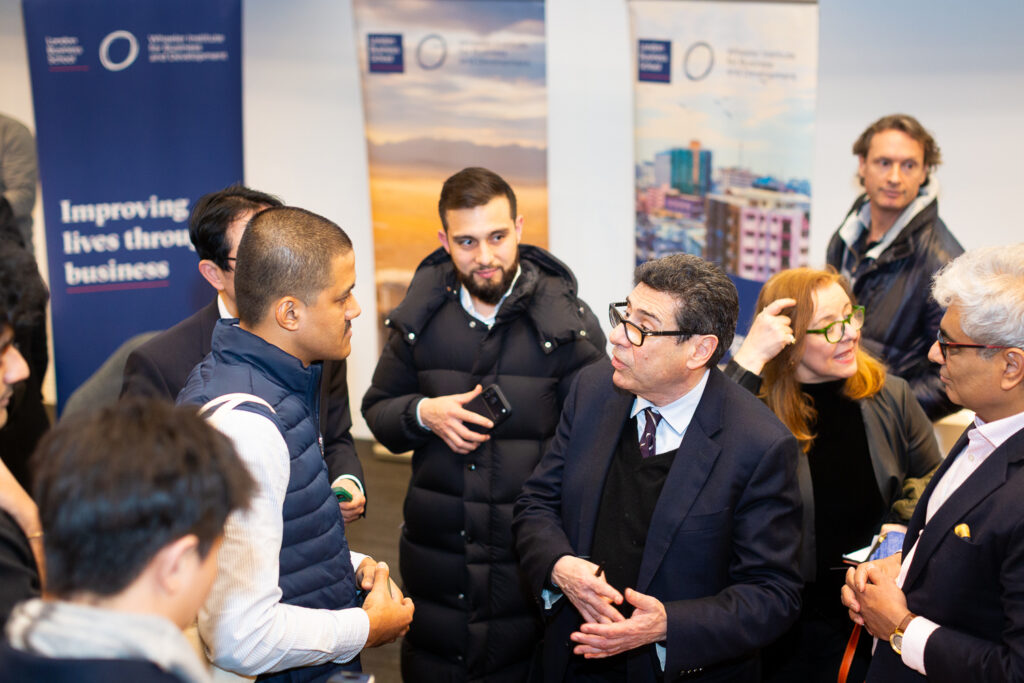
The Wheeler Institute for Business and Development was delighted to host Philippe Aghion, recent Nobel Laureate of Economics, for a discussion on the relationship between innovation, competition, institutions, and long-run economic growth. The event was opened by Sergei Guriev, Professor of Economics and Dean of LBS, and moderated by Paolo Surico, Professor of Economics at LBS. It marked the first in a limited series of conversations on Public Policy in the Age of Innovation.
Creative Destruction: Innovation as the Engine of Growth
Aghion’s work builds on Joseph Schumpeter’s concept of Creative Destruction, introduced in Capitalism, Socialism and Democracy (1942). Creative Destruction describes the process through which innovation continuously transforms the economic structure, displacing older technologies and business models in favour of more productive ones. While inherently disruptive, this mechanism is central to sustained economic growth.
Aghion’s research sought to explain the drivers of long-run growth once diminishing returns to capital accumulation set in. In collaboration with Peter Howitt, he developed a rigorous, modern framework for Schumpeterian growth theory, demonstrating that growth is driven not simply by investment, but by the continuous renewal of the economy through innovation.
Their work highlights three core mechanisms:
- Growth builds on prior innovation: Long-run growth is cumulative, with new advances standing on the foundations of earlier discoveries. Entrepreneurs play a central role in generating these innovations.
- Innovation is inherently disruptive: New technologies displace older ones, reshaping firms, industries and job composition. While this process underpins productivity growth, its short-term effects may include worker displacement, shifting skill demands, and economic pressure on incumbent firms and regions.
- Competition sustains innovation: Competitive pressure is essential to prevent technological stagnation. Incumbent firms, seeking to preserve rents, may resist further innovation, generating a structural tension within the growth process. Effective competition policy limits the ability of dominant firms to suppress new entrants and ideas.
The Role of Government
Against this backdrop, Aghion addressed the role of government in supporting innovation-led growth. Rather than choosing between markets and state intervention, he emphasised their complementarity. Governments, in his view, should pursue both horizontal and vertical policies that enable experimentation, entry, and diffusion.
Horizontal policies include:
- Education reform: Broad-based education reform expands the pool of potential innovators and supports social mobility.
- Competition policy: Regulatory frameworks should prevent incumbents from entrenching market power and stifling dynamism.
- Flexicurity: As technological change accelerates labour market disruption, policies that combine flexibility with income security can support adjustment without undermining innovation.
- Long-term research funding: Innovation requires tolerance for failure. Aghion cited France’s Laboratories of Excellence (LabEx) as an example of mission-driven funding shown to stimulate breakthrough innovation across diverse sectors.
Vertical policies, by contrast, involve targeted institutional structures designed to foster high-risk, high-reward research.
DARPA and the Innovation State
Aghion pointed to the U.S. Defense Advanced Research Projects Agency (DARPA) as a leading example of effective state-supported innovation. Established under President Eisenhower in 1958 in response to the Soviet launch of Sputnik, DARPA has played a pivotal role in enabling foundational technologies, including ARPANET, the internet’s predecessor, and stealth systems.
Crucially, DARPA’s model emphasises bottom-up competition and flexibility. Through mechanisms such as “open topics”, the agency funds early-stage research without prescribing specific technological requirements, lowering barriers for new entrants while catalysing broader innovation ecosystems. This approach not only supports startups but also encourages venture capital formation and increased R&D investment among incumbents.
Europe’s Innovation Puzzle
Why, then, has Europe struggled to produce comparable levels of breakthrough innovation?
Despite generating highly cited scientific research, Europe has been less successful in translating knowledge into globally dominant technologies. Aghion attributed this gap to structural factors: market fragmentation, regulatory complexity, and comparatively shallow capital markets.
Innovators face layered regulatory regimes combining national and EU-level rules, often resulting in “gold-plating” that raises compliance costs and limits scalability. At the same time, Europe’s financial ecosystem provides less risk capital for both early-stage ventures and large-scale technological bets.
Yet Europe also possesses important structural strengths and “soft power”. At a time of political and societal uncertainty, many European countries provide promise of institutional stability, democratic governance, and robust social models, contributing to the region’s growing attractiveness for global talent and long-term research investment.
Guns, Butter and Fiscal Choices
Where we may have previously questioned the potential for dramatic government intervention, recent crises – from the pandemic to geopolitical conflict – have demonstrated governments’ capacity for rapid and large-scale fiscal intervention, reshaping debates around public spending.
These shifts raise important questions about how governments deploy expanded fiscal capacity. Aghion emphasised that sustained investment in research and development – including but not limited to defence-related R&D – depends on credible fiscal frameworks and disciplined management of long-term expenditure commitments.
Aghion further argued that the perceived trade-off between social protection and strategic investment is often overstated. Fiscal space can be expanded through disciplined management of recurring expenditures, enabling investment in growth-enhancing sectors such as AI, energy, and defence.
Comparisons between innovation agencies illustrate the scale of divergence. The UK’s Advanced Research and Invention Agency (ARIA), for example, operates with annual funding of approximately £200 million, while DARPA’s budget is measured in billions.
Foundations of the Innovation Ecosystem
As recommended further reading, Surico pointed the audience to Vannevar Bush’s 1945 report, Science: The Endless Frontier. Commissioned by President Roosevelt at the end of the Second World War, the report examined how lessons from wartime scientific mobilisation could be applied to civilian progress, particularly in health, science, and technological development.
Bush identified three pillars that continue to shape the US innovation ecosystem today: a government role in identifying and supporting areas of public interest; research institutes and universities advancing the frontier of knowledge through investment in basic research; and a competitive private sector translating new knowledge into new products and industries.
This framework – which also features in Surico’s reflections on “Penicillin and American Power”– highlights how public investment in foundational science can crowd in, rather than crowd out, private innovation.
Innovation and Inclusion
A defining message of the conversation was that innovation policy alone is not enough; it must be inclusive. Innovation-driven growth generates disruption alongside prosperity, making inclusivity essential for long-term sustainability.
Competition, education, and flexicurity policies play a dual role: supporting economic dynamism while providing social mobility. Without mechanisms that broaden opportunity and cushion adjustment, voters may turn towards political extremes, undermining the institutional foundations necessary for innovation itself.
Ultimately, the challenge is not to choose between guns and butter, but to implement policies that sustain both growth and social cohesion. Innovation must be accompanied by mobility, opportunity, and credible social protection. In this framework, creative destruction remains central – not only as an engine of growth, but as a force that must be governed to deliver broadly shared prosperity.
Further discussion of these ideas can be found in Philippe Aghion’s ‘The Power of Creative Destruction: Economic Upheaval and the Wealth of Nations’ and Paolo Surico’s “Penicillin and American Power” on Project Syndicate.
About the speaker

Philippe Aghion is the Kurt Björklund Chaired Professor of Innovation and Growth at INSEAD and a Visiting Professor at the London School of Economics. He is a 2025 Nobel Prize laureate in Economic Sciences, awarded jointly with Joel Mokyr and Peter Howitt for their work on innovation-driven economic growth. He is also a Fellow of the Econometric Society and the American Academy of Arts and Sciences, and has held academic appointments at institutions including Harvard University, University College London, and the Collège de France.
Professor Aghion has served as an advisor to governments and international organisations, contributing to policy debates on growth, innovation, competition policy, and institutional reform in both advanced and emerging economies. His research lies at the intersection of economic growth, innovation, and development, with a particular focus on the role of competition, institutions, and financial systems in fostering sustained and inclusive growth. He is best known for his foundational contributions to the theory of innovation-driven growth and creative destruction, and his recent work addresses topics including the middle-income trap, industrial policy, education, inequality, climate change, and designing capitalism for long-term resilience and social cohesion.
About the moderator

Paolo Surico is Professor of Economics at London Business School. His research focuses on public policies for innovation, including public R&D, government-funded and defence-related innovation, and the role of corporate taxation in shaping firms’ innovative activity and economic performance. He has also made influential contributions to research on monetary policy, inequality, and the redistributive effects of interest rate changes and quantitative easing. His work is widely published in leading academic journals and is characterised by rigorous empirical analysis and strong policy relevance. He has extensive experience advising policymakers, including consultancy for the European Commission and the European Central Bank, and past advisory roles with the Bank of England and the Financial Conduct Authority. His research has influenced the conduct of monetary policy and the design of fiscal policy across Europe.
About the writer

Anna Sutton is an MBA 2027 candidate at London Business School and an Outreach Intern at the Wheeler Institute for Business and Development. Prior to LBS, she worked at Boston Consulting Group in Australia as a Senior Associate, working with organisations across the public, private, and non-profit sectors.
Anna is interested in how technological innovation, public policy, and business strategy interact to support sustainable long-run growth and inclusive economic outcomes.
Further reading
- Penicillin and American Power: the industrial policy America forgot, Paolo Surico (2026)
- Science- the endless frontier, Vannevar Bush (1945)
- The future of European competitiveness, Mario Draghi (2024)
About the Series
Public Policy in the Age of Innovation is a Wheeler Institute limited series, led by Paolo Surico, Professor of Economics at LBS. In a series of three events, Paolo will explore in conversation how innovation, public policy, and institutions can adapt to the economic, technological, and social challenges of our time. Each conversation will invite leading scholars and policymakers and the next event will take place on March 20, 2026, with Stefanie Stantcheva, Nathaniel Ropes Professor of Political Economy at Harvard and founder and director of the Social Economics Lab.