
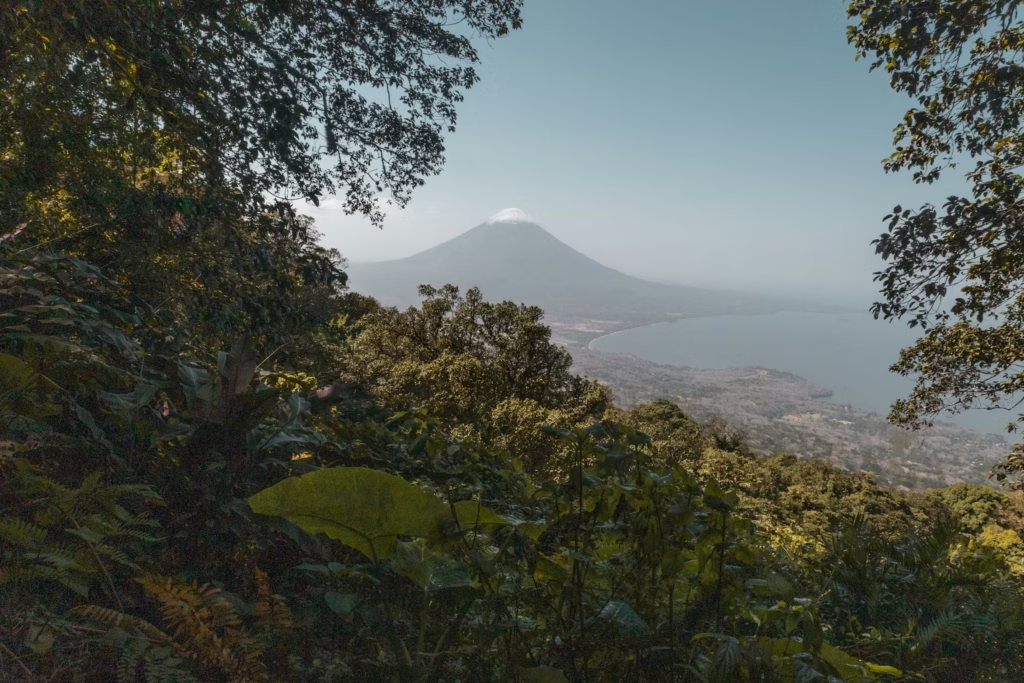
Communities on the outskirts of León, Nicaragua have faced a dire environmental and public health challenge that has intensified over the past decade. Large-scale deforestation and intensive peanut farming have removed natural windbreaks, leaving soils exposed to strong seasonal winds. The result is tolvaneras, or dust storms, that darken the sky, disrupt daily life, and harm the locals’ respiratory health. During a volunteer trip from Los Angeles to rural Nicaragua, I joined a community-led reforestation effort. The work made clear how environmental pressures in emerging markets are shaped by global demand, agricultural incentives, and the business models behind export-oriented farming.
From Cotton to Peanuts: A Legacy of Extraction
To understand the current context, one must look back at the region’s economic history. For decades, the Pacific plains of Nicaragua were dominated by the “cotton boom” that began in the 1940s and 1950s. This era saw the fertile plains of the Pacific converted into consolidated monocultures, accompanied by intense modernization and the heavy use of agro-chemicals. By the 1990s, following the economic and political crises of the previous decade, the agricultural landscape had shifted, with land rights formalized for those living in the environs of cane, cotton, sesame, and peanut plantations.
In the aftermath, production pivoted to peanuts, particularly in the departments of León and Chinandega, where volcanic soils are highly suitable for this crop. This transition supported the agricultural economy; today, the local peanut industry accounts for more than 20,000 workers and contributes over $90 million in revenue. However, the sector remains susceptible to environmental factors, including weather variability and drought phenomena like El Niño, which continue to impact production quality and yields.
Understanding the Supply Chain Pressures
Northwestern Nicaragua, specifically the departments of León and Chinandega, produces more than 90 percent of the country’s peanuts, with most of the harvest exported to markets in the Netherlands (21%), the United Kingdom (20%), Mexico (11%), El Salvador (10%), Guatemala (9%), Germany (6%), Costa Rica (6%), and Honduras (3%). To make way for more agricultural land, trees that serve as natural windbreakers are often cut down. After each harvest, the stubble (which is the the remaining stem and leaves rooted in the ground) is removed and sold as cattle feed, leaving the soil bare and devoid of nutrients. Without tree cover or ground vegetation, strong trade winds lift fine particles directly into neighboring communities. Residents describe this period as the “Eternal Black Summer,” where homes are constantly covered in powder.
The consequences are severe: residents suffer from respiratory diseases and eye irritation due to the excess dust. Traffic slows due to low visibility, businesses are forced to close to stay safe, and families keep doors and windows sealed. The situation in León illustrates how agricultural
systems designed around global supply chains can drive soil degradation and public health risks.
Reforestation & Business Partnerships
Restoring tree cover has become a priority to mitigate environmental impacts. Suppliers for major international markets, such as the United Kingdom, have collaborated with the Nicaraguan Environment Ministry to plant nearly one million trees—equivalent to roughly 649 hectares. Similarly, non-profit organizations like Raleigh International work with thousands of young people and local farmers to tackle deforestation and improve green livelihoods through campaigns like “Dame Chance.”
These companies and organizations have recognized that unchecked soil degradation and the removal of windbreaks threaten both community health and agricultural viability. Planting trees is viewed as a key strategy to stabilize soils, restore watersheds, and create living barriers to reduce the severe dust storms that plague the region. This shift illustrates how market incentives and environmental realities can push firms to adopt practices that better balance production goals with ecological resilience.
Working Alongside Local Residents
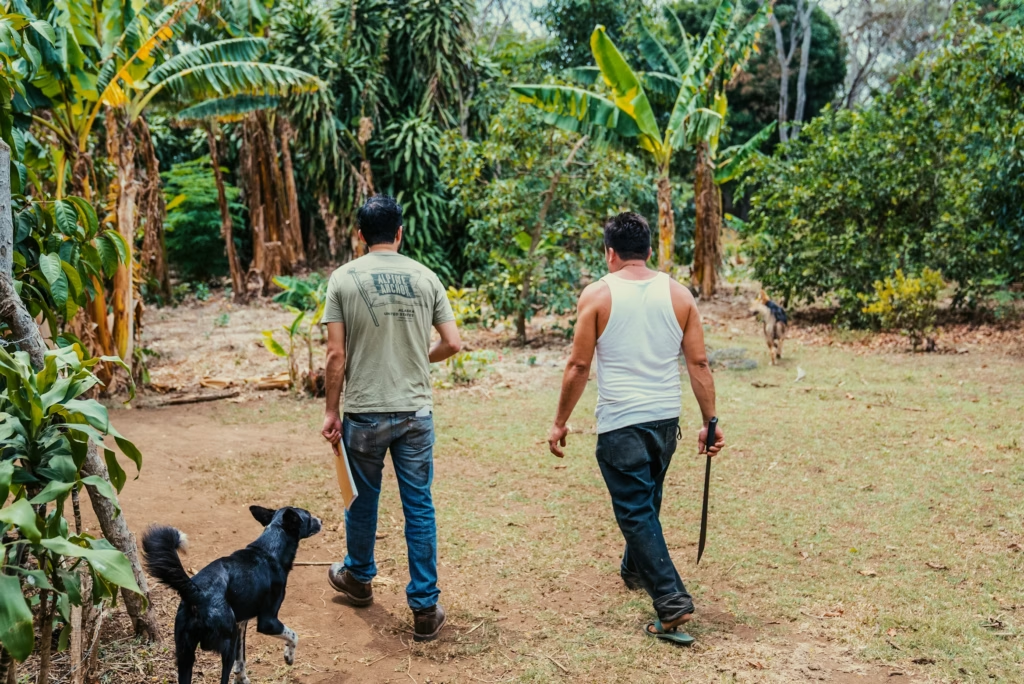
My week-long planting campaign in León’s outskirts was an experience that has stayed with me. Local agronomists guided our work and taught us how to plant seedlings to survive dry-season winds. Each morning, we dug holes, added fertiliser, and positioned the young trees. The spirit of collaboration is what stood out to me. One mother told me she hoped her son would one day play outside in the dry season without worrying about harming his lungs. Her words grounded the project in a very human hope for cleaner air and a healthier future.
Toward a More Resilient Future
The trees we planted would take time to mature, but even young windbreaks can reduce dust and improve local conditions. Reforestation alone will not solve the structural pressures behind land use. However, partnerships between farmers, communities, and export-oriented businesses suggest a pathway where environmental restoration and economic opportunity can reinforce each other. My experience in León showed that solutions to climate and environmental challenges often are most effective when community leadership and market incentives move in the same direction.
“Quien a buen árbol se arrima, buena sombra le cobija.”
References
[1]Freguin-Gresh, S. and Cortes, G. (2022) ‘Social history and institutional change in Nicaragua’s agricultural and food policies’, in Le Coq, J.F. et al. (eds) Public Policies and Food Systems in Latin America. Versailles: Éditions Quae. Available at: https://www.ncbi.nlm.nih.gov/books/NBK592172/,.
[2]Grundberg, E. (2006) ‘Confronting the Perils of Globalization: Nicaraguan Banana Workers’ Struggle for Justice’, Iowa Historical Review, pp. 96–126.
Lubin, R. (ed.) (2021) NextGen Nicaragua. A Special Daily Mirror project in collaboration with Raleigh International. Available at: https://mirror.shorthandstories.com/nextgen-nicaragua/index.html.
[3]Nading, A.M. (2024) ‘Disposability, social security, and the facts of work in Nicaragua’s sugarcane zone’, Tapuya: Latin American Science, Technology and Society, 7(1). Available at: https://doi.org/10.1080/25729861.2024.2357392.
[4]USDA Foreign Agricultural Service (2025) Nicaragua Peanut Report Annual. Voluntary Report NU2025-0010. Managua: United States Department of Agriculture. Available at: https://apps.fas.usda.gov/newgainapi/api/Report/DownloadReportByFileName?fileName=Nicaragua%20Peanut%20Report%20Annual_Managua_Nicaragua_NU2025-0010.pdf
About the writer

Ari Elan Deshpande is an MBA 2027 candidate at London Business School and a Research Intern at the Wheeler Institute for Business and Development. Prior to joining LBS, she worked in entertainment at Netflix, Universal Pictures, John Legend’s Get Lifted Film Co., and several start-ups, holding roles in creative development and acquisitions. Ari is also a Producer and the Founder of Meet Qute Entertainment, where she develops multicultural romantic comedies and dramas for film and television. She is particularly interested in how business, media, and film can translate complex global challenges into ideas that move people to action, and in how business models, policy, and technology can be leveraged to build community and drive social impact.
Student voice
The Wheeler Institute for Business and Development is seeking to understand, illuminate and offer solutions to the challenges faced by the developing world, with an aim to identify the role of business in addressing these challenges and a focus on the implications and actions for those in developing countries. In support of our students, we approach this blog section as a reflective platform and a space where individuals can generate debate as long-term agents of positive change. This article is solely authored by a student and reflects their individual research, opinion and point of view and is not based on research led or supported by the Wheeler Institute.