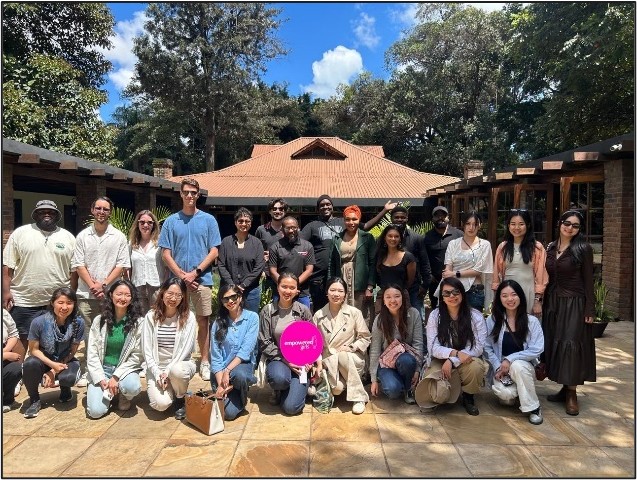
On the London Business School East Africa Social Impact Trek across Kenya and Tanzania, one idea surfaced again and again across very different organisations, sectors, and conversations: money alone is not the problem. East Africa is not short of entrepreneurs with ideas, communities with unmet needs, or even, increasingly, investors with capital. What it has historically lacked is the connective tissue including structured partnerships, patient financing, and embedded technical support. What we saw on the trek suggested that this is beginning to change through blended finance deployed not just as a funding tool, but as a framework for accountability and ecosystem-building.
The Execution Gap: Why Good Ideas Stall
The place to start is with the problem. At Twende, a social innovation hub and community workshop in Tanzania, we learnt that what is missing is innovation and infrastructure to build locally owned solutions. Over 70% of youth in East Africa are unemployed or underemployed (Ripple Effect, 2024), but they live closest to the problems that need solving. The argument was not merely about jobs. It was about an innovation deficit, a systematic failure to turn ‘proximity to a problem’ into ‘the capacity to solve it’. This hinders local problem-solving, stifles homegrown technologies, and locks communities into dependency on imported solutions.
This framing matters because it redefines the development challenge. If the issue were only a lack of capital, the solution would be straightforward, that is more investment. But what Twende illustrated by incubating organisations such as Kyaro Assistive Tech, which designs assistive technology devices built for the local environment and customised to individual user needs, is that the real gap is one of enabling infrastructure. Communities can innovate when given the tools, mentorship, and institutional support to do so. Without that, even the best ideas remain untapped.
The Nairobi-based Grassroots Business Fund (GBF), which has spent over 20 years deploying capital to growth-stage SMEs across East Africa, offered a more granular diagnosis of the same failure. Businesses across the region fall through in execution more often than they lack access to financing. Support is fragmented across different providers. There is a persistent gap between when businesses need help, especially organisational or technical talent, and when that help becomes available to them. The kind of flexible, adaptive technical assistance that can support a business through its growing pains is also rarely bundled with capital itself.
GBF’s response, managing over $140M in capital, supporting 500+ SMEs, and running programmes like the Jiinue Growth Program with the Mastercard Foundation, which has reached over 200,000 entrepreneurs (GBF, 2025) is instructive precisely because it treats financing and capability-building as inseparable. With an 85% focus on women-led enterprises, their model embeds technical assistance in governance, financial management, ESG, and market access alongside every investment, recognising that a business without organisational capacity cannot absorb capital productively, however well-intentioned the investor.
Blended Finance as Accountability Architecture
What struck me across multiple organisations was how blended finance is increasingly being used not just to de-risk investments for private capital, but to create accountability structures that neither pure grants nor purely commercial investments would produce on their own.
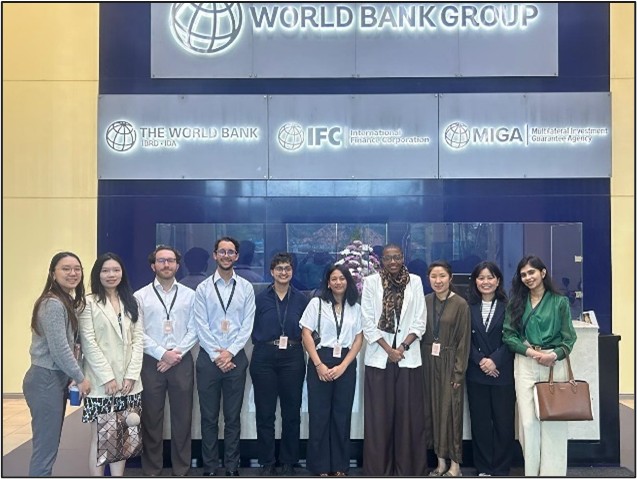
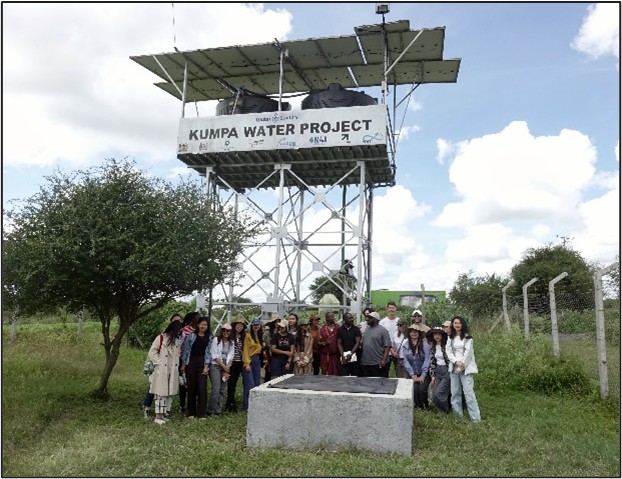
The IFC’s framing was direct whereby blended finance augments their resources with donor funds to pave the way for private investment. This is familiar language. But we heard a more novel version of the argument when we visited Amref Health Africa’s WaterStarters project, which applies blended finance principles to rural water access in ways that go beyond the standard capital-stacking logic.
The WaterStarters approach blends private-sector efficiency with public health objectives, financing local water service providers while building accountability mechanisms into the structure. The early results were encouraging: a sharp reduction in acute waterborne diarrhoeal diseases (from a baseline of 14% to 1% at mid-term evaluation), school attendance increasing by over 60% in some areas, and new income-generating activities emerging around climate-smart farming. Financially, the franchise fees were recovered, interest and principal paid on schedule, and average revenue has grown at 4% per project per month (Amref, 2025). The WaterStarters model requires franchises to meet operational standards, report real-time data, and participate in a system of continuous training and business development support. The financing structure enforces accountability in deeper ways than grants.
Convergence’s data suggests this dynamic is playing out across the region. The blended finance market for Sub-Saharan African SME-focused deals has reached $11 billion across 145 transactions (Convergence, 2023), yet it remains just 14% of aggregate financing in the region, a share that implies enormous room for growth if the right structures can be replicated and scaled.
Innovation Cannot Wait for Infrastructure
Another observation came at B-Lab, which manages B-Corp certification and spoke about the Resilience Sustainable Business Program as a tool for building credibility with impact investors and encouraging a longer-term view of investment returns. The insight behind the programme is that accountability and transparency, the things certification confers, are not just ethical stamps, but preconditions for a more mature investment ecosystem. Investors who trust the businesses they invest in can afford to be patient. Patient capital, in turn, is exactly what early-stage social enterprises need to grow without distorting their mission.
E3 Capital’s work on electrification reinforced a related point. Renewable energy and AI-driven energy management are the infrastructure on which everything else depends. A water franchise cannot operate without reliable power. An assistive technology workshop cannot scale without consistent electricity. An SME cannot adopt digital systems without connectivity. The sequencing argument that innovation must wait for infrastructure misses the point that in many communities, the innovators themselves are the ones building the infrastructure, bottom-up.
That bottom-up logic was again visible in the approach of the Segal Family Foundation, which backs organisations that are founded and led by people within the communities they serve. They also support disabilities and mental health, two areas described as systematically underfunded in East Africa’s development landscape. The model is deliberately partnership-based and community-oriented by building the local capacity and peer networks that allow communities to address their own challenges. It is a slow approach, but one that recognises the limits of externally driven development.
The Ecosystem Is the Point
Taken together, what the organisations we visited suggest is that the development challenge in East Africa is not a series of isolated funding gaps. It is a question of ecosystem design. Blended finance structures work best when they are embedded in a web of technical assistance, certification and accountability frameworks, innovation infrastructure, and community ownership. GBF’s decades of experience have taught them that structured yet adaptive support is what actually builds business capacity. Amref’s WaterStarters works because the financing structure and the operational support are designed as a single system. Twende matters because it treats local innovation as a precondition for growth, not a nice-to-have.
Between 8 and 11 million African youth enter the labour market every year, while only around 3 million formal jobs are created annually (WEF, 2024). That arithmetic does not resolve itself through better impact reports or more patient capital. It resolves itself when communities are equipped to innovate, when enterprises have the support to execute, and when financing structures are designed to build accountability from the ground up rather than impose it from outside. What the trek made clear is that the tools to do this exist and that East Africa’s development ecosystem is learning, organisation by organisation, how to use them together.
About the East Africa Social Impact Trek
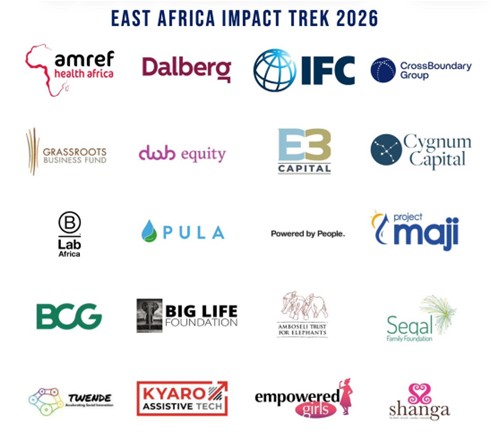
From 2 to 10 May 2026, a group of London Business School students travelled to Kenya (Nairobi) and Tanzania (Arusha) as part of the LBS Social Impact Trek. Over nine days, the group visited a range of impact investing firms, consultancies, and social organisations, exploring how business and capital are being deployed to tackle East Africa’s most pressing development challenges.
The journey between the two cities, a 500-kilometre drive via Amboseli National Park, offered a rare pause for perspective, including a safari stop where the group spotted much of the park’s fauna and came away with some memorable photographs. The trip also included a screening of ‘Searching for Amani’, an Emmy-nominated documentary recognised for outstanding coverage of social issues in the region.
Equal parts immersive learning experience, cultural encounter, and shared adventure, the trek was a reminder that understanding a market means seeing it, not just reading about it. A special thanks to Eamon O’Brien (MBA 2027) for bringing it all together.

About the writer

Pritika Nayak is an MBA 2027 candidate at London Business School. Before her MBA, she was a consultant at Kearney in India, advising Fortune 500 clients across business transformation, operations and growth. Her experience spans industries including oil and gas, chemicals, insurance and education.
Alongside her consulting career, she is passionate about social impact and has managed CSR partnerships and led volunteer programmes with education and healthcare non-profits. Participating in The East Africa trek is an extension of that commitment: an attempt to understand, up close, what it looks like when business strategy and social purpose are built together from the ground up.
References
Convergence Blended Finance (2023) Blended Finance in Sub-Saharan Africa: SME Financing. Available at: https://www.convergence.finance
Grassroots Business Fund (2025) The GBF Platform. Nairobi: GBF.
Mastercard Foundation (2026) Africa Youth Employment Outlook 2026. Available at: https://mastercardfdn.org
Ripple Effect (2024) Half of young people in East Africa are unemployed. Available at: https://rippleeffect.org/blog/africa-youth-unemployment/
World Economic Forum (2024) Empower youth in Africa to create jobs, growth and peace. Available at: https://www.weforum.org