
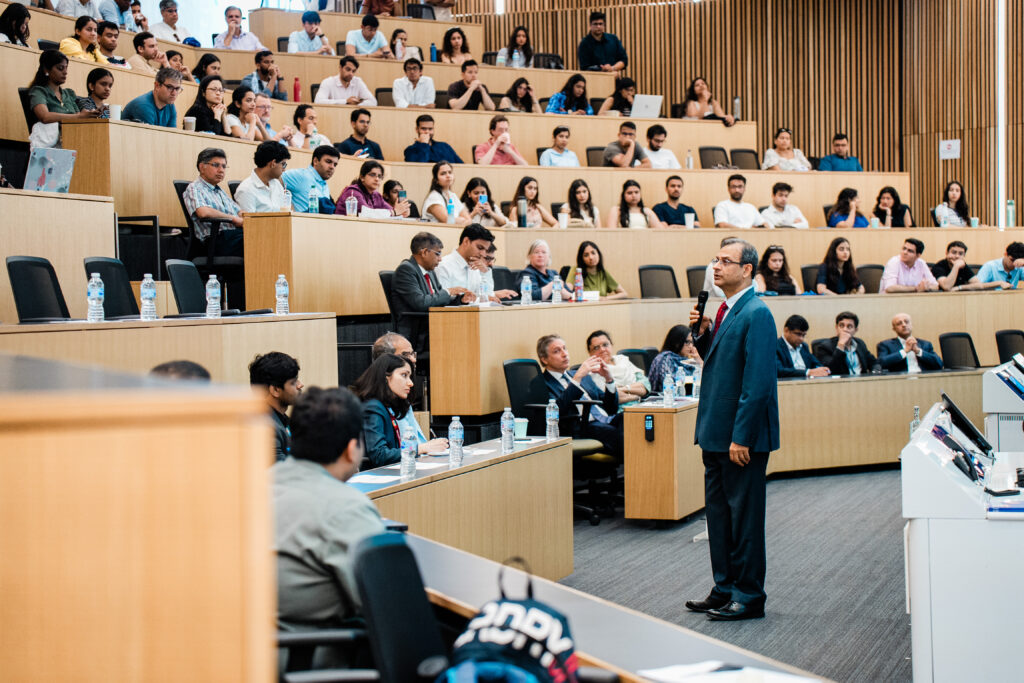
In a conversation at London Business School, Reserve Bank of India (RBI) Governor Sanjay Malhotra returned repeatedly to one idea: trust. He described it as fundamental to institutions, arguing that resilience depends not only on policy frameworks, but on whether people believe in the institutions managing them. Across a wide-ranging discussion on inflation, geopolitical shocks, digital payments, and the rupee, his framing was consistent: the RBI’s role is not to generate growth, but to create the conditions that make growth sustainable.
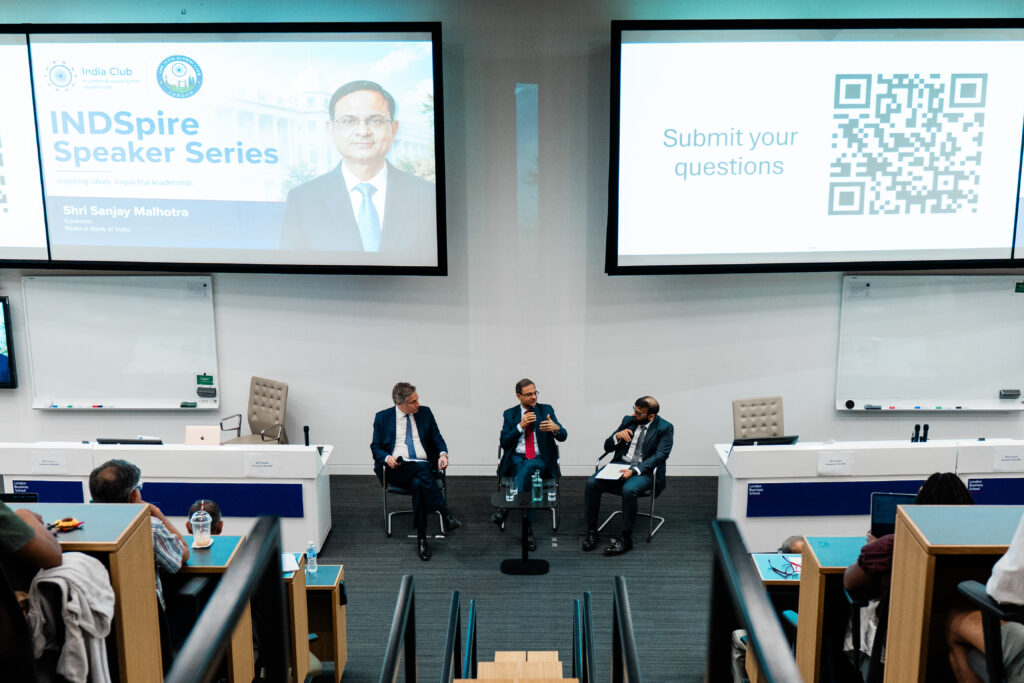
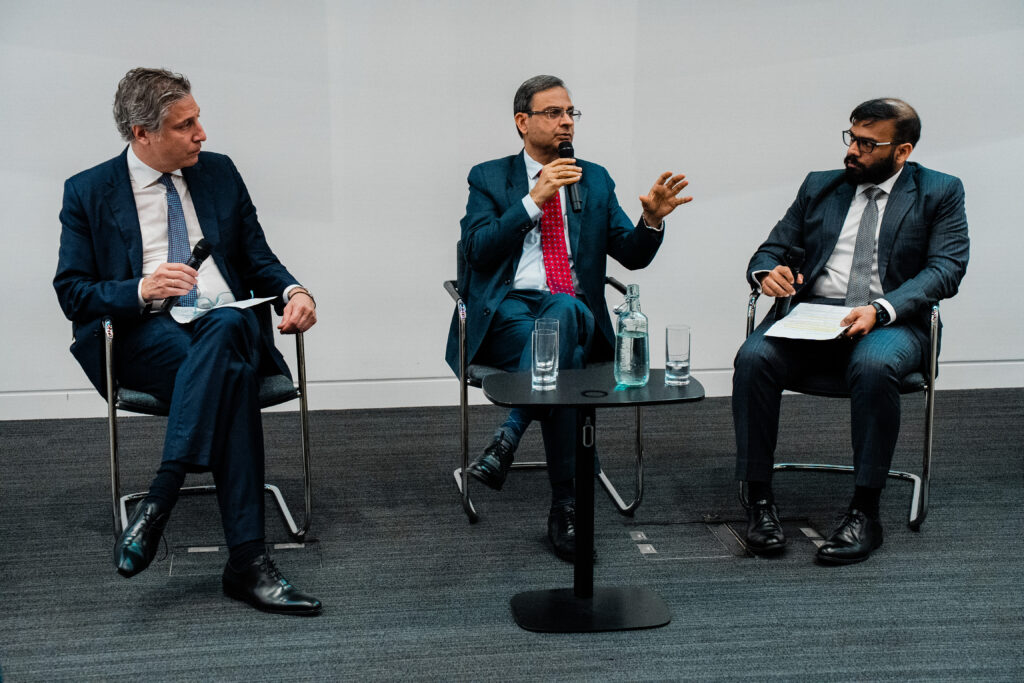

The event was opened and closed by Isha Choudhary, MBA 2026 and President of the India Club at LBS and was moderated by Elias Papaioannou, Professor of Economics, Alex Knaster Chair in Economics at LBS and Co-Academic Director of the Wheeler Institute for Business and Development and Abhinav Jain, Treasury Team at the World Bank Group and LBS Alum, MIFFT 2023.
The event was organised by the India Club and the LBS India Alumni Club at London Business School as part of their INDspire Speaker Series, supported by the Wheeler Institute.
Price Stability First, with Growth in View
Malhotra described India as one of the fastest-growing major economies, with growth running at roughly 7.5% and still substantially consumption-led at roughly 60%. But he drew a clear line between that growth story and the RBI’s mandate. The central bank, as he framed it, is not there to drive growth. Its primary objective is price stability, placing India between systems built around inflation alone and those with broader dual mandates.
He linked that mandate to India’s inflation-targeting framework introduced in 2016. Amendments to the RBI Act established a Monetary Policy Committee composed of RBI representatives alongside three external members appointed by the government. Under that framework, average inflation has fallen by roughly 2 percentage points over a decade. India, he said, has moved from running inflation above many emerging-market peers to being relatively better placed, and was among the earliest economies to bring inflation back to target after the post-pandemic and Ukraine-war shocks. He tied price stability to everyday planning, arguing that businesses and households function better when inflation is predictable, since price instability distorts decisions across investment, operations, and consumption.
Why Trust & Governance Matter
Institutions matter, Malhotra argued, because they generate trust, which he called the first currency, paired with governance as a second pillar for businesses and banks alike. Long-term resilience, in this framing, is not accidental: it reflects years of institutional development and coordination across government and the financial system.
He made the argument concrete through crisis resilience, pointing to India’s relative stability during the Asian Financial Crisis and the Global Financial Crisis as evidence of institutional preparedness, including calibrated capital controls in the earlier episode. The same logic appeared in his comments on the banking sector, where capital adequacy, liquidity, profitability, and asset quality have all improved markedly since 2015, when many banks were running losses. Structural reforms like the Insolvency and Bankruptcy Code, he said, changed how corporates think about debt and improved balance-sheet discipline across the system. In a sector where public sector banks still account for roughly 57% of the market, he credited governance reforms that have given bank management greater operational flexibility while the government has stepped back from day-to-day operations.
Geopolitical Shocks & India’s Exposure
On geopolitical fragmentation and the risks from turmoil in the Middle East, Malhotra emphasised how exposed India is to the region: roughly 9 million Indians working there, about a quarter of crude imports, two-fifths of fertilizer imports, and 28% of remittances. He said the government had managed the supply side well so far, with no major disruptions in crude, petrol, or diesel supply and adequate fertilizer stocks maintained through diversified sourcing. The price burden, he noted, had initially been absorbed by reduced excise duties before more of it began reaching consumers over the prior fortnight.
He translated that uncertainty into a scenario. Prior growth assumptions had been built around crude at about $85 a barrel; closer to $95, growth could fall by roughly 1 percentage point if the disruption persisted. Such shocks can create a near-term correction even when long-term fundamentals remain intact, though the broader uncertainty itself weighs on investment and business planning.
Inflation in a Food-Heavy Economy
Inflation targeting in India, Malhotra noted, is complicated by a structural feature: food accounts for roughly 46% of the consumer price index basket, far higher than in most large economies. That weight makes headline CPI more volatile, because food prices are exposed to supply chain disruptions and monsoon-related swings. He acknowledged that different parts of society experience inflation differently, especially lower-income households that are more dependent on food, but said the RBI still anchors policy around headline CPI while communicating clearly about what it is doing and why.
He pointed to a recent divergence as illustration: in April, the wholesale price index jumped to 8.2% while CPI sat around 3.5%, largely because energy price increases had not yet been passed through to retail consumers. The RBI’s response to such supply shocks, he said, is to look past first-order effects on fuel and fertilizer and watch for second-round effects: broader price increases, rising wage demands, and inflation expectations becoming embedded across the economy.
Central Banking as the Management of Uncertainty
The most memorable stretch of the conversation came when Malhotra reflected on uncertainty itself. He called it not just a feature of central banking but its most certain feature. Even in normal times, policymakers work with imperfect models, estimated data, and changing human behavior. His answer was a philosophy of robustness. In uncertain times, he said, policymakers may need to compromise on theoretical optimality to reduce the risk of large mistakes: better to avoid being badly wrong than to chase a finely tuned answer that proves fragile. He paired that with gradualism, using the image of crossing the river by feeling the stones, and emphasised that uncertain periods place greater weight on communication, transparency, and data-dependence.
Stablecoins, Monetary Sovereignty & UPI
Malhotra’s comments on digital finance were notably nuanced. On stablecoins, he acknowledged possible efficiency gains in payments and cross-border transfers, but flagged cyber vulnerabilities, disintermediation, complications for monetary-policy transmission, and the deeper question of monetary sovereignty. History, he argued, moved from fragmented private monies toward unified national systems for good reason. The RBI had not formed a settled view and was still evaluating.
On Unified Payments Interface (UPI), India’s flagship mobile-based real-time payment system, his tone shifted to something more definitive. He described it as a major success, noting thatIndia accounts for more than half of the world’s digital payment transactions, and that UPI now processes around 750 million transactions a day. It is already connected to eight or nine countries including Nepal, Singapore, Mauritius, and France, with Europe set to join. The barrier to cross-border expansion is less technical than regulatory: bilateral arrangements scale poorly as the number of participating countries grows, since each new connection requires reconciling different frameworks. He noted that the Bank for International Settlements is working on comparable multilateral approaches.
The Rupee & the Investment Case for India
On the rupee, Malhotra drew a distinction between short-run and long-run valuation. In the short run, markets are often driven by sentiment; in the long run, fundamentals matter more. By that measure, the rupee was not overvalued and might even be somewhat undervalued, including from the perspective of the real effective exchange rate. But he declined to forecast where it would go, with a line that prompted laughter in the room: he is Sanjay, he said, but not a soothsayer.
When asked what non-Indian investors may be missing, he returned to long-term fundamentals: rising incomes, urbanisation, skills development, literacy gains, and the scale of opportunity in the economy. He emphasised the role of business in creating prosperity, arguing that the state’s role is increasingly to create the conditions in which private activity can flourish. That theme extended into financial inclusion. He cited Jan Dhan Yojana’s roughly 500 million accounts alongside microfinance, priority-sector lending, and the growth of non-bank financial companies, which have helped formalise credit away from informal moneylenders and, in turn, strengthened the transmission of monetary policy itself.
A Worldview More Than a Message
What made the conversation interesting was the worldview tying its parts together. Malhotra presented a central bank that does not claim ownership of India’s growth story, but does claim responsibility for preserving the conditions that support it. He spoke less like a forecaster than a custodian, focused on institutions, transmission, discipline under uncertainty, and the maintenance of trust. In his view, trust is not a soft concept sitting outside economics, but rather a part of the operating system.
About the series
The INDspire Speaker Series is an exclusive leadership event hosted by the India Club and the LBS India Alumni Club at London Business School. It convenes top-tier policymakers, global economists, and business leaders to discuss India’s economic trajectory, FinTech advancements, and global strategy.
About the India Club
The India Club focuses on economic and professional opportunities in India by bringing together business leaders & entrepreneurs who are pioneers in their fields. It aims to provide a bridge between the global LBS community and the Indian subcontinent’s cultural heritage, global positioning & economic interests.
About the speaker
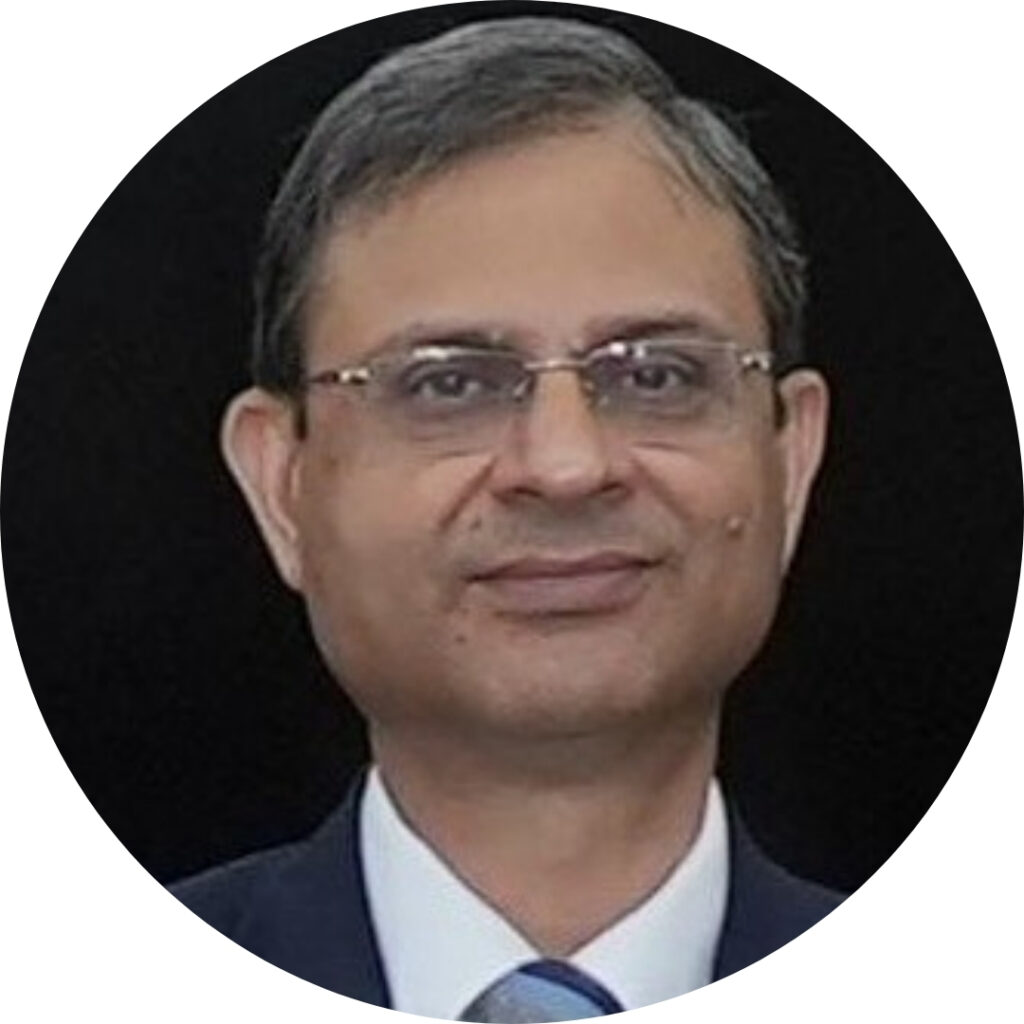
Sanjay Malhotra is the Governor of the Reserve Bank of India, having assumed office in December 2024, and is a senior Indian public servant with extensive experience across economic policy, financial regulation and public administration. A career member of the Indian Administrative Service (Rajasthan cadre), he has held senior leadership roles at both state and central government levels, including serving as Secretary in the Ministry of Finance in charge of the Department of Financial Services and subsequently the Department of Revenue. His work has spanned key sectors including finance, taxation, power and information technology, and he has also served as Chairman and Managing Director of the Rural Electrification Corporation. Malhotra previously served on the Central Board of the Reserve Bank of India. He brings a combination of technical expertise and policy experience to his role as central bank governor, overseeing monetary policy, financial stability and banking regulation in one of the world’s largest emerging economies.
About the moderators

Elias Papaioannou is Professor of Economics, Alex Knaster Chair in Economics at London Business School and Co-Academic Director of the Wheeler Institute for Business and Development. His research focuses on international finance, political economy, economic history, growth, and development, with work published in leading journals such as Econometrica, Review of Economic Studies, Quarterly Journal of Economics, Journal of Political Economy, American Economic Review, and Journal of Finance. He is also a CEPR Research Fellow, Managing Co-Editor of the Review of Economic Studies and Fellow of the British Academy. In the 2019/2020 academic year, Elias held the Varian Visiting Professorship of Economics at the MIT Department of Economics.

Abhinav Jain is a Treasury professional at the World Bank Group, where he works on developing local currency capital markets solutions in Asian markets. He holds a Master’s in Finance from London Business School and previously graduated from the Indian Institute of Science (IISc), Bangalore. As an active member of the London Business School Alumni community, he is passionate about fostering dialogue between global policymakers, business leaders, and the academic community.
About the writer

Ari Elan Deshpande is an MBA 2027 candidate at London Business School and a Research Intern at the Wheeler Institute for Business and Development. Prior to joining LBS, she worked in entertainment at Netflix, Universal Pictures, John Legend’s Get Lifted Film Co., and several start-ups, holding roles in creative development and acquisitions. Ari is also a Producer and the Founder of Meet Qute Entertainment, where she develops multicultural romantic comedies and dramas for film and television. She is particularly interested in how business, media, and film can translate complex global challenges into ideas that move people to action, and in how business models, policy, and technology can be leveraged to build community and drive social impact.