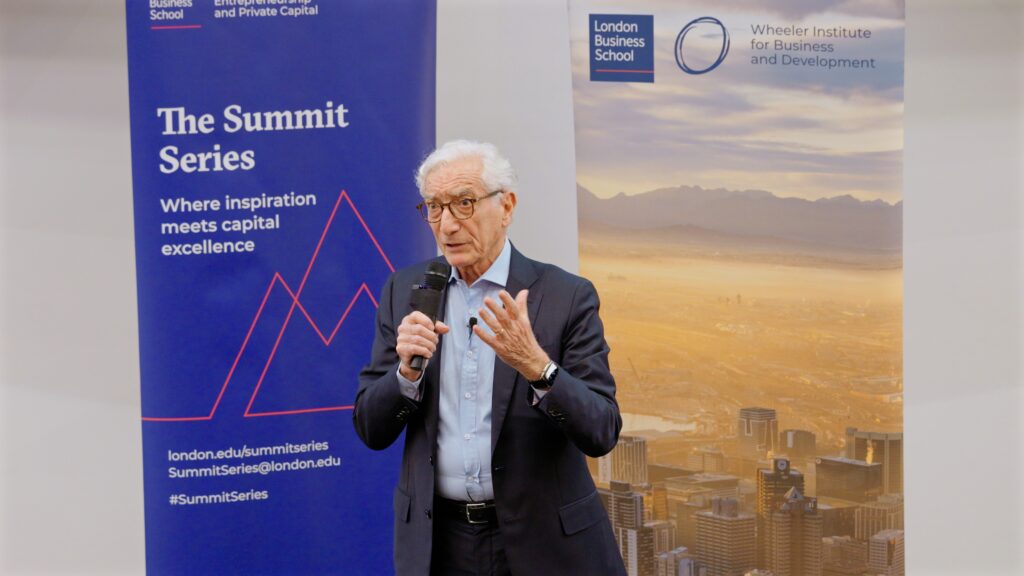
At a recent Summit Series event, hosted by the Institute of Entrepreneurship and Private Capital in collaboration with the Wheeler Institute for Business and Development, Sir Ronald Cohen, widely regarded as the “father of Impact Investing” and author of IMPACT: Reshaping Capitalism to Drive Real Change, discussed the transformation underway in global capital markets and the growing role of impact investing in shaping the future of capitalism. The event was opened by Shagun Damani, MBA 2026 at London Business School and Co-President of the Social Impact Club, and moderated by Lucrezia Reichlin, Professor of Economics at London Business School. The event was also supported by the LBS Entrepreneurship Club.


For decades, investors evaluated opportunities based on two fundamental variables: risk and return. Financial markets were designed to maximise profits while managing uncertainty, with little systematic attention paid to the broader social and environmental consequences of investment decisions.
But according to Sir Cohen, this model is beginning to evolve: “Capitalism has historically focused on risk and return,” he explained during the conversation. “But we are now entering a world where impact will become the third dimension of investment decisions.”
As better data becomes available and social and environmental challenges intensify, investors are increasingly recognising that long-term economic performance cannot be separated from a company’s impact on society and the planet. The rapid expansion of ESG investing (now representing around $30 trillion in global assets) reflects this shift, although traditional ESG frameworks often struggled to demonstrate whether they were delivering measurable impact.
From philanthropy to impact investing
Traditionally, efforts to address social and environmental challenges relied heavily on philanthropy. Foundations, charities, and public donations have long played a critical role in supporting initiatives aimed at reducing poverty, improving education, or protecting the environment. However, philanthropy alone cannot mobilise the scale of resources required to address today’s global challenges.
Impact investing offers an alternative approach. Rather than relying solely on donations, it seeks to harness the power of capital markets to finance solutions to social and environmental problems. Investments are designed to generate both financial returns and measurable positive outcomes. For Sir Cohen, this represents an important shift in how society approaches economic development. Instead of separating profit-making activities from efforts to create social value, the goal is increasingly to integrate the two.
Businesses are therefore being challenged to demonstrate that they can deliver financial performance while also generating positive impact.
Measuring impact
One of the biggest obstacles to integrating impact into financial markets has historically been the difficulty of measurement. Investors have long had detailed financial information about companies, but far less data about their environmental or social effects.
That situation is beginning to change. Advances in data collection and reporting are making it possible to track a growing range of environmental and social indicators. These include metrics such as carbon emissions, water pollution, workforce diversity, wage levels, and the effects of business activity on surrounding communities.
Cohen discussed how these metrics increasingly allow comparisons across companies and sectors. For example, diversity analyses have highlighted significant gaps between major corporations, with estimates suggesting that companies such as Amazon and Apple face large diversity deficits when workforce representation is compared to broader population benchmarks.
As this information becomes more transparent, investors gain new tools to evaluate companies not only in terms of financial performance, but also in terms of their broader societal footprint. He emphasised that transparency is central to this transformation, “impact transparency leads to impact accountability.” Once impact becomes visible and measurable, markets can begin to price it, rewarding companies that generate positive outcomes while penalising those that impose social or environmental costs. Impact measurement may increasingly become integrated into corporate financial accounts, allowing companies to publish information that reflects both financial performance and their environmental and social outcomes.
Reaching a tipping point
Sir Cohen suggested that capital markets may be approaching a critical tipping point. If even a relatively small share of global capital begins systematically integrating impact metrics into investment decisions, the effects on corporate behaviour could be substantial. When investors reward companies that combine financial performance with strong environmental and social outcomes, businesses have powerful incentives to adapt.
Consumer behaviour is already reinforcing this trend. Increasingly, individuals seek products and services that align with their values, avoiding companies associated with pollution or harmful practices. And digital technologies are accelerating this shift. Applications such as Yuka, for example, allow consumers to scan product barcodes and immediately access information about health and environmental impacts. As consumers change their purchasing habits, investors take note, and capital allocation begins to respond. Over time, these dynamics can reshape markets by directing investment toward businesses that deliver both financial value and positive impact.
The role of policy and institutions
Public policy also plays a critical role in enabling the growth of impact-driven markets. Governments can accelerate change by establishing regulatory frameworks that promote transparency, encourage impact measurement, and reward socially beneficial outcomes. The UK has been a pioneer in developing innovative financing models designed to attract private capital to social programmes. Such initiatives demonstrate how public policy and private investment can work together to address complex societal challenges.
At the same time, policy decisions often involve difficult trade-offs. Governments must balance priorities such as climate action, economic growth, and security concerns, which can complicate long-term policy commitments.
Nevertheless, aligning economic incentives with environmental and social outcomes will likely remain an essential element of building a more sustainable economic system.
Redefining capitalism
The integration of impact into financial markets represents more than a technical innovation, it reflects a broader transformation in how capitalism functions. If investors increasingly allocate capital to businesses that combine strong financial performance with positive social and environmental outcomes, companies will have powerful incentives to adapt their behaviour. Over time, this could reshape the incentives that drive corporate decision-making and redefine what constitutes success in business.
As Sir Cohen concluded, the future of capitalism may ultimately rest on a simple but powerful idea: investment decisions that balance risk, return, and impact.
You can watch the video recording of this event here
About the speaker
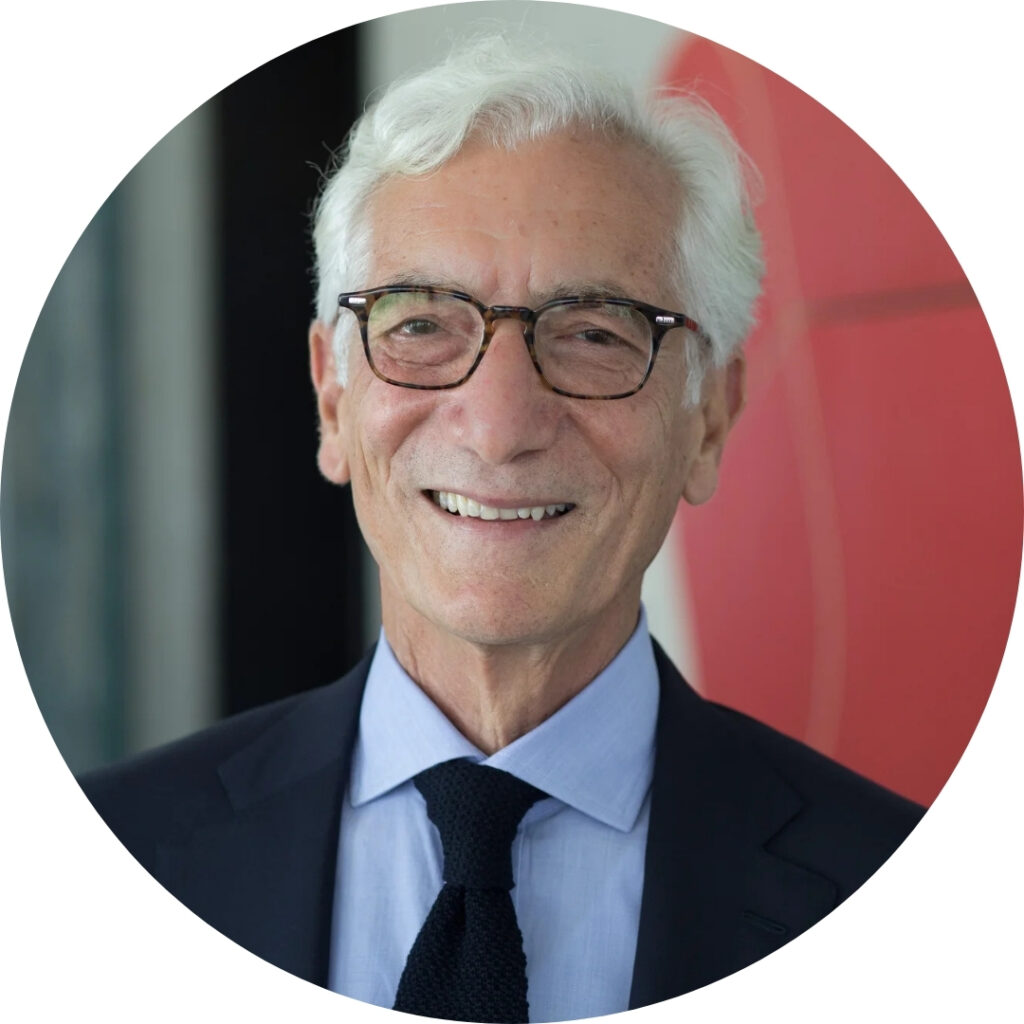
Sir Ronald Cohen is a pioneering philanthropist, venture capitalist, and social innovator, widely regarded as a leading figure in the global impact investing movement. He is President of GSG Impact and Chair of The Portland Trust, and serves as Vice-Chair of Capitals Coalition. He has played a central role in the development of social finance, co-founding Social Finance, the Education Outcomes Fund, Bridges Fund Management, and Better Society Capital. He also chaired the G8 Social Impact Investment Taskforce.
Earlier in his career, he co-founded and led Apax Partners, and was instrumental in establishing the UK and European venture capital industry.
Sir Cohen is the author of IMPACT: Reshaping Capitalism to Drive Real Change (2020), a Wall Street Journal bestseller, and ON IMPACT: A Guide to the Impact Revolution. Born in Egypt, he came to the UK as a refugee at age 11 and studied at Oxford University and Harvard Business School.
About the moderator

Lucrezia Reichlin is a Professor of Economics at London Business School, an external fellow at the Brussels based think-tank Bruegel, and Chair of the group of the National Schools of Economics and Statistics (GENES) in Paris. She is a macroeconomist and econometrician. She pioneered methods for the economic analysis of large dimensional data and now-casting and co-founded the company now-casting limited in 2011. She was director general of research at the European Central Bank from 2005 to 2008. Professor Reichlin is a Fellow of the British Academy and the Econometric Society, an honorary international fellow of the American Economic Association, and a distinguished fellow of the CEPR.
About the writer

Carolina Amaral is an MBA 2026 candidate at London Business School and an Outreach Intern at the Wheeler Institute for Business and Development. She previously worked as a Consultant, where she advised clients across private and public sectors in Latin America. She is interested in how investment, policy, and business innovation can drive scalable economic development in emerging markets, particularly through nature-based and climate solutions at the intersection of technology, sustainability and in finance, and in how private capital and public policy can be leveraged to address climate change. At London Business School, she is Co-President of the Social Impact Club and an Investor Associate at the Student Impact Investing Fund.
About the series
This event was part of the Summit Series, an initiative of the Institute of Entrepreneurship and Private Capital at London Business School, which brings together founders, investors, and business leaders to share insights on building, scaling, and investing in transformative ventures.
SustainableShift