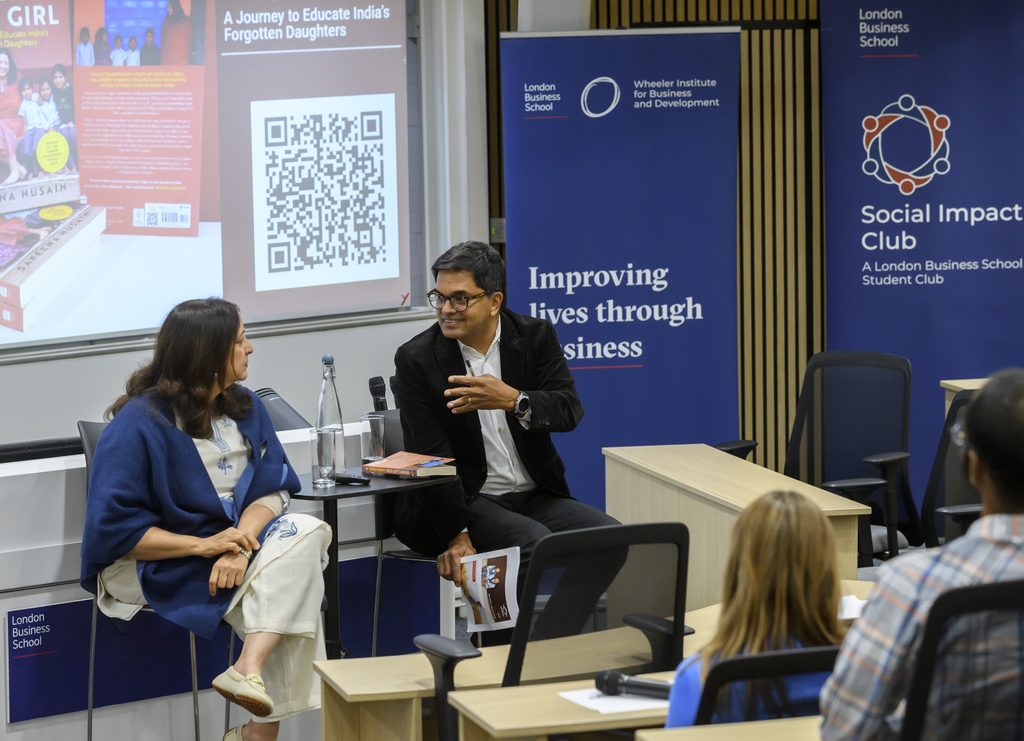
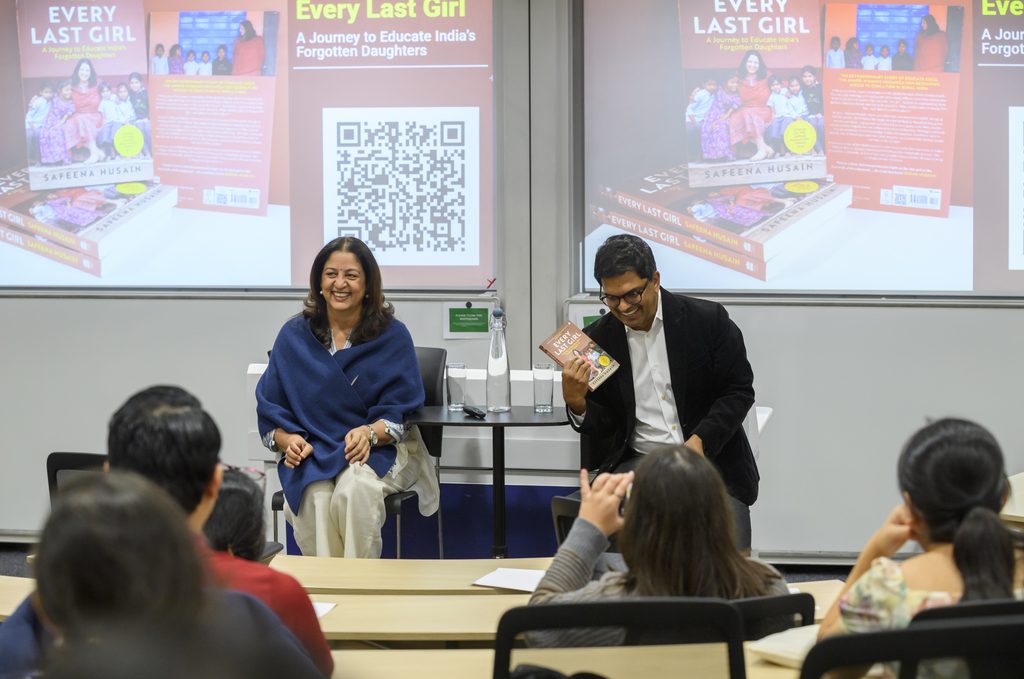
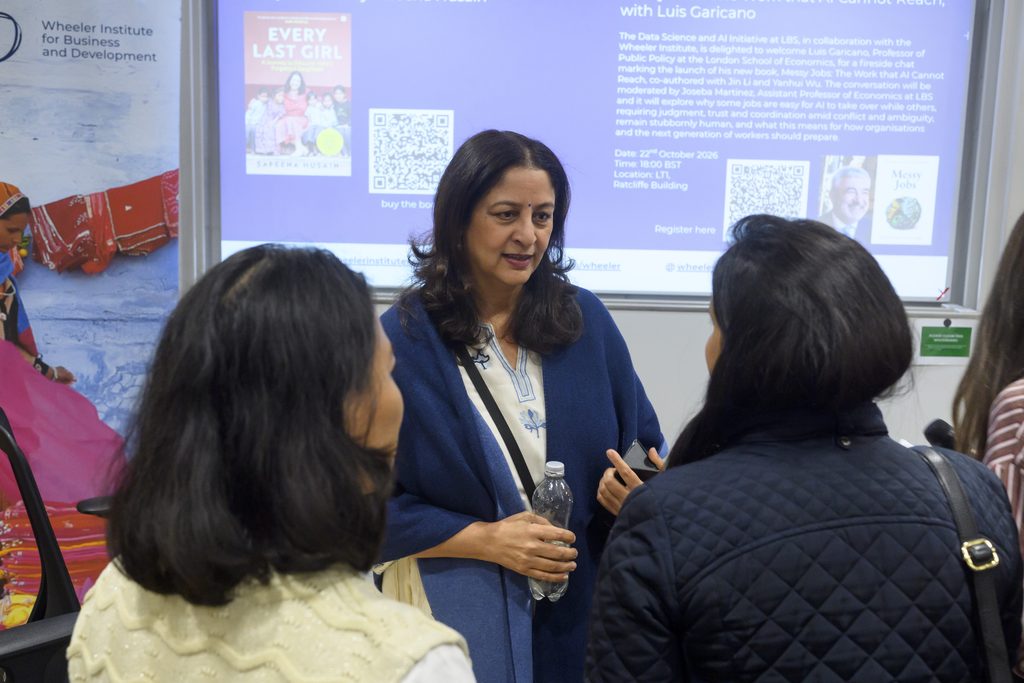
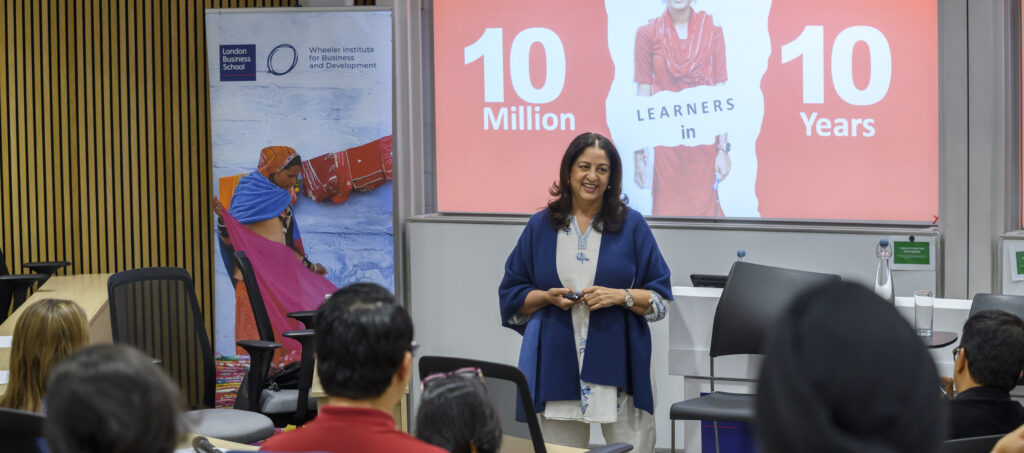
In an inspirational session hosted by the Wheeler Institute with the support of the LBS Social Impact Club, Safeena Husain shared the blueprint behind one of India’s most expansive educational movements. Speaking with Rajesh Chandy, Professor of Marketing, Tony and Maureen Wheeler Chair in Entrepreneurship and Co-Academic Director of the Wheeler Institute at London Business School, Husain, founder of Educate Girls and author of the newly released book Every Last Girl : A Journey to Educate India’s Forgotten Daughters, detailed her mission to empower marginalized learners. Husain, who was recently named one of TIME’s Women of the Year 2026 and led her organisation to the 2025 Ramon Magsaysay Award, anchored the discussion on a core structural flaw. She argued that a rigid educational journey will always lose the students whose lives face interruptions, meaning systems must be redesigned to allow girls to start, pause, and restart their schooling at any point.
A Mission Rooted in Lived Experience
Husain framed her approach as deeply connected to her own interrupted childhood. Growing up in Delhi, she navigated significant early challenges that resulted in a three-year gap in her formal education. Fortunately, with support from her aunt, she eventually returned to the classroom, setting her on a path to become the first in her family to attend university.
After graduating from the London School of Economics in 1995 and spending a decade leading nonprofits across the Americas and South Africa, her focus crystallised during a trip back to India. While visiting a Himalayan village clinic she had helped build, local women mourned that her father had only a daughter and urged him to try for a son. When her father proudly replied that she was his everything, Husain realised a stark truth: she had the agency to leave the village, but the girls living there were trapped by their invisibility.
The Flow, the Stock, & the 10th-Grade Threshold
Husain divided India’s out-of-school girls crisis into two distinct demographics. The “flow” consists of approximately 4 million girls who drop out of the system each year, often pulled away to care for siblings while their parents perform migrant labor. The “stock” close to a staggering 100 million young women and adolescent girls who have aged out of the system and will not complete the 10th grade. While policy focuses almost entirely on the flow, Husain warned that India will not realise its demographic dividend without reaching the millions of women and girls left behind.
The 10th-grade qualification acts as a critical gateway to the formal economy. Without it, a woman may be unable to qualify for a formal bank loan, become a supervisor under the rural employment guarantee scheme (MGNREGA), or secure stable employment. Yet the Right to Education Act only guarantees schooling through the 8th grade, and supply narrows sharply thereafter. For every 100 primary schools, there are only about 59 middle schools and 20 secondary schools.
The cost of this inaction extends far beyond economics. Keeping girls out of school drives early marriage, higher child mortality, and increased vulnerability to climate disasters. Husain noted that women and girls are up to 14 times more likely to die in climate emergencies because they lack mobility, bank accounts, and assets. Educating girls, by contrast, creates a massive positive multiplier. Project Drawdown has ranked girls’ education as the sixth most effective action to combat climate change, placing it above solar panels and electric vehicles.
Mindset Before Policy
The most striking segment of the conversation centered on the cultural devaluation of girls. Husain asked the audience about the meanings behind their names, contrasting them with girls she had met in rural communities named Mafi (apology), China (unwanted), and misssed Call (God missed our call for a son).
Coupled with field quotes stating that “a goat is an asset while a girl is a liability,” Husain illustrated how poverty and patriarchy combine to make daughters bear the heaviest costs. She acknowledged significant progress in primary enrollment, but warned of three emerging headwinds: government schools are becoming increasingly feminised as families invest in private education for their sons, a rapid shift in technology is accelerating the digital gender divide, and climate disruptions are pulling girls out of school first to manage household survival.
Designing for Scale & Lifelong Learning
To combat these systemic issues, Educate Girls operates on the principle of lifelong learning. The organisation uses predictive AI to locate the 5% of villages that hold 40% of out-of-school younger girls. Once identified, teams go door to door to register every child.
Younger girls are brought back into the classroom with foundational literacy and bridge courses. Older women join the second-chance programme, gathering in village spaces to study three hours a day to complete their 10th-grade exams. This model is entirely community-driven, utilising 55,000 volunteers who act as gender champions, 70% of whom are men. Furthermore, the organisation embeds technical teams within the Ministry of Education to ensure the model can be absorbed by the government. With over 2.2 million girls mobilized to be back to school and a goal to reach 10 million learners by 2035, Husain emphasized that scale is non-negotiable for gender work because social norms only shift when a message saturates an entire geography.
Funding, Empathy, & the Baby Grip
Husain was candid that she began without knowing exactly where to work or how to build a corporate structure. She started by asking the central government to identify districts with the highest gender gaps in enrollment. Out of 26 critical districts nationwide, nine were in Rajasthan. She approached the state government and asked for their 50 worst villages, eventually launching her first pilot there.
The growth from that initial pilot was explosive, scaling rapidly from 50 villages to 500, and soon crossing 5,000. To manage this hyper-growth, Husain leveraged pro bono help from top-tier consulting firms. An HR firm even ran a psychometric profile on Husain, revealing that while her superpower was bringing people together, she struggled with setting boundaries and negotiating contracts. Armed with this knowledge, she intentionally built a leadership team to complement her own blind spots. This operational resilience laid the groundwork for innovative financing.
To fund their expansion to over 31,500 villages, Educate Girls launched the world’s first Development Impact Bond in education, a three-year pay-for-results model tied directly to enrollment and learning gains. The first two years yielded no results, a failure Husain embraced publicly. The critical pivot came when the organisation realized data could not just live in donor reports. Information had to be fed back to frontline workers within 24 hours to diagnose individual learning errors, such as a child failing to grasp the concept of zero. By year three, students achieved 140% of their learning targets. Husain likened this management turnaround to a “baby grip” in golf. You cannot squeeze teams for targets. Instead, monitoring systems must be wrapped in a thick layer of empathy and function as support mechanisms rather than surveillance.
Ultimately, Husain did not present Educate Girls as a rescue mission for individual children. She framed it as a necessary reconstruction of the educational pathways that society failed to provide. By building a flexible infrastructure for the most marginalized, the system improves for everyone, proving that a second-chance is not an exception to education, but a vital part of its design. At its heart, Husain’s mission is to ensure that no girl’s future is determined by the circumstances of her birth, or by a world that taught her she was worth less before she ever had the chance to discover her own potential, claim her agency, and shape her own future.
About the speaker
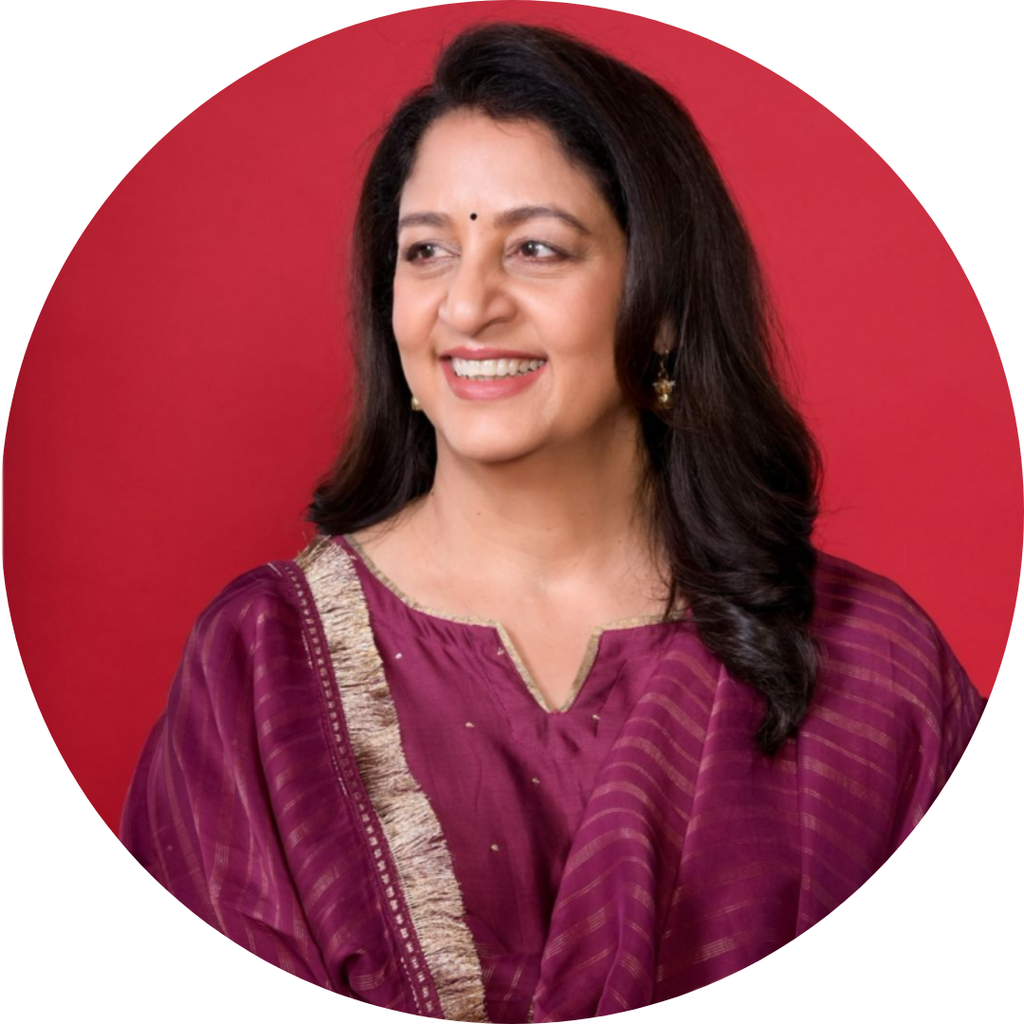
Safeena Husain is the Founder of Educate Girls, an award-winning Indian non-profit that partners with governments and communities to improve girls’ education in India’s marginalised regions. She was named to the TIME Women of the Year 2026 list and led Educate Girls to become the first Indian non-profit to receive the Ramon Magsaysay Award in 2025. Her vision is to empower 10 million learners by 2035 through scalable, community-led solutions.
About the moderator

Rajesh Chandy is Professor of Marketing and the Tony and Maureen Wheeler Chair in Entrepreneurship at London Business School, where he serves as Co-Academic Director of the Wheeler Institute for Business and Development. His research sits at the intersection of business and development, spanning projects on micro-entrepreneurship in South Africa, innovation among farmers in India, and the use of big data for development outcomes. He is an elected Fellow of the British Academy and of the American Marketing Association.
About the writer

Ari Elan Deshpande is an MBA 2027 candidate at London Business School and a Research Intern at the Wheeler Institute for Business and Development. Prior to joining LBS, she worked in entertainment at Netflix, Universal Pictures, John Legend’s Get Lifted Film Co., and several start-ups, holding roles in creative development and acquisitions. Ari is also a Producer and the Founder of Meet Qute Entertainment, where she develops multicultural romantic comedies and dramas for film and television. She is particularly interested in how business, media, and film can translate complex global challenges into ideas that move people to action, and in how business models, policy, and technology can be leveraged to build community and drive social impact.
Ogunlana Olusegun Adewale