
At the 20th LATAM Business Forum, organised by the LATAM Business Club and the Brazil Business Club at London Business School on March 4th 2026, one idea stood out across very different conversations: development in Latin America in this era is highly dependent on infrastructure. Not only roads, ports or power grids, it is also the digital systems that connect people to finance, education and ultimately opportunity and employment.
Financial inclusion through digital access
The conversation with Alejandro Perez-Reyes, CFO of Credicorp, moderated by Jeremy Browne of Canning House, titled “Financial innovation & inclusion: doing business for profit and for good,” centred on Yape, the digital wallet created by BCP, Credicorp’s largest asset in Peru. Yape is a striking example of how business innovation can respond to one of Latin America’s most persistent development challenges: exclusion in economies still marked by widespread informality. In the first half of 2025, 46.7% of employed people in Latin America and the Caribbean were working under informal conditions, according to the ILO, underscoring how large a share of the region still operates at the margins of the formal economy.
The scale of that challenge regarding access to the financial system is still considerable. Credicorp’s 2025 Financial Inclusion Index shows that the region’s overall financial inclusion score rose from 38.2 in 2021 to 48.5 in 2025, a meaningful improvement, but one that still leaves ample room for progress. In Peru, the score increased from 37.9 to 47.0 over the same period, driven mainly by gains in access. The report also highlights how digitalisation has reshaped the inclusion landscape. In recent years, the use of digital wallets has grown exponentially in countries such as Peru, Colombia and Panama, while progress in the region has been driven by stronger access and wider adoption of formal financial tools.
Perez-Reyes’ account of Yape gave those regional trends a concrete face. In a country where many people remain outside the banking system, BCP saw an opportunity in one of Peru’s most widespread assets: the mobile phone. By building a digital wallet around existing behavioural realities rather than idealised assumptions about banking adoption, Yape helped lower the barriers to entry into formal finance. And because digital wallets in Peru have become interoperable, users are no longer joining a closed ecosystem. Having one wallet allows them to transact across the broader system, making digital finance more useful in everyday life.

Inclusion can also mean profitability
What makes the Yape story especially powerful is that it does not fit the outdated idea that social impact must come at the expense of profitability. On the contrary, Perez-Reyes explained how Yape has become a strong business precisely because it solves a real problem at scale. Cash is costly for the financial system, and the pandemic accelerated demand for cashless alternatives. At the same time, the model is efficient: customer acquisition costs have been minimal in recent years, service is largely automated, and the platform generates valuable behavioural data that allows BCP to understand and serve populations that were previously invisible to the formal system.
This has opened the door to one of the most transformative aspects of the model: lending. According to Perez-Reyes, Yape has already extended loans to around four million Peruvians, and for 2.6 million of them it was their first formal loan. This matters because access to credit is not simply a financial milestone; it is a development lever. In many cases, these small loans help users build their homes or start small businesses. In other words, the platform is not only facilitating transactions. It is helping households and entrepreneurs cross a threshold into greater economic agency.
To move even further Latin America needs infrastructure
Yet the conversation also made clear that digital innovation alone cannot close Latin America’s development gaps. Yape’s future growth depends on reaching the half of the population that still remains excluded, and that requires something more fundamental: infrastructure. If access to the internet remains uneven, especially outside major urban areas, then the benefits of digital finance will remain uneven too.
Credicorp’s report explicitly makes this connection, arguing that progress in financial inclusion requires better digital infrastructure, greater connectivity, and reliable electricity in rural areas, all supported by coordination between the public and private sectors. This is not a marginal issue: even in a highly urbanised region, 18.8% of the population in Latin America and the Caribbean still lives outside urban areas, according to ECLAC, making rural connectivity a central development challenge rather than a peripheral one.
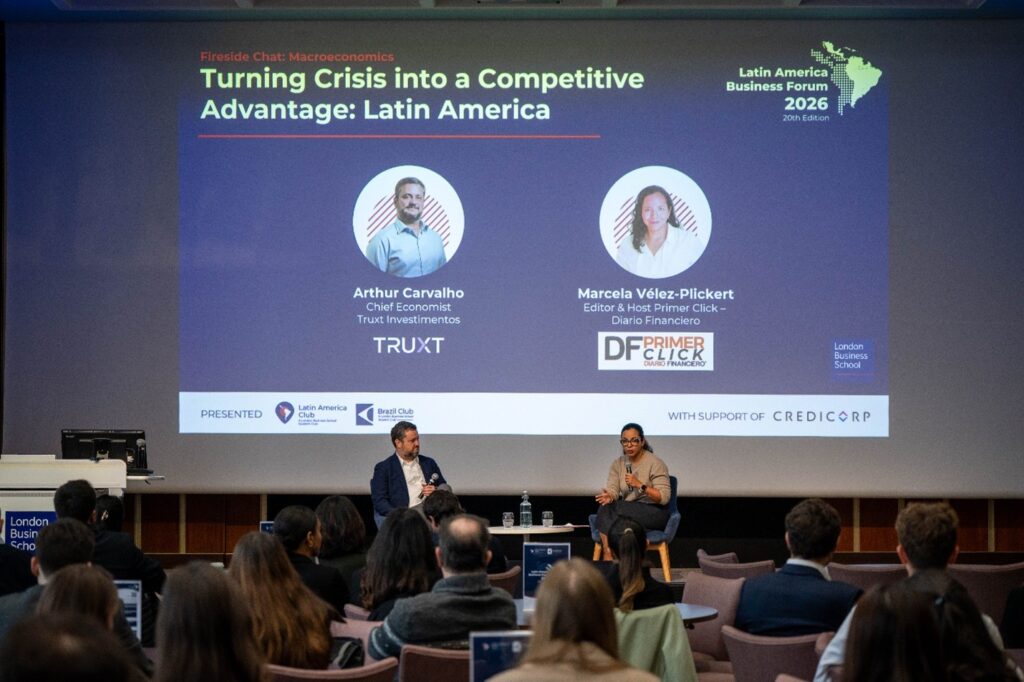
This broader point was reinforced in the fireside chat “Turning crisis into a competitive advantage for Latin America” with Arthur Carvalho from Truxt Investimentos and Marcela Velez from the Diario Financiero. Their discussion looked at Latin America from a strategic investor perspective, stressing that the region’s relative isolation from global conflict spillovers could become an advantage. But their argument was not that geography alone will deliver development. Rather, the real test is whether the region can turn periods of favourable demand, including potential commodity booms linked to AI, into long-term productive capacity. That means resisting the temptation to treat windfalls as short-term fiscal relief and instead investing in infrastructure that can sustain employment, competitiveness and private investment over time.
Their remarks expanded the definition of infrastructure in a way that fit neatly with the Yape example. Infrastructure is not just transport logistics; it also includes broadband access, stable utilities, and the conditions necessary to attract data centres and other forms of digital investment. In that sense, the conversation moved the debate from inclusion at the level of the user to competitiveness at the level of the region. If Latin America wants to participate meaningfully in the next wave of technological change, it must build the physical and digital backbone that allows innovation to scale.
Thinking in the long term, the infrastructure gap is costing a generation their education
Jaime Saavedra, World Bank Director, returning after the success of last year’s forum (available to interested readers here), brought the same argument into the field of education in his session “Education as a foundation for sustainable growth in Latin America.” His remarks on AI in schools showed that the digital divide does not only shape markets; it also shapes human capital and the future of students. Estimates discussed in the session suggested that around 60% of students in Latin America could be excluded from access to AI because of insufficient infrastructure, while among those with access, a substantial share may use these tools without a teacher who knows how to guide them. Saavedra’s point was that the AI revolution could easily deepen inequality if access depends on whether a student’s school has internet, devices, adequate physical conditions for learning – and above all, a teacher who can turn those tools into learning.
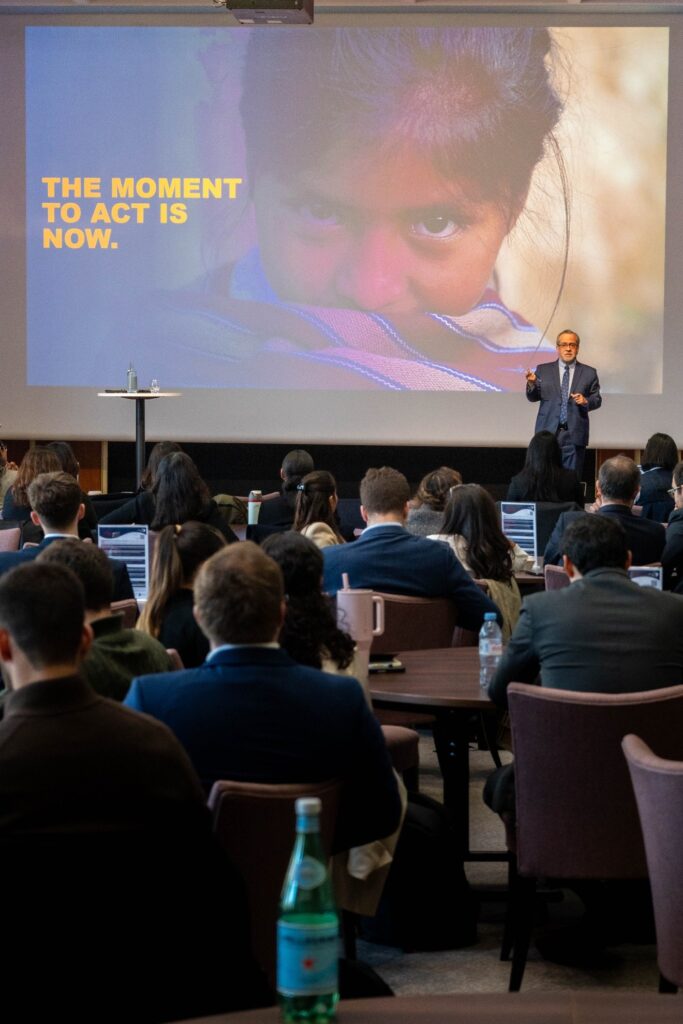
This insight brings the forum’s different conversations together. Financial inclusion, regional competitiveness and educational opportunity may appear to belong to separate debates, but they are all constrained by the same underlying issue: infrastructure determines who gets to participate in development. Without connectivity, digital finance cannot scale. Without stable energy and broadband, digital investment cannot flourish. Without basic school infrastructure, the productivity gains promised by AI may reinforce rather than reduce inequality.
What the forum ultimately highlighted is that infrastructure should not be treated as background policy. It is the mechanism through which innovation becomes inclusion, and through which business can translate efficiency into social progress.
About the writer

Lauren Mercado Manotas is an MBA 2027 candidate at London Business School and an Outreach Intern at the Wheeler Institute for Business and Development. Prior to her MBA, she was a Consultant at Bain & Company in Colombia, where she advised leading companies across Latin America on strategy, operations, and large-scale transformations.
Her experience spans industries including mining, financial services, healthcare, and retail, with a focus on driving efficiency and growth through data-driven decision-making. Lauren is particularly interested in how strategic execution and capital allocation can unlock sustainable growth opportunities in emerging markets.
About the organisers
– LATAM Business Club:
the Latin America Business Club develop mutually beneficial and long-term relationships between LBS students, faculty, alumni, and the Latin American Business Community as a whole.
– Brazil Business Club:
Enhances employment opportunities for LBS students interested in Brazil, promotes networking, and organizes cultural events.
References
Credicorp (2025) Índice de Inclusión Financiera 2025. Banco de Ideas Credicorp. Available at: https://bancodeideascredicorp.com/indice-inclusion-financiera/
Economic Commission for Latin America and the Caribbean (ECLAC) (no date) Regional urban statistics. Available at: https://plataformaurbana.cepal.org/en/regional-urban-statistics
International Labour Organization (ILO) (2025) Employment holds steady in Latin America and the Caribbean, but informality and labour poverty persist. Available at: https://www.ilo.org/resource/news/employment-holds-steady-latin-america-and-caribbean-informality-and