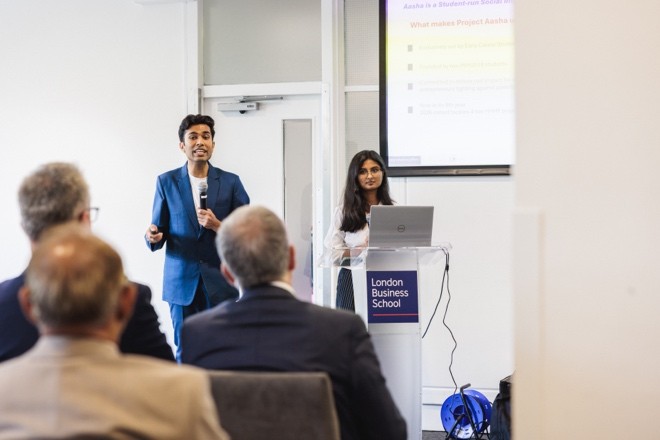
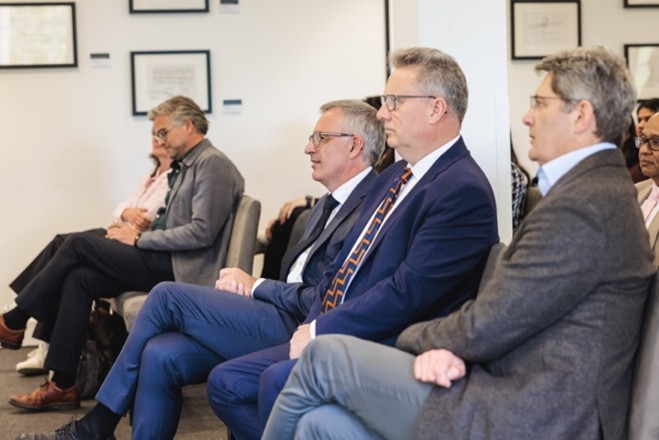
On 14th May 2026, Project Aasha 2026 team and Experiential Learning team hosted an evening presentation and reception to mark the close of its ninth Project Aasha cohort. The event was hosted by project co-leads Anushree Sharma, MFA2026 and Rishi Ghiraiya, MiM2026, who facilitated the programme from its January kick-off through to final delivery . The event was honoured by the presence of Dean Sergei Guriev of London Business School, Deputy Dean Gary Dushnitsky, Associate Dean Graham Hastie, and Tiago Ivo Martinho, Executive Director of The Wheeler Institute for Business and Development.
Background
Project Aasha translates from Hindi as “hope” and is a student-run social impact initiative exclusively led by LBS Graduate Masters students. Now in its ninth year, Project Aasha provides LBS’s early-career students with the opportunity to work as pro-bono consultants for Indian organisations (known as changemakers) driving positive impact in local communities. For students, it is a strong opportunity to try out the consultant working style (and many Aasha alumni indeed follow careers in the consulting industry after graduation) and to use the skillsets they have built before and at London Business School creating an impact that matters. For changemakers, Aasha is an opportunity to have a team of talented students work on a critical challenge that the organisation may not have had the capacity or capability to tackle. Aasha was founded and continues to be based on this symbiotic relationship between changemakers and students and helps advance the purpose of London Business School: To have a profound impact on the way the world does business and the way business impacts the world.
The initiative works in partnership with Head Held High Foundation (HHHF), a Bangalore-based organisation acting as an incubator for social startups, committed to eradicating poverty across rural India. To date, Project Aasha has engaged over 200 LBS early-career student consultants, supported 22 social enterprises, and reached more than 12,000 estimated beneficiaries across all documented projects.
The 2026 cohort addressed four live project briefs spanning fundraising, donor management, women’s entrepreneurship, and a youth aspiration index. Representatives from each project shared their key methodologies and impact, together with their reflections:
Project 1: Youth Aspiration Index
The team opened by presenting a foundational problem in India’s approach to youth development. India’s 600 million rural youth are treated as a single group, with existing data only capturing demographics rather than what drives their decisions. This creates three specific problems:
- Skilling programmes are designed without segmentation; hence, they reach everyone but resonate with no one.
- Two youth with identical backgrounds can have entirely different orientations, which inherently require different approaches.
- Without a framework to capture aspiration, interventions stay reactive, and long-term impact goes unmeasured.
The objective of the project was to build India’s first behavioural youth segmentation through YouGRAF, a readiness index bridging aspiration and policy. The team conducted fieldwork across 11 states, gathering 1,087 rural respondents and 59 youth pilot survey responses. They built a youth index, YouGRAF, on four pillars covering Growth, Resilience, Aspiration, and Future Readiness which unified what were previously three separate stakeholder groups, youth, policymakers, and employers, into one product.
Ultimately, it was identified that policy built on demographics alone will miss the mark. Because aspiration is measurable, behavioral segmentation is how youth livelihoods need to be understood and designed for.
Project 2: Women’s Entrepreneurship Programme Analysis
HHHF’s Antarprerana programme creates first-generation rural women entrepreneurs and shows positive outcomes, yet the programme lacks a blueprint for significantly more impactful, sustainable, and rapidly scalable delivery across a complex multi-state environment. The objective of this project was to evaluate Antarprerana against national and global best practices and deliver a prioritised, actionable blueprint for impact, sustainability, and scale.
By targeting first-generation rural women entrepreneurs across Jharkhand, Maharashtra, Gujarat, and Karnataka, the team identified a critical structural gap. Market-based businesses earn 3x more than home-based activities, yet 63% of active entrepreneurs remain in the latter.
Benchmarking against Kudumbashree, Mann Deshi Foundation, and ILO WEDEE confirmed that collective market infrastructure generates orders where platform access alone does not, and that post-training mentorship is a primary outcome driver, not a secondary activity.
Project Lead Rhutuja Lokhande MiM2026 noted that learning to follow evidence rather than hypotheses was among the team’s most valuable takeaways. The income gap data clearly showed that training conversion is only half the story, and what happens afterward matters just as much.
Project 3: Donor Management and Relationship Management
While HHHF’s donor management infrastructure had grown organically over the years, the foundation lacked a formal restructuring plan, a structured and tiered engagement model, and centralised data to streamline access across the organisation. The project aimed to design a restructuring plan, provide team management tools, and bring clarity to current and prospective donor data.
Working across three core areas including anchor donor identification, donor journey design, and data centralisation, the team mapped a six-stage donor journey from identification to renewal. They developed donor personas with tailored management plans and built a Monitoring and Evaluation (M&E) results framework alongside new communication packages. Centralising data outside the existing CRM system allowed the entire HHH team to easily access all files.
The team reflected that engaging with an Indian organisation as a global student cohort broadened their professional outlook, and helped them develop client-facing skills they will carry far beyond LBS.
Project 4: Crowdfunding and Retail Investors
The Crowdfunding and Retail Investors project team opened by posing a question to the room: how much does it cost to take someone from earning £3 a month to earning £300 a month? Head Held High Foundation has changed 200,000+ lives through Make India Capable (MIC), yet its funding came almost entirely from CSR and institutional grants, restricted, earmarked, and hard to deploy flexibly, with no retail donor base and no crowdfunding presence. The brief was to build a crowdfunding strategy for MIC from the ground up.
The team reviewed ten programmes within the foundation’s portfolio before identifying Make India Capable as the strongest candidate for a first crowdfunding campaign. They established a clear unit cost of 24,000 Indian rupees (approx~£185) to fund one beneficiary through the full programme, built four donor personas from retail giving research, and designed two campaign versions for different donor markets. This resulted in a comprehensive handover pack detailing campaign narrative for time and skills-based giving.
Experiential Learning Team Remarks and Reflections
Allison Coppola, Associate Director of Experiential Learning at LBS, closed the evening with remarks cutting to the heart of the programme’s purpose. She highlighted that the students’ choice to voluntarily take on this work reflects what makes the LBS model distinctive. While technical rigour is expected, developing empathy is an essential part of changing the way the world does business.
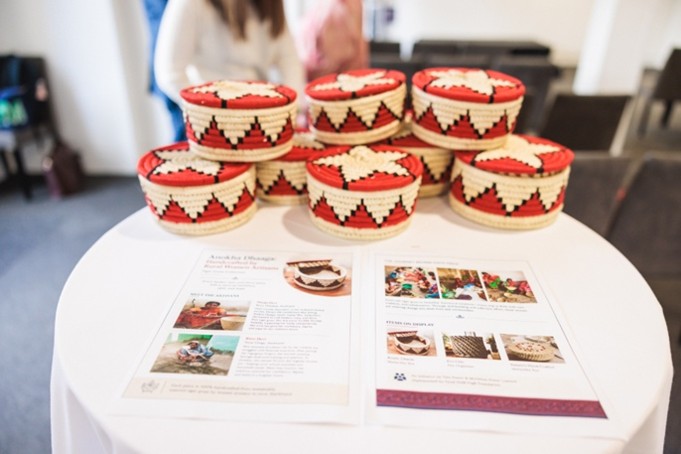
During an interactive session, the cohort was asked: “What does Aasha (Hope) mean to you?”. Beyond an exposure to impact consulting, the word cloud of responses made it abundantly clear that to these students, Aasha means future, giving back, and strength. A special highlight of the evening was the presentation of beautiful, handcrafted tokens of appreciation made by Anokha Dhaaga, a woman-led artisan initiative in rural Jharkhand, serving as a powerful reminder of the human impact behind the data.
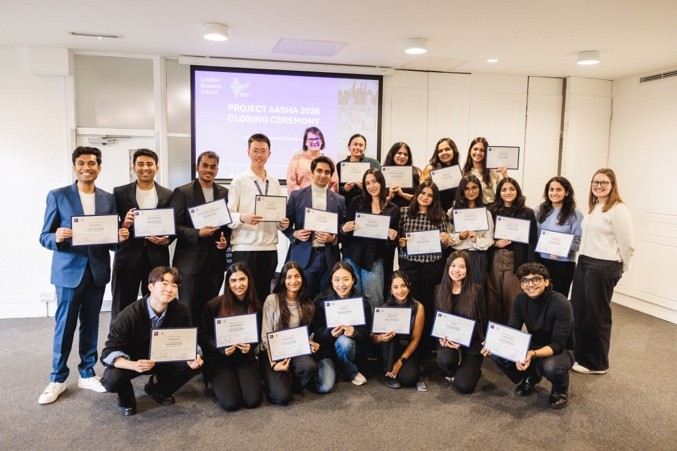
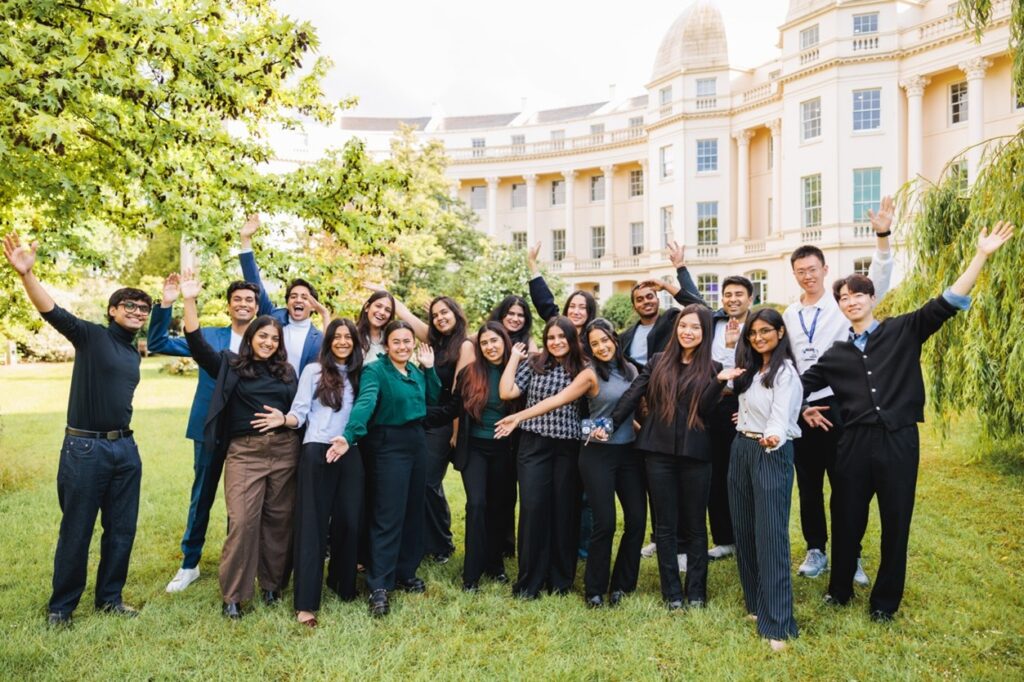
The Project Aasha 2026 Team
- Project Leadership: Anushree Sharma MFA2026 (Project Co-Lead), Rishi Ghiraiya MiM2026 (Project Co-Lead), Derinsu Ekici MiM2026 (Operations Lead), Sanika Attarde MiM2026 (Marketing Lead)
- Youth Aspiration Index Pranav Srikar MAM2026, Nishika Kogta MFA2026, Sanskruti Soni MiM2026, Flora Fang MAM2026, Anna Reshidko MiM2026
- Women’s Entrepreneurship Program Analysis Rhutuja Lokhande MiM2026, Saloni Chaudhary MAM2026, Malaika Mathew MiM2026, Ami Vithalani MiM2026, Snega Suresh MiM2026, An Tran MiM2026, Jeanne Delsart MiM2026
- Donor Management and Relationship Management Julia Knauz MiM2026, Shivani Polsani MFA2026, Yatika MFA2026, Veronica Lai MiM2026, Hongxi Hu MiM2026, Lulu Xiong GMiM2027
- Crowdfunding and Retail Investors Panshul Jetwani MiM2026, Atharva Karkhanis MiM2026, Aryan Agarwal GMiM2027, Harrison Kim MiM2026, Ariel Loo MiM2026, Sabina Dragan MiM2026
About Experiential Learning
Experiential Learning at LBS enables students to apply their learning in real-world settings, creating lasting impact for businesses, communities, and themselves while developing the leadership skills needed to shape the future.
About the writer

Woraba Dansua Abban, MAM2026 is a Research and Outreach Intern at the Wheeler Institute for Business and Development. She holds a BSc Business Administration from Ashesi University and has worked as an Associate Consultant at Deloitte and Touche (Accra), where she assisted clients in resolving their governance and risk management needs across diverse industries. Woraba aspires to bring lasting change to Africa’s developmental challenges through her passion for the international development industry.